
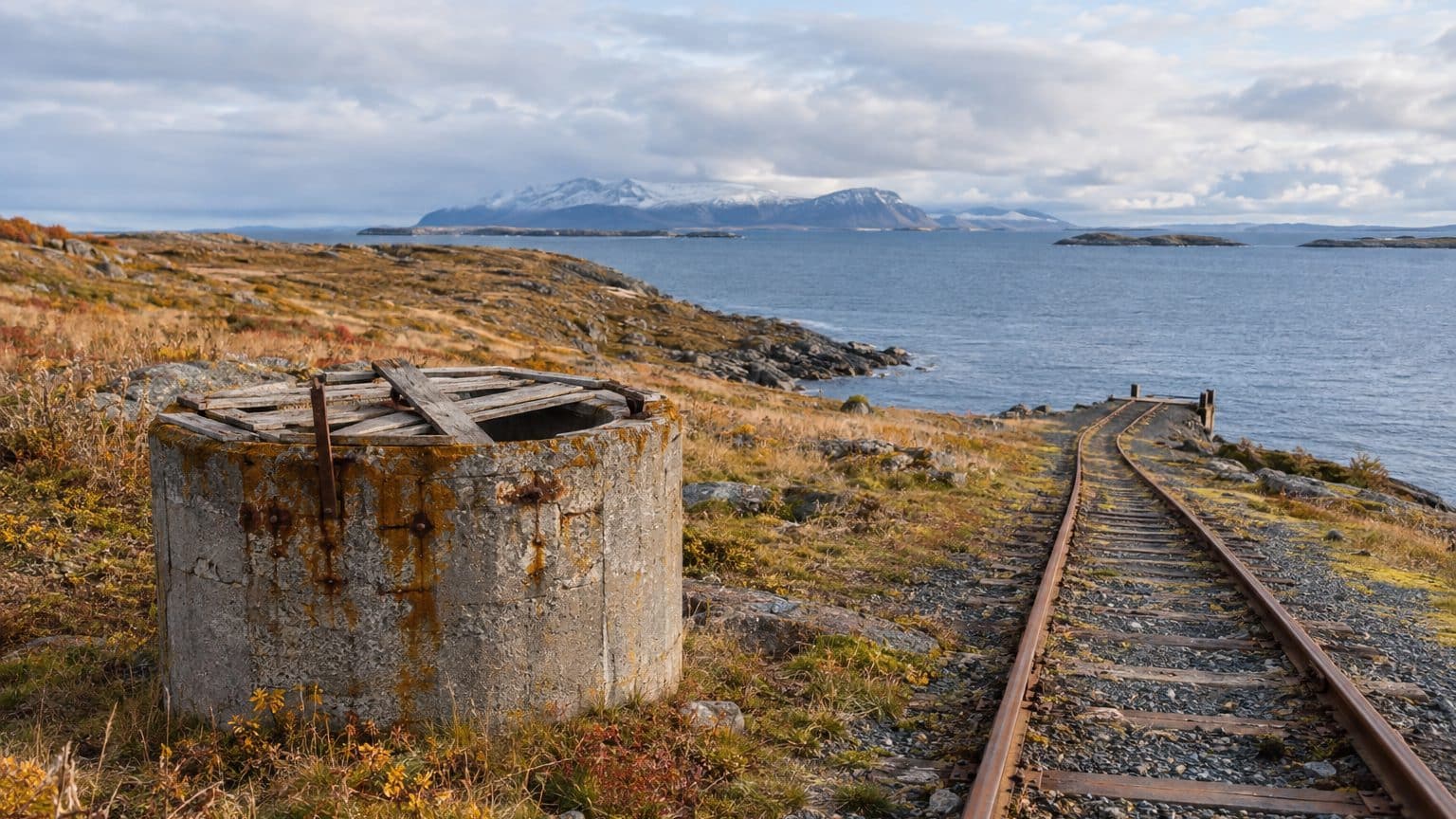
The first construction attempt dates back to 1953, the final year of Stalin’s rule. At Cape Lazarev, on the continental shore, it left a walled shaft, rails that lead nowhere, and an artificial island abandoned in the middle of a frozen strait. In Khabarovsk Krai, 120 km of track had nevertheless been laid to bring trains up to the tunnel.
The tunnel itself was almost never begun.
- A secret decree from 1950 launched the tunnel project under the Tatary Straits.
- About 27,000 people worked on the two shores at the start of 1953.
- The project was halted in 1953, and the tunnel was almost never begun.
A Secret Decree, a Strait, and a Strategic Obsession
It all starts with a text that no one was supposed to read. A secret decree of the USSR Council of Ministers, dated May 5, 1950, cuts a line between dam, bridge, and tunnel: it will be a tunnel, with a reserve ferry. It sits within the construction of the Komsomolsk-on-the-Amur – Pobedino railway line, in the north of Sakhalin. The technical specifications are approved on September 6, 1950.
For Stalin, the issue went beyond mere transport. It was about securing permanent access to Sakhalin, rich in coal and timber, without relying on the ice that blocks the strait for part of the year. The chosen route connects Pogibi Cape, on the island, to Lazarev Cape, on the continent, and plans for a tunnel of about 10 km, extended by 327 km of rail. Some titles mention 7 km of strait, but the sources consulted agree on about 10 km, at the point where the strait is narrowest.
The organization is divided into three construction sites. Site 506 lies on the island, near Tymovskoïe, and 507 on the continent, toward De-Kastri, while the tunnel proper falls under Site 6.
The schedule left no room for error. The provisional service with a ferry was to begin by late 1953, the tunnel by late 1955, for an expected annual traffic of 4 million tonnes. To meet these deadlines, the line was designed as a provisional route, and the use of untreated sleepers was authorized in the initial phases. They built quickly, even if it meant rebuilding later.
What 27,000 Men Really Left Behind
The labor shortage began as early as 1950. The Interior Ministry released up to 8,000 detainees to assign them directly to the project, the work resting on forced labor from the Gulag. By early 1953, the builders on both shores exceeded 27,000 people. That is more than the population of many French sub-prefectures, gathered in a region where roads were counted on one hand.
On the continental shore, 120 km of rails were laid.
A dam is also built near the future terminal, and at Cape Lazarev workers bore the first entries of the tunnel from both shores. Their most spectacular achievement remains the vertical shaft. Deep by almost 60 meters, it is reinforced with cast-iron pipes, like in the subway. This careful work contrasts with the rest: at the time the project halted, the actual drilling under the strait had hardly begun.
Today, construction shafts remain visible near the town of Lazarev, which earned town status in 1952. The main employers there are now the wood industry and natural gas, with a pumping station for gas and oil arriving from Sakhalin. The island’s energy thus crosses the strait without a railway tunnel, by other means.
The Death of a Man, Then a Beria Calculation
Neither rock nor cold stopped the engineers.
It was the death of a man in Moscow that brought the project to an end. According to Wikipedia, Beria, concerned about the financial cost and the risks of uprisings among prisoners, ordered a stop to the works. In a country where the Gulag supplied the labor force, a project employing tens of thousands of detainees, far from anything, became a political risk as well.
Archives provide a dated reference. A draft decree of the Council of Ministers, No. 149 of March 21, 1953, concerns the modification of the 1953 construction program and halts several large-scale projects, including the tunnel under the Tatary Strait. The document justifies these suspensions by the absence of necessity, not by technical impossibility. The decree thus confirms an halt that became inevitable: the tunnel had been designed by a man, for a system that did not survive him.
The dream, however, did not disappear with the project. Since the 2010s, a link between continental Russia and Sakhalin has been revisited, generally in the form of a bridge rather than a tunnel. Wikipedia, however, argues that budgetary, diplomatic (Kuril Islands), and technical difficulties render the realization highly unlikely.
For those who want to trace the sources, historians Kokurin and Morukov devoted a reference article to the project, published in the journal Archives historiques in 2001 (No. 6) covering the years 1950-1952. It relies on the Council of Ministers documents, the very documents that enabled the reconstruction of the project now that the secrecy has been lifted.
Sources: shango.media | keops-ingenierie.fr
