
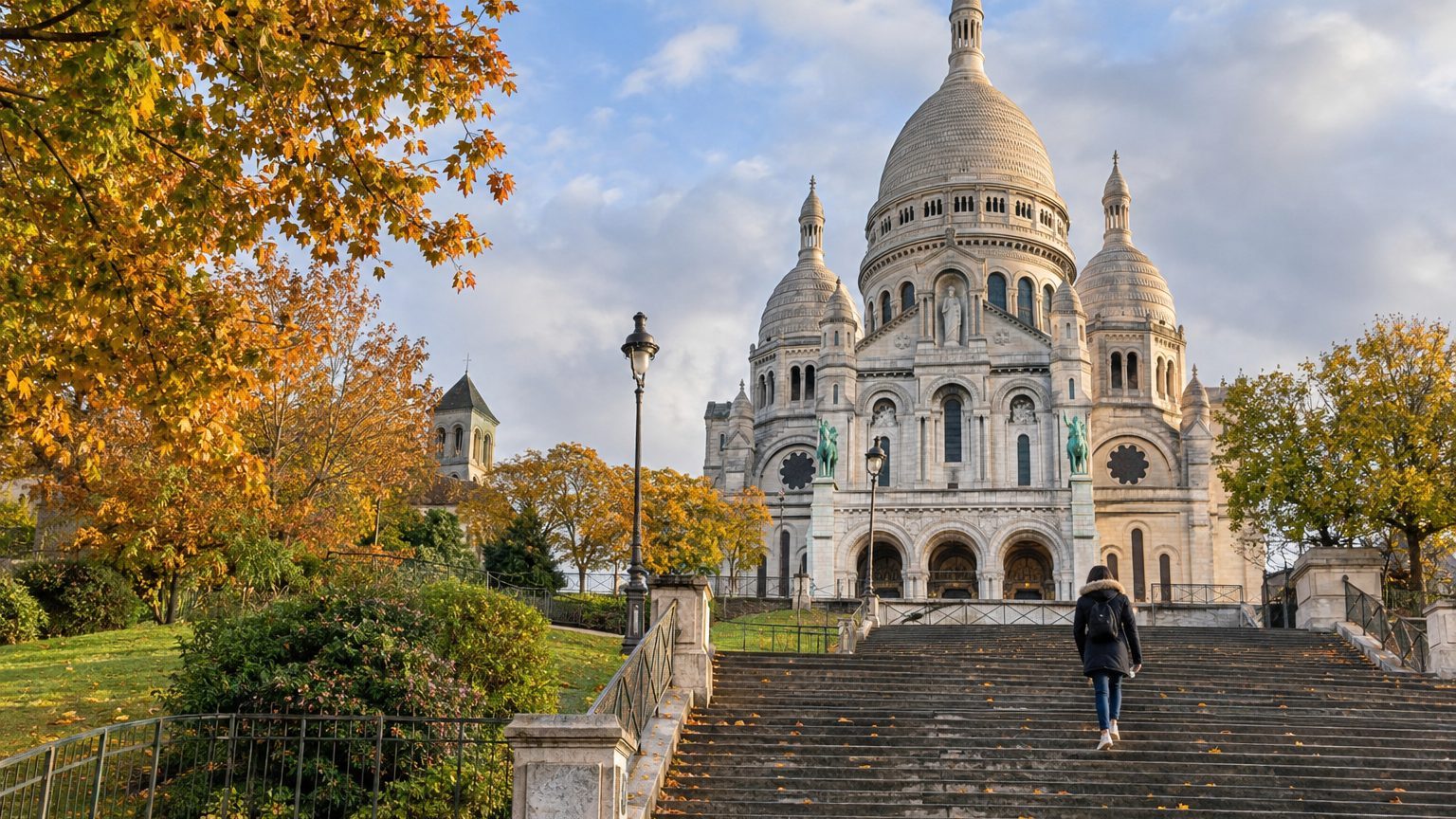
Under a downpour, the Sacré-Cœur does not dull: it whitens. Its stone, a limestone quarried less than 100 km from Paris, reacts to rain by washing on the surface, and those corners that the water never reaches take on a darker shade.
The contrast is written into the building itself. The domes and the exposed façades, battered by the rain, stay of an almost luminous white above the capital. Under the cornices and in sheltered crevices, the stone darkens.
- The Sacré-Cœur’s stone comes from Château-Landon, in Seine-et-Marne.
- This very low-porosity limestone absorbs little water and cleans on the surface.
- Sheltered parts of the structure darken, because nothing carries away the pollution.
A white basilica on a gray hill
The Sacré-Cœur rises above Paris from the summit of Montmartre, where it was erected beginning in 1875 according to the plans of architect Paul Abadie. Parisians quickly nicknamed it “la grosse meringue,” and that sobriquet still clings to its domes.
About 10 million visitors ascend to it each year, according to RTL. Many depart with the same question: why, in a city where ashlar stone fades to gray, does this church stay so bright?
The answer lies in what was chosen to build it.
The Souppes-sur-Loing stone, a limestone that washes
The basilica is constructed of Château-Landon stone, quarried from the Souppes-sur-Loing pits, in Seine-et-Marne. It is a lacustrine limestone from the Bartonian stage, formed roughly 40 to 37 million years ago, at the bottom of ancient lakes. Geologists classify it among the “cold stones”: extremely durable and hardly porous, it absorbs little water.
This low porosity changes everything. Rainwater does not seep into the body of the stone; it acts on the surface. According to ISTeP, the laboratory at Sorbonne Université, this is what gives the stone its whiteness as it ages.
The mechanism, put simply: rain dissolves a bit of limestone at the surface, then redeposits it as a thin pale layer. Every downpour renews this film and carries away the dust deposited between two showers.
Sources differ on the chemical details of this transformation. RTL mentions “calcin,” ISTeP speaks of oxidation, and Unicem references gypsum. All agree on the outcome: the stone lightens when rain touches it.
Conversely, the sheltered parts tend to darken. Without runoff, nothing removes the pollution that accumulates there.
The same stone at the Arc de Triomphe and on the Pont de la Tournelle
The Sacré-Cœur does not hold an exclusive claim to this limestone. The Arc de Triomphe and the Pont de la Tournelle, on the Seine, are also built with Château-Landon stone, and they similarly brighten with time.
The three monuments are not of the same era nor the same function. They share a quarry origin, and thus a comparable reaction to water.
The exposed parts lighten. Surfaces protected by an overhang, a cornice, or a recessed corner remain dark.
That is why a monument made of this stone does not need to be scrubbed to stay clear. Weather does much of the work, provided water can reach the facade.
7 million euros for the Opera, rain for Montmartre
Facing this natural cleaning, other Parisian buildings undergo restoration. The restoration of the façade of the Opéra Garnier cost seven million euros.
The figure puts into perspective what the basilica owes to its material: a dense, low-porosity stone that regenerates with every downpour. A monument built in a softer stone becomes stained more deeply, and only a heavy renovation can restore its original color.
That does not render the Sacré-Cœur invulnerable. The corners that rain does not reach continue to darken, and that is what you notice when you look up at the undersides of cornices on a bright sunny day.
The best moment to observe remains the day after a heavy shower, when the contrast between washed façades and sheltered corners is at its maximum.
Sources: sacre-coeur-montmartre.com | paris-monuments.fr | decouvrir-paris.info
