
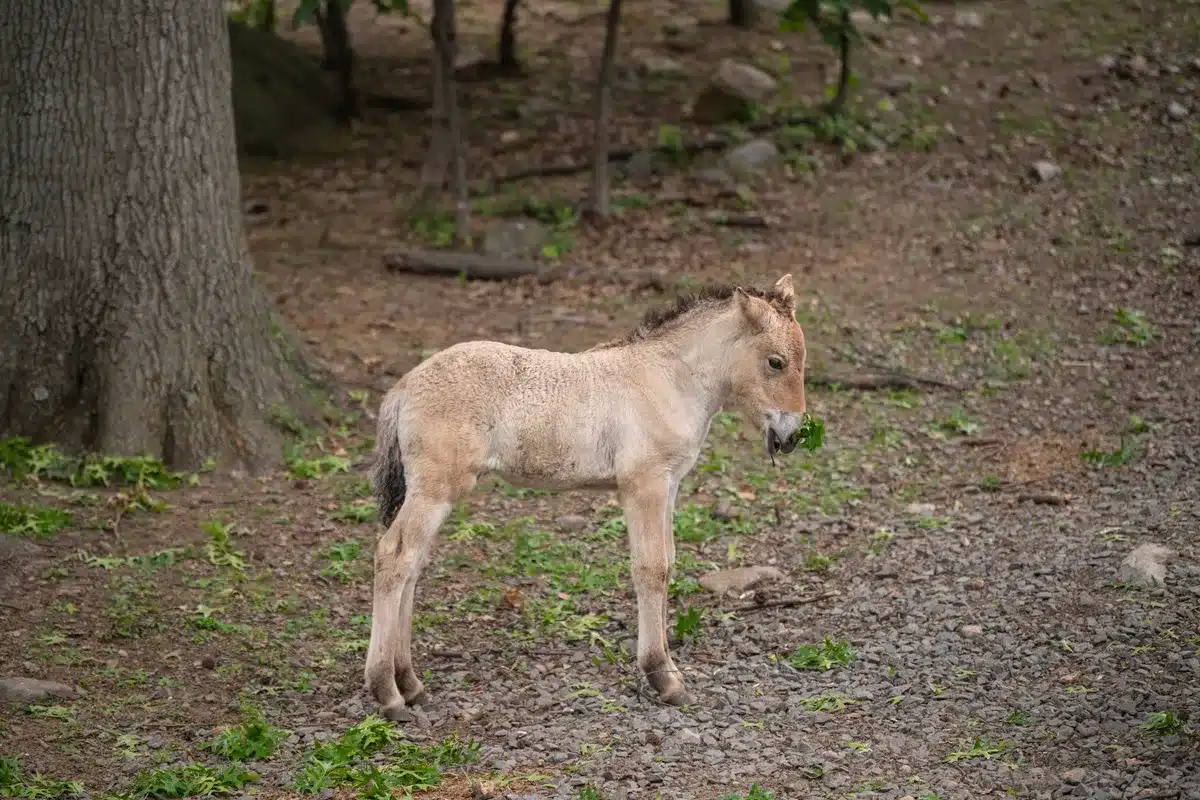
At the Bronx Zoo, a foal born on April 21 now trots alongside its herd. Nothing extraordinary at first glance—except that this compact little horse with amissioned mane belongs to the rarest species in the horse world: the Przewalski’s horse, the only horse that has never been domesticated, once declared extinct in the wild in the 1960s and brought back from the brink thanks to twelve individuals captured.
What you will learn
- How a species declared extinct in the wild was rebuilt from twelve horses kept in captivity
- Why Przewalski’s horses thrive today in the Chernobyl Exclusion Zone
- What still threatens the species’ survival despite its remarkable comeback
The last truly wild horse
The Przewalski’s horse is not a horse that has returned to the wild. It is a horse that has never been domesticated — the last equine species to claim that title.
You can recognize it by its distinctive morphology: a stocky body, a mane standing upright like that of a donkey, and legs shorter than those of domestic horses. Mentioned for the first time in a ninth-century Tibetan text, it prospered for centuries on the steppes of Central Asia.
Until everything collapsed.
From extinction to return: the story of the twelve
By the end of the 18th century, the population began to decline rapidly — climate change, habitat loss, competition with livestock, hunting. In the 1960s, the verdict arrived: extinct in the wild.
The species survived only because twelve individuals had been captured and placed in captivity. It is from this handful of horses that all living Przewalski horses today descend.
Breeding programs in zoos around the world — including the Bronx — gradually rebuilt the population. In 1992, sixteen horses were released in Mongolia. Since then, reintroductions have taken place in China, in Kazakhstan, and in a place more unexpected.
1,000 observations in Chernobyl
The Chernobyl Exclusion Zone, evacuated after the 1986 nuclear disaster, has become one of Eastern Europe’s densest wildlife sanctuaries. Przewalski’s horses were reintroduced there—and they have thrived.
After the massive forest fires of 2020, the lush vegetation that regrew on the burned ground drew many ungulates, including these horses. Camera traps detected them more than 1,000 times during fieldwork conducted between 2020 and 2021.
Less than 2,000 individuals, and a genome finally mapped
The Bronx foal’s good news should not mask the fragility of the situation. Fewer than 2,000 Przewalski horses exist worldwide. The IUCN still classifies them as a threatened species.
Genetic diversity is the central challenge: all living individuals descend from the same twelve horses, which limits their capacity to adapt to diseases and environmental changes.
Two recent advances offer hope. In 2024, scientists mapped the species’ entire genome for the first time. And in 2020, the world’s first clone of a Przewalski horse was born—opening a path to reintroduce genetic diversity from biological material preserved for decades.
In the meantime, the Bronx Zoo foal trots in its enclosure. A horse that should not have existed—and yet here it is.
