
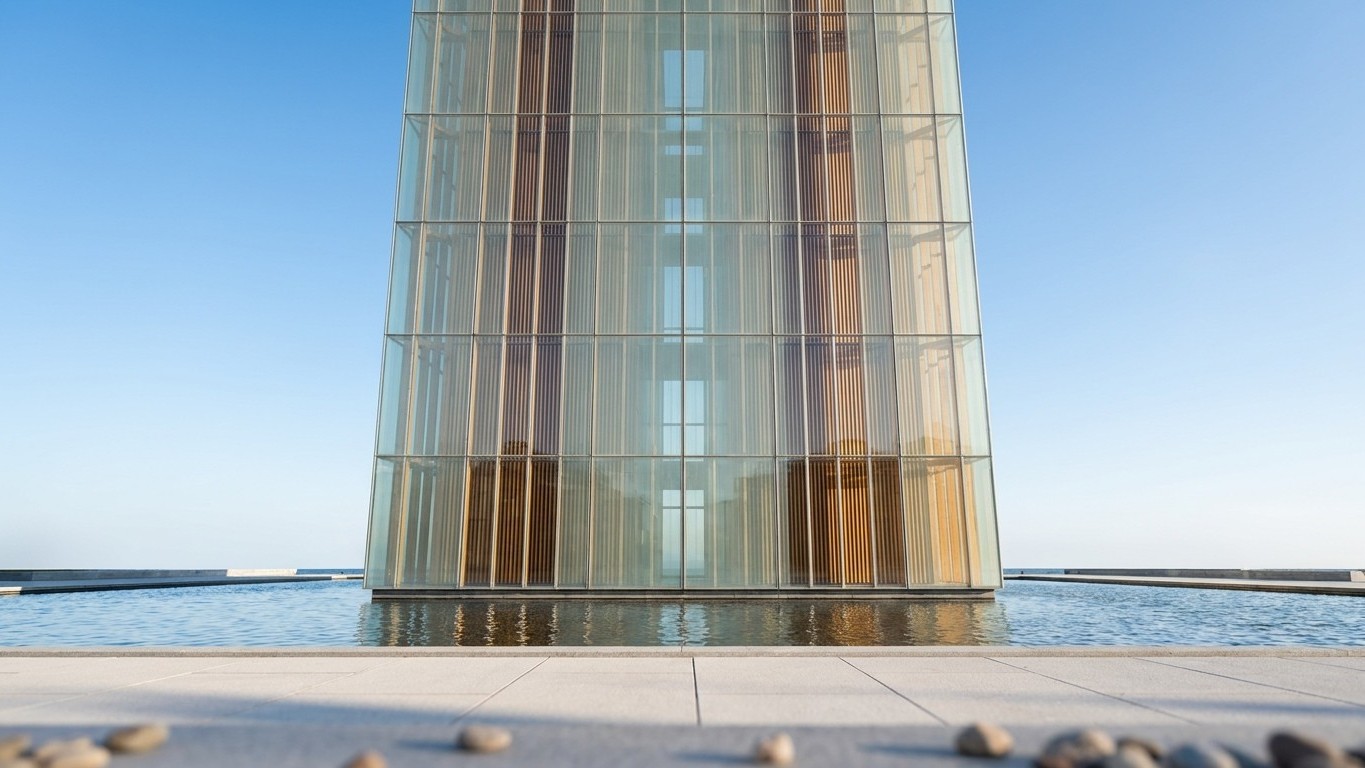
Eighty meters tall, four glass towers rising in a right angle along the Seine in Paris’s 13th arrondissement. Since opening to the public in 1996, they have housed millions of books. But behind their transparent façades lies a secret of a thwarted architect: thousands of wooden shutters added to prevent daylight from harming the paper these towers were meant, precisely, to showcase.
Key takeaways
- Four giant 80-meter glass towers were built to expose books to light
- Ultraviolet light destroys paper: 20,000 wooden shutters had to be installed to shield them
- A discreet budget overrun: 7.9 billion francs instead of the originally planned 7.2 billion
Four Glass Giants to House Kilometers of Books
The François-Mitterrand site of the National Library of France stands apart from any other public building in Paris. Four towers shaped like open books, 80 meters tall, house seven floors of offices and 11 levels of storage. An architectural vertigo brought to life by Dominique Perrault, winner of the international competition in 1989 when he was only 36 years old.
Under these towers sits a vast plinth that serves as the principal reserve. Some 57,000 square meters of storage total 400 kilometers of linear shelves, long enough to span the distance between Paris and Rennes. The building’s total capacity reaches 18 million documents, and each year 80,000 works enter via the legal deposit. The four towers bear programmatic names: Tower of Times, Tower of Laws, Tower of Numbers, Tower of Letters, arranged in an L-shape, evoking books opened to knowledge—the four pillars of learning.
The Light Trap: When Glass Threatens Paper
The problem is obvious from the design phase, yet no one wanted to abandon it: glass-walled towers, fully exposed to direct sunlight above the Seine, would be a heresy for paper conservation. Ultraviolet light and heat accelerate yellowing, fiber brittleness, and the drying out of bindings. Storing millions of heritage documents behind glass, on paper specifically, amounted to programming their deterioration.
The remedy consists of several layered defenses, stacked like a technical mille-feuille. First, a double skin of glass: clear glass envelopes, inner and outer, host an air layer nine centimeters thick, intended to prevent condensation and fogging. Then comes the true light shield: a 90-centimeter air gap that allows cooled air to limit the temperature; this setup is complemented by fixed aluminum shutters and an Okoumé wood veneer. Behind this discreet shielding, fixed aluminum shutters clad in Okoumé veneer and backed by a plaster wall isolate the book’s rays from the light.
The result, on the scale of the building, is dizzying: each tower is equipped with 5,000 wooden shutters. Twenty thousand shutters in total, an interior cladding almost as substantial as the framework itself. Okoumé, a light and stable tropical timber, was chosen for its resistance to warping with humidity changes, unlike more common species. A technical choice, not an aesthetic one, even if the outcome evokes a warm paneling that contrasts with the cold of the exterior glass.
7,200 Million Francs Announced, Nearly Eight Thousand in the End
The construction of the BnF long stood as a symbol of the grand projects of the Mitterrand era, with its share of budgetary controversies. The official figures, transmitted to the National Assembly, settle the debate between dark legend and accounting reality. In total, the expenditure amounts to 7,963 million francs in current francs. The initial envelope of 7,200 million francs (in 1989 francs) was slightly exceeded, as the total and final credits opened in 1989 francs come to 7,334 million francs.
Thus, a contained overrun at the scale of the project. But the bill does not stop at the walls. The operating cost of the Bibliothèque nationale de France in steady state was estimated at 1,019 million francs by the General Inspectorate of Finance in January 1996. A later parliamentary report would point out that the anomalies surrounding this construction constituted a performance shortfall, with operating costs representing for the State three-fifths of the budget devoted to all French university libraries. The Senate would also note an important accounting nuance: while the projected cost of the operation appeared to be respected on the surface, the final cost exceeded the envelope, since some expenses were shifted to other budget lines, such as the transfer of collections or the construction of restoration workshops at Marne-la-Vallée.
A Cascade of Corrections, Up to the Building’s Entrances
The wood shutters were not the only patch applied to the original project. Other adjustments, less spectacular but just as revealing, followed the opening. Nearly two decades later, the library had to rethink its entrances entirely: access was created at the center of the building, along the edge of the central atrium, with two enormous inclined moving walkways—eastward for the entrance and westward for the exit—a device judged less practical, less visible, and less elegant than the original entrance, but deemed necessary to absorb visitor flow.
Even the inner forest, planted in the heart of the esplanade to soften the mineral palette, suffered its share of wear. The original pines, rooted in five meters of soil, developed horizontal root systems, and their tall trunks needed guying; those that fell during the 1999 storm were replaced. A Senate report from 2000, tasked with assessing the project, even began with a question that captures the scale of the architectural discomfort: “Should the four Tolbiac towers be destroyed?” Thirty years on, the towers remain, with their wooden shutters invisible from the Seine. The light Perrault aimed to grant the books, in order to save them, had to be almost entirely removed to protect them.
Sources: senat.fr | cahiers-techniques-batiment.fr | assemblee-nationale.fr
