
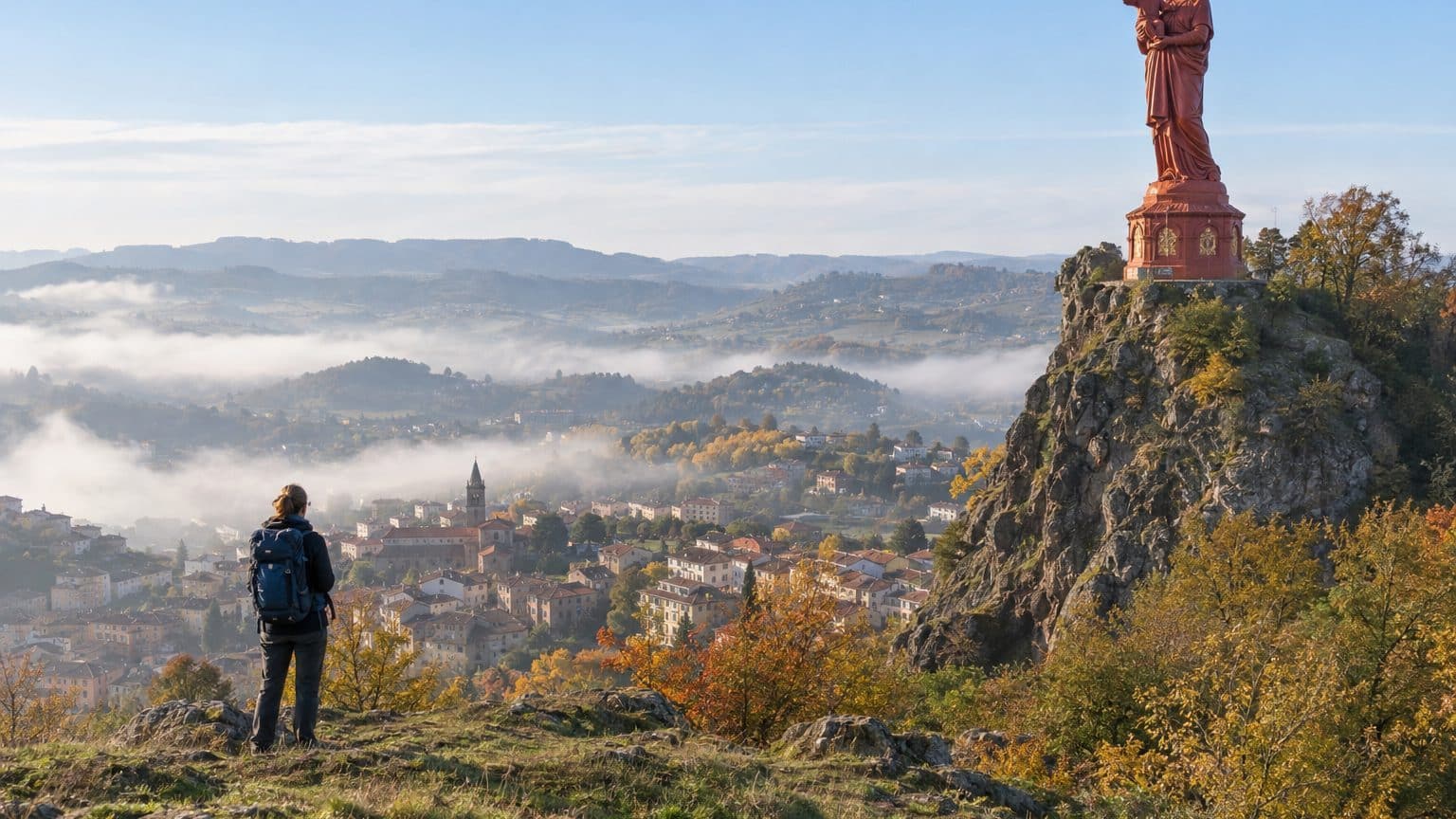
The Notre-Dame de France statue, perched 757 m above the Corneille rock, has watched over Le Puy-en-Velay since 1860. It was melted from the metal of 213 Russian cannons, according to the Haute-Loire departmental agency. These artillery pieces, seized at Sevastopol during the Crimean War, arrived in Le Puy because a bishop obtained a promise from Napoleon III.
The bishop was named Auguste de Morlhon.
- A promise from Napoleon III allowed the statue to be melted from cannons captured at Sevastopol.
- The statue stands 22.70 m tall and rises at an altitude of 757 m on the Corneille rock.
- The hollow interior can be climbed by cast-iron stairs, but the monument is closed from September 2026 to May 2028.
A European competition and a 325,000-franc subscription
The project begins with an artistic choice. On November 8, 1853, Jean-Marie Bonnassieux’s drawing was chosen from among 53 or 54 models in a European competition. The first stone was laid on December 10, 1854, and the fundraising drive to finance the work reached 325,000 francs.
The sculptor is long remembered for a legend that runs through the Velay. According to this rumor, he would have committed suicide because he placed the Child Jesus on the Virgin’s right arm rather than on the left. This is false: Bonnassieux died at 81 years old in 1892. The choice of the right arm was deliberate, because it allows the Child to bless the city without hiding his mother’s face, an unusual arrangement in statuary.
September 5, 1855: the bishop pleads his case in Paris
That day, Mgr de Morlhon traveled to Paris to see Napoleon III. He returned with a donation of 10,000 francs and a promise to provide the cannons captured at Sevastopol should the siege succeed. According to Wikipedia, the idea came from Marshal Pélissier.
The city fell three days later.
However, it was necessary to wait until the end of the war for the Emperor to honor his word. The Treaty of Paris was signed on March 30, 1856, and twenty days later the delivery arrived: 150,000 kg of iron derived from naval cannons. Sources do not agree on this point: Wikipedia gives the weight of the iron not counting the guns, while the department cites the figure of 213 cannons. It is therefore “213 cannons, according to the department” that should be written, without turning it into an archival tally.
The project took place in Givors, where the statue’s iron casting began as early as March 1856. The first pieces reached Le Puy on July 28, 1859. Just over a year later, on September 12, 1860, the statue was blessed in front of nearly 120,000 worshippers.
A hollow cast-iron giant that can be climbed
The Virgin measures 16 m and rests on a pedestal of 6.70 m, giving a total height of 22.70 m. It rises at an altitude of 757 m, atop a 132 m basalt neck, a remnant of an ancient volcanic conduit. From the lower town, it is visible from everywhere, especially since its iron is painted red.
The monument weighs around 835 t in total, of which 110 t belong to the statue alone. It is assembled from around a hundred bolted iron pieces, like a metal jigsaw puzzle.
This Virgin is hollow and can be climbed. You first pass 33 steps in the pedestal. A spiraling cast-iron staircase of 58 steps, spread across three levels, then leads up to the head. A ladder finally allows access to the crown.
At the three levels, windows open onto the city and its surrounding region. The cannon has thus become a staircase, with cast-iron steps salvaged from a Russian fleet.
The most visited monument in Haute-Loire, closed until 2028
In 2024, the statue welcomed 115,399 visitors, making it the most visited monument in Haute-Loire. That amounts to an average of more than 315 people each day of the year. Many come on foot, via an ascent equipped with rest stops.
This visitation will pause for a period. The statue is closed for works from September 2026 to May 2028, a project of about 20 months. Curious visitors will therefore have to content themselves with viewing it from afar, from the town.
The site was inscribed as a historic monument by an order of November 10, 1997. The protection covers the statue and its pedestal, but also the Sevastopol cannons kept on site and the statue of Mgr de Morlhon, erected in 1864 opposite the Virgin by the same sculptor.
Sources: myhauteloire.fr | guide-tourisme-france.com
