
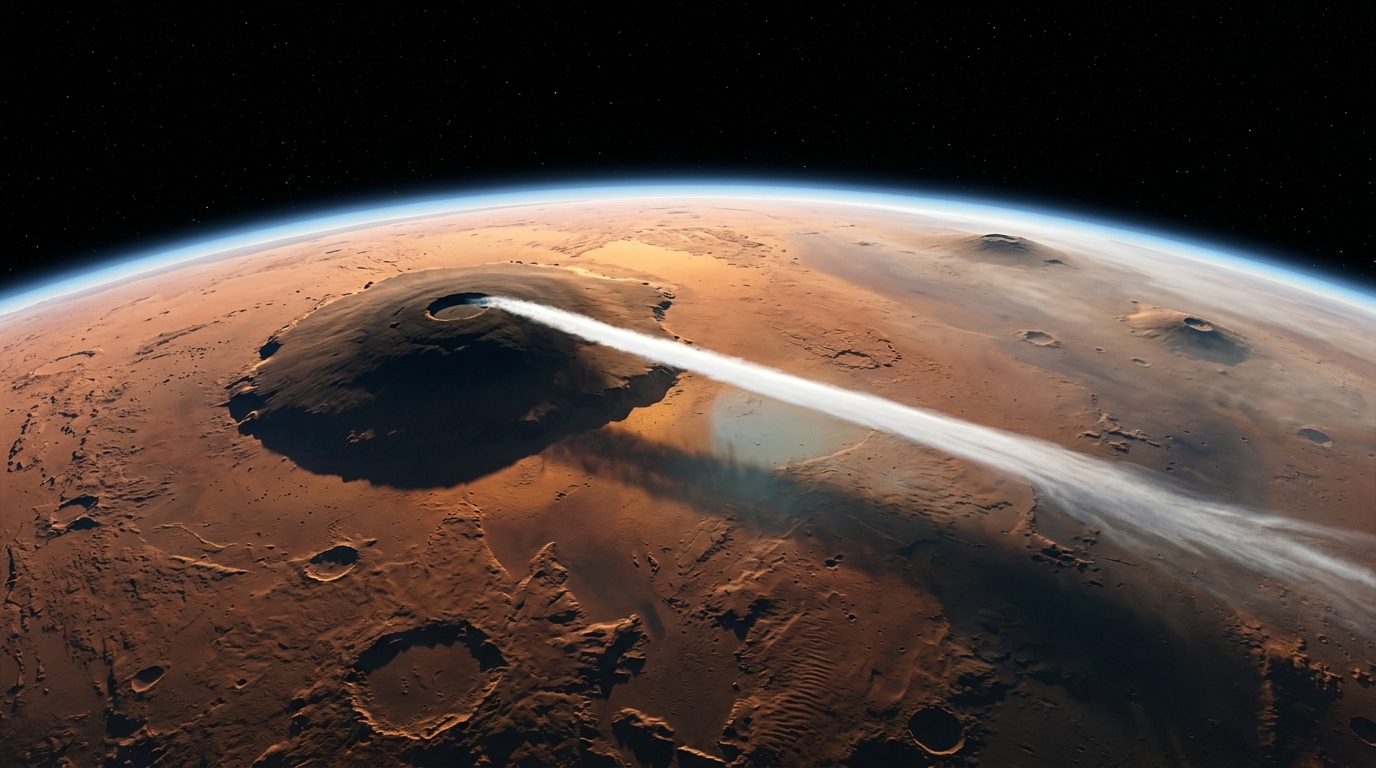
We often picture Martian clouds as simple ochre dust veils, as dull as the ground that shapes them. Yet, every southern spring, a colossal plume of ice stretches above a volcano on the red planet, reaching nearly 1,800 kilometers in length before dissipating in barely a few hours. A phenomenon terrestrial meteorology still struggles to fully explain.
- Each southern spring, the Arsia Mons volcano generates an ice cloud (AMEC) up to 1,800 km long, the largest known orographic cloud in the Solar System
- This plume forms before dawn, expands westward in two to three hours, and vanishes around noon, a cycle observed by Mars Express for over a decade
- New simulations show that the cloud results from homogeneous nucleation, a theoretical process never observed before in nature, confirmed with the Mars Express instruments
- A ice plume as long as France that defies earthly logic
- Arsia Mons, the invisible architect of an unprecedented meteorological phenomenon
- What Martian simulations reveal about a mechanism never seen elsewhere
An ice plume as long as France that defies earthly logic
Stacking together the distance from Lille to Marseille, nearly doubling it, gives a fairly accurate idea of the size of this cloud nicknamed AMEC, for Arsia Mons Elongated Cloud. According to data relayed by the European Space Agency, this white trail can stretch about 1,800 kilometers to the west. A scale that simply has no earthly counterpart.
What is striking as much as its size is its discipline. The cloud always appears according to the same script: it forms before dawn, rapidly extends westward in two to three hours, then dissipates around midday. An express ballet, on the scale of an entire planet, that recurs almost daily during the dust season.
Scientists now regard it as the longest orographic cloud, i.e., generated by terrain, ever observed in the Solar System. Mars Express has spotted it on several occasions over more than a decade, notably in 2009, 2012, then in autumn 2018 just after a global dust storm, and again in July 2020. A recurring phenomenon, but still largely misunderstood.
Arsia Mons, the invisible architect of an unprecedented meteorological phenomenon
Behind this atmospheric spectacle lies a 20-kilometer-high volcano, Arsia Mons, perched in Mars’ southern hemisphere. It is under the wind of this giant, during Martian spring and summer, that the cloud is born. The relief acts as an obstacle that forces air masses to rise, much like a wave breaking against a cliff.
A previous study by the same team, published in 2022 in the Journal of Geophysical Research: Planets, had already dissected part of the mechanism. Their mesoscale model, developed by the Laboratoire de Météorologie Dynamique, described a cloud with a head of about 120 kilometers in diameter extended by a tail more than 1,000 kilometers long. It also showed a temperature drop of up to 30 kelvins between 40 and 50 kilometers altitude, caused by a hydraulic jump following a windstorm descending.
Problem: this model, even as detailed as it was, did not fit reality. The optical depth of the simulated cloud remained too shallow, and above all, the tail never managed to extend as in the real images. A failure the authors themselves had acknowledged at the time, leaving room for an explanation still missing.
What Martian simulations reveal about a mechanism never seen elsewhere
A recent study fills this gap. To faithfully reproduce the AMEC, the team had to incorporate an extra ingredient: homogeneous nucleation. Specifically, it is a process by which water vapor directly turns into ice crystals, without needing to cling to a dust grain to start crystallization.
Jorge Hernández-Bernal, the lead author of the work, notes that this physics is indeed in textbooks, but it is generally considered purely theoretical. In other words, the researchers knew the mechanism existed on paper, without ever having had evidence that it actually occurred somewhere in nature.
New simulations thus suggest that this mysterious elongated cloud appears repeatedly in the sky of the red planet thanks to a meteorological process never observed before. To validate this hypothesis, the researchers compared their results with images from three instruments aboard Mars Express: the Visual Monitoring Camera, the High Resolution Stereo Camera, and the OMEGA spectrometer. The correspondence obtained lends weight to this explanation long kept in the shadow of equations.
This discovery goes well beyond the simple case of a Martian volcano. It shows that a mechanism once confined to atmospheric physics textbooks finds, somewhere in the Solar System, the ideal conditions to manifest on a large scale. A reminder that Mars, despite its thin atmosphere and its icy climate, continues to hold surprises for those who observe its sky with care.
