
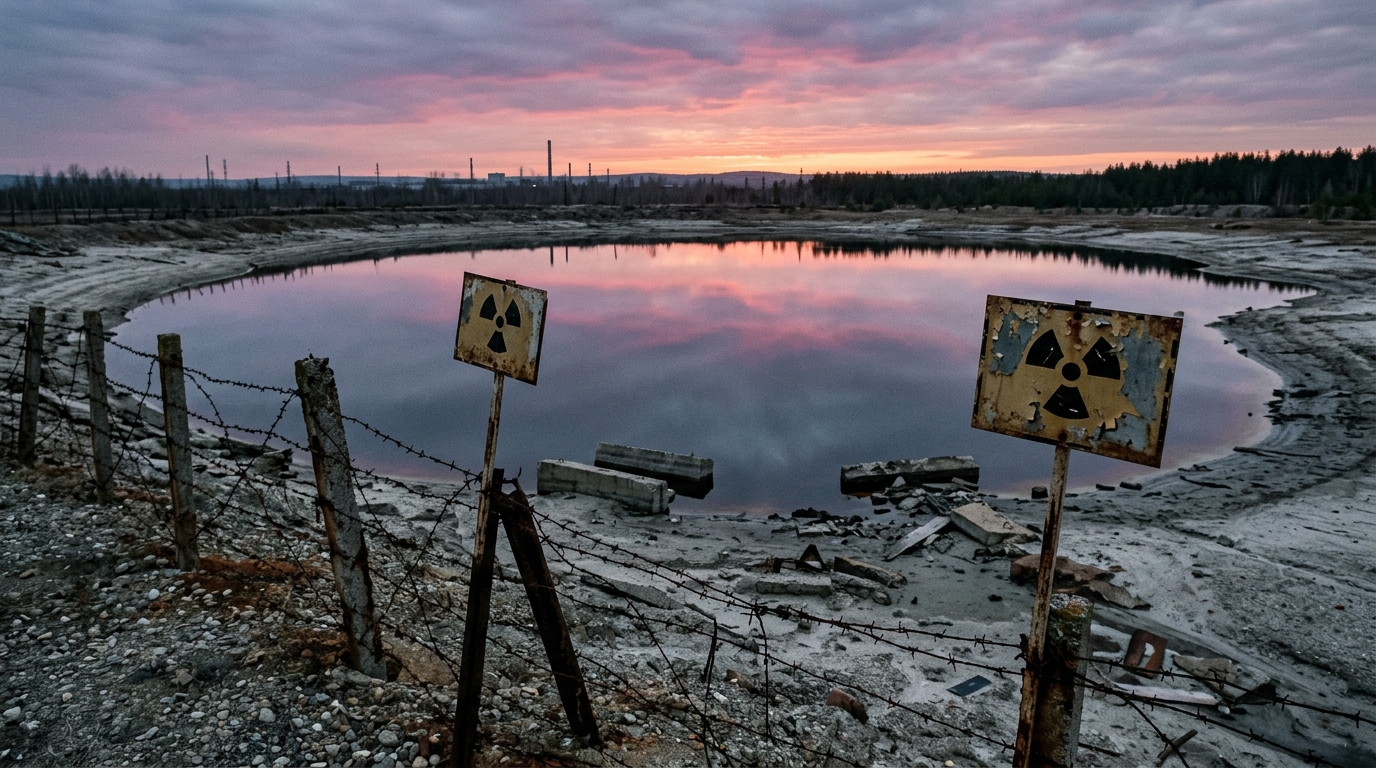
Imagine a bathtub being filled with poison rather than emptied: that is precisely what the USSR did with a small lake in the Urals. In 1951, the authorities diverted the worst wastes from their Maïak nuclear plant into this lake. The result, forty years later, merely standing on its shore would feel like signing one’s death warrant.
- In 1951, the USSR diverted the most dangerous radioactive waste from the Maïak plant to the small Karatchaï Lake, nicknamed “Reservoir 9,” to shield villages contaminated by the Techa River
- In 1990, radiation near the discharge point reached about 600 roentgens per hour, a dose lethal in one hour of exposure
- After attempts to stabilize with concrete blocks starting in 1978, the lake was definitively filled and converted into permanent dry storage in November 2015
- The Karatchaï Lake, the radioactive dump chosen by the Kremlin
- 600 roentgens per hour: a shore more deadly than a reactor
- Filling the unfillable: the concrete battle waged until 2015
The Karatchaï Lake, the Radioactive Dump Chosen by the Kremlin
Before this lake entered history for the worst reasons, the Maïak military complex already faced a problem. From its inception, the plant discharged directly into the Techa River the cooling water from its reactors as well as wastes from plutonium extraction. It was a quick-and-dirty method, typical of the Soviet nuclear urgency at the dawn of the Cold War, where producing the bomb took precedence over everything else.
The issue was that people lived downstream. In September 1951, measurements taken in villages along the Techa revealed radiation levels so high that even the Soviet authorities, notoriously reluctant to disclose health data, had to react. The chosen solution was not ecological: they simply moved the problem somewhere else.
Thus the most dangerous wastes were diverted toward a small body of water near the closed city of Ozersk, then known by the code Techa-65. This lake bore the name Karatchaï. Internally, Maïak engineers gave it a far colder, almost administrative label: “Reservoir 9.” A mere number to designate what would become one of the planet’s most contaminated places.
600 roentgens per hour: a shore more deadly than a reactor
To grasp how badly the situation spiraled, you have to look at the numbers. A study conducted in 1993 determined that the lake emitted the equivalent of 120 million curies of radioactivity, i.e., 4,440,000,000,000 megabecquerels. Such figures are so abstract that they nearly defy comprehension, far beyond ordinary scales of meaning.
Let’s adopt a more tangible benchmark. According to the Worldwatch Institute, in 1990 radiation measured near the discharge point stood at roughly 600 roentgens per hour. To put it in perspective, a dose of this magnitude received in an hour is lethal to a human being. In other words, standing on that shore for an hour would condemn any living organism in its vicinity.
The danger did not stay confined to the water. In the 1960s, the lake began to dry out, its surface shrinking from 0.5 square kilometers in 1951 to about 0.15 square kilometers by the end of 1993. As it receded, radioactive sediments were exposed to the air. The International Atomic Energy Agency even identified wind-driven resuspension of these radionuclides from the lake’s shores, in 1967, as one of the sources contributing to Techa contamination. The wind literally carried radioactivity beyond the site.
Filling the Unfillable: the Concrete Battle Waged Until 2015
Faced with this reality, it was impossible to leave the lake open to the sky any longer. Between 1978 and 1986, Soviet engineers sank nearly 10,000 hollow concrete blocks into Reservoir 9, hoping to stabilize the sediments and prevent further movement. A stopgap solution, but one that held long enough for authorities to devise a more durable plan.
That strategy finally emerged decades later, driven by a Russian federal program named “Nuclear and Radiological Safety,” which took over in the 2000s. The objective was clear: permanently fill the lake rather than continue wrestling with its overflow. The complete infilling was completed in November 2015, gradually transforming this poisoned body of water into a solid surface.
The work concluded in November 2015 with the laying of a final layer of rock and soil atop the special concrete blocks. The site thus became a permanent dry storage facility, a way to seal the threat for the long term rather than simply erasing it. Yet the Maïak case is far from closed: a Russian court ruling established that between 2001 and 2004, some 30 to 40 million cubic meters of radioactive waste still flowed into the Techa, causing environmental contamination by strontium-90. The complex, now operated by Rosatom, continues to carry the legacy of one of the darkest chapters in global nuclear history.
From the Karatchaï Lake, there remains only a stretch of concrete and earth, closely watched, but whose radioactive memory continues to weigh on the region. The story of this “Reservoir 9” serves as a reminder of how industrial choices in the early decades of the nuclear era sometimes sacrificed entire ecosystems, with consequences that generations must strive to rectify, when possible.
