
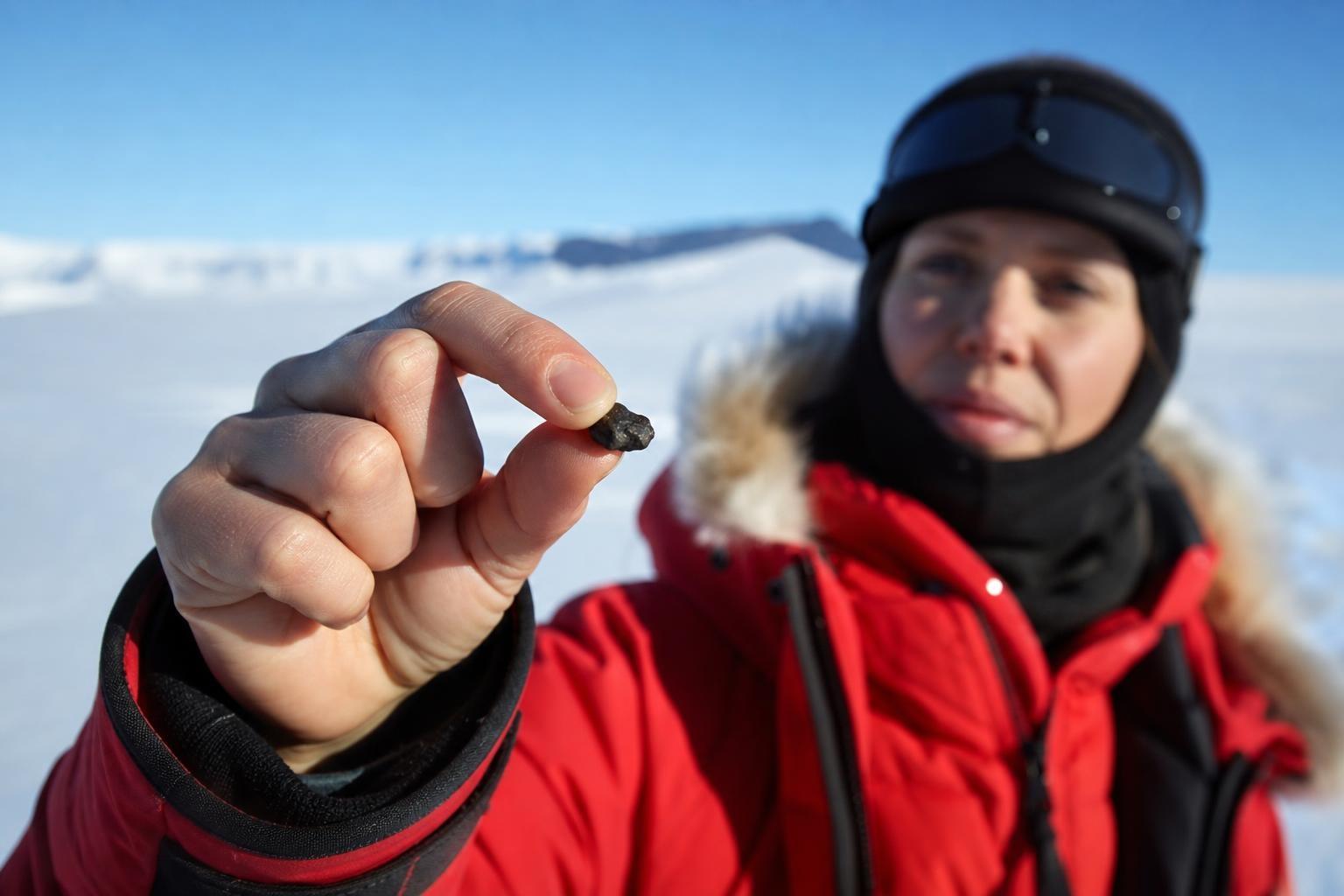
Our world swims through a fine mist of interplanetary grit. Every day, tiny fragments of comets and asteroids spiral down, melt in the air, and settle like invisible soot on seas, ice, and cities. It sounds like steady weight gain, yet the bigger story is a paradox: despite this daily drizzle, the planet’s total mass is edging downward. As one researcher likes to say, “Mass is a ledger, and space keeps the books.”
A gentle rain from beyond
The downpour is mostly micrometeorites—dust specks smaller than a grain of sand. Roughly 100 tonnes fall in a day, spread so thinly you’ll never feel a flake. A fraction burns as meteors, but most arrives softly, becoming soot-like particles trapped in snow, silt, and deep-sea mud. “Space is not empty; it’s a slow rain of powder,” as the saying goes.
Why the numbers don’t add up
If mass only arrived, Earth would fatten up. But the atmosphere is a leaky envelope, and the lightest atoms escape to space. The gains from dust are real, yet the losses are larger—and they happen all the time.
- Gains: about 30,000–50,000 tonnes per year from interplanetary dust and small meteoroids. Losses: roughly 95,000 tonnes per year of hydrogen, around 1,600 tonnes of helium, about 10–20 tonnes converted to radiated energy from interior heat, plus a trickle from spacecraft that truly escape Earth’s gravity. Net: a small but persistent deficit.
The sky’s silent leak
At the top of the air sits the exosphere, where molecules can drift for ages, meet sunlight, and pick up enough speed to fly away. Hydrogen goes first because it’s light, hot, and hard to contain. Helium follows, born from radioactive decay in rocks and then swept off in the polar wind. “The atmosphere is not a wall; it’s a sieve,” says a common refrain in space physics.
How dust finds us
Most particles are shed from comets and asteroid collisions, ground down in the zodiacal cloud and nudged inward by sunlight’s subtle drag. When they hit air, they flash, melt, and often turn into glassy spherules rich in iron and nickel—little fingerprints found in Antarctic snow and ocean sediments. A few larger bits survive as meteorites, but the bulk is too small to notice.
The ledger in plain numbers
Think of the planet as a bank account. Every day, dust pays in a modest deposit. Every day, hydrogen and helium make a larger withdrawal. On an annual scale, the account finishes a little lighter, even though deposits never fully stop.
Energy, rockets, and other subtleties
Earth’s interior heat flows outward as infrared light, and E = mc² means energy carries a trace of mass. That steady glow “costs” on the order of a few tens of tonnes per year, tiny but not zero. Human rockets add a romantic footnote: a handful of probes—Voyager, Pioneer, New Horizons—achieved escape velocity and took their hardware with them, but the mass lost is only a sprinkle compared to atmospheric escape.
Scale puts it in perspective
Earth’s total mass is about 5.97 × 10^24 kilograms. Losing tens of thousands of tonnes per year is a rounding error in a number with 24 zeros. Even across a million years, the change is minuscule—important for curiosity and calculation, not for tectonic drama. The continents won’t float differently, and the seas won’t drop because of this leakage.
But the chemistry matters
Hydrogen and helium aren’t just numbers; they shape the long-term character of the air. Helium becomes geologically rare because it escapes, which is why we mine and conserve it. Hydrogen loss whispers about our planet’s past water and photochemistry, while the polar wind ties Earth’s magnetosphere to the solar weather. “Small fluxes over deep time write history,” as geochemists like to remind us.
What the paradox teaches
Two truths can be compatible: we’re sprinkled with dust and still getting lighter. The balance depends on what space gives and what the sky relinquishes. In the near term, dust brightens meteor showers, feeds tiny ocean ecosystems, and leaves a measurable layer in polar ice. In the long term, escape edits the air’s lightest ingredients.
Seeing the planet as a process
The key is to treat Earth as a living system, not a sealed container. Mass flows in, mass flows out, and the books never truly close. Today’s dust fall is a quiet arrival; tonight’s hydrogen leak is a quiet departure. Between them lies a world that is always in motion, steady yet subtly changing.
