
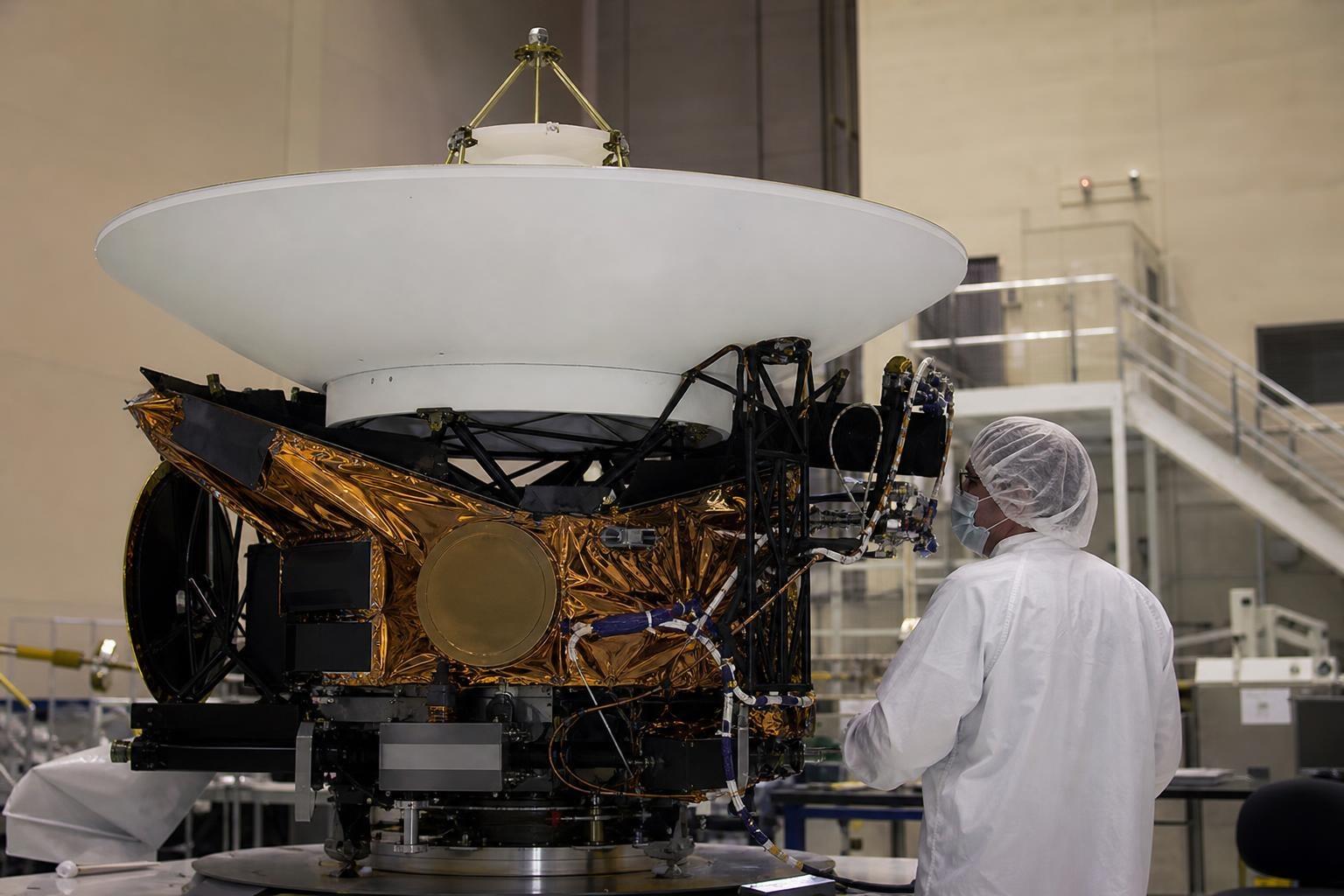
In the late 1970s, a small robot the size of a closet left Earth with a simple brief: go far, look hard, tell us what you see. Decades later, its faint heartbeat still brushes our antennas, a data trickle from the deep, black between the stars. Engineers call the incoming signal a “whisper,” but the science it carries lands like a shout.
A grand tour that rewrote the map
The craft began by surfing a rare alignment of the outer planets, a gravitational slingshot that stitched together close passes of Jupiter and Saturn. Those flybys transformed distant points of light into geologic worlds, revealing volcanoes on Io, storm belts on Jupiter, and ring physics around Saturn that textbooks had never imagined. With each maneuver, the probe traded orbital energy for speed, arcing onto a path that would one day pierce the Sun’s protective bubble.
Past the Sun’s invisible shore
Far beyond Pluto’s orbit lies the heliopause—the place where the Sun’s wind yields to the interstellar medium. Crossing that boundary was like stepping from a warm breeze into the cool draft of the galaxy itself. “Interstellar space is not empty,” mission scientists like to say; it’s a thin sea of plasma and cosmic rays, and the probe feels every delicate ripple.
What the signal still carries
Even now, the spacecraft returns measurements of charged particles, magnetic fields, and the density of the local plasma. The bit rate is painfully slow—mere tens of bits per second—but each frame is a treasure from a realm we’ve barely touched.
- Plasma wave tones that map density like sonar in a cosmic ocean
- Counts of high‑energy particles that trace the shape of the Sun’s faded influence
- Magnetic field readings that hint at the structure of our galactic neighborhood
“Every packet is a postcard,” one engineer joked, “mailed from a place we can’t yet visit.”
The improbable art of surviving
Longevity here isn’t luck; it’s gritty craft. The probe runs on radioisotope generators—warm lumps of plutonium that turn heat into electricity—and the available power has been fading yearly. To stretch the timeline, teams have turned off heaters, re‑routed circuits, and coaxed ancient computers with memory measured in kilobytes. When a flight data subsystem hiccuped in recent years, engineers painstakingly re‑threaded its software, proving that calm minds and long screwdrivers can still repair a ship you can’t touch.
The record for whoever finds it
Bolted to the bus is a gold‑plated phonograph, a time capsule for any curious finder. On it spin greetings in many languages, a baby’s first cry, waves and wind and thunder that sound like Earth’s collective exhale. Music stretches from Bach to blues, while etched diagrams explain where we live and how to play the disc. Carl Sagan once called it a “bottle in the cosmic ocean,” a hopeful act of radical politeness.
The hardest part: getting the whisper home
Catching the probe’s murmur requires the Deep Space Network, a global trio of dish antennas tuned to listen across the void. The signal arrives weaker than a snowflake’s touch, broadened by motion and the cold of space, yet software and patient math pull meaning from the noise. “It’s like hearing a watch tick across an ocean,” operators say, an everyday miracle built of timing, discipline, and very stable clocks.
What we’re learning out there
The readings refine our picture of the Sun’s bubble, showing how solar storms push and bruise the boundary like weather on a flexible skin. They tell us the local interstellar medium is denser than we once thought, and that cosmic rays thread the region like ghostly needles. Each update helps mission designers craft the next‑generation interstellar probe—faster, tougher, and with instruments tuned to the unknown.
Why it matters at home
There’s a human dividend, too. Seeing Earth recede to a pale, pixel helps shrink our differences and enlarge our shared stakes. The mission keeps reminding us that curiosity is a form of care, and that careful work, done long enough, can make time itself an ally.
How long the light can last
Power budgets grow tighter with every year, and instruments will wink out one by one. Most forecasts point to science operations through the late 2020s, perhaps with a carrier tone drifting longer as a final sign of life. That’s okay. The path is the payload, and the map it drew—of planets, of boundaries, of human possibility—is already safely home.
Somewhere beyond the Sun’s last footstep, a metal emissary keeps its patient watch, sending back the quietest, bravest yes our species has ever uttered.
