
The stakes feel unusually high as a Chinese spacecraft lines up a daring rendezvous with a tiny world that shadows our planet. For years, astronomers have tracked this faint companion, a quasi-satellite that loops around the Sun in lockstep with Earth. Now, a robotic explorer is poised to perform a delicate touchdown, scoop up pristine material, and carry it home. If first impressions hold true, the dust in its sample canister may be a literal fragment of our own Moon.
What is Earth’s “second moon”?
Astronomers call it a quasi-satellite—a small body that co-orbits the Sun on nearly the same timeline as Earth, while tracing a graceful corkscrew in our sky. The best-known example is 469219 Kamoʻoalewa (2016 HO3), a faint object just a few dozen meters wide. From Earth’s perspective it appears to hover nearby, looping slowly as our planet completes each solar year.
Despite the nickname, it’s not a true moon, because it’s bound to the Sun rather than Earth’s gravity. But its unusual, long-lived dance makes it easy to follow, and unusually tempting to visit. “A neighbor moving in our lane,” as one observer put it, “and just quiet enough to surprise us.”
Why some think it’s a shard of the Moon
Kamoʻoalewa’s reflected light carries a signature that has raised eyebrows: its spectrum looks remarkably lunar. In near-infrared measurements, the slopes and absorption features resemble mature regolith more than typical near-Earth asteroids. That hint suggests an origin as lunar ejecta—debris blasted off the Moon by an ancient, high-speed impact.
If that’s true, this little rock is a time capsule, preserving layers of space-weathered dust unaltered by Earth’s thick atmosphere or harsh reentry. Scientists imagine a chain of events: a collision excavates lunar crust, fragments drift through cislunar space, and one piece settles into a stable, resonant orbit alongside us. “A lost pebble from a very old story,” some researchers have mused.
Inside China’s bid to bring a sample back
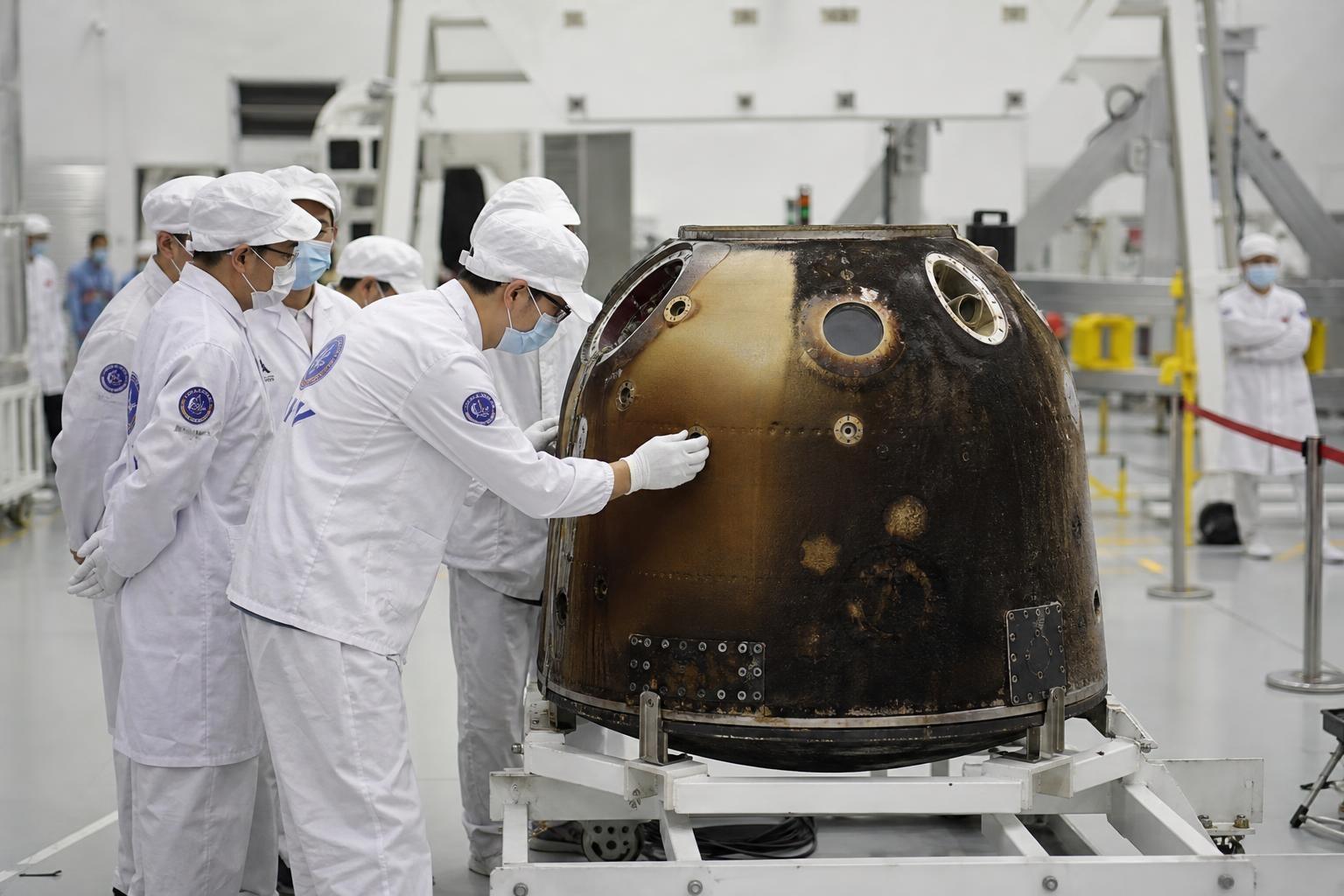
China’s next deep-space foray, widely known as Tianwen‑2, aims to collect and return samples from a small near-Earth object, with Kamoʻoalewa as a prime target. The spacecraft will execute a proximity rendezvous, survey the body’s shape and spin, and perform a brief touch‑and‑go to grab grains from the surface. After stowing the material in a sealed capsule, the probe will depart and steer a careful trajectory back toward Earth.
Mission planners are threading a tight needle: tiny gravity, rapid rotation, and unknown surface texture complicate the choreography. A boulder-strewn field could frustrate a soft contact, while electrostatically clinging dust may complicate collection. But recent triumphs—Japan’s Hayabusa2 at Ryugu and NASA’s OSIRIS‑REx at Bennu—show that small-body sampling is both feasible and transformative.
China’s playbook adds a notable twist: after releasing the return capsule for Earth recovery, the spacecraft may continue on to survey another target, wringing extra science from a well-fueled platform. Each leg sharpens China’s deep-space capabilities—precision navigation, autonomous guidance, and sample-handling sterility—that underpin more ambitious missions to come.
What the samples could reveal
If the grains prove lunar, we’ll gain a new window into the Moon’s far‑flung debris and the physics of high‑energy impacts. Comparing their textures and isotopes with Apollo and Chang’e samples could reveal which basin-forming event launched this piece, and how long it wandered under solar radiation.
If they are not lunar, that outcome is equally provocative. A space-weathered, silicate-rich near-Earth asteroid that only looks lunar would force a rethink of spectral interpretation and surface evolution under micrometeoroid bombardment. Either way, laboratory analysis—down to micron-scale grains, noble gases, and delicate organics—will turn guesswork into grounded knowledge.
“Bring the rock to the instruments,” planetary scientists like to say, because mass spectrometers and electron microscopes on Earth reveal subtleties no flyby can ever match. Even a teaspoon of regolith can anchor decades of theories, recalibrating models of how small bodies darken, crack, and shed dust over cosmic time.
Why this matters right now
This mission sits at the crossroads of national ambition, scientific curiosity, and a new era of practical exploration. A nearby target with a potentially lunar heritage offers fast-turnaround science with headline impact. It also advances global know‑how in small-body operations, sample planetary protection, and precision navigation that future crews to the Moon and Mars will need.
- If Kamoʻoalewa is lunar, we learn how the Moon chips and sheds fragments into near‑Earth space.
- If it isn’t, we refine how we read asteroid surfaces from telescopes and spacecraft spectra.
- Either result sharpens defenses against hazardous asteroids by improving small‑body models.
- And the engineering lessons feed a growing, interoperable deep‑space toolkit for all future missions.
In the quiet glow of dawn, that faint smudge near the ecliptic seems almost anonymous. Soon, a returning capsule may tell us it was family all along—a traveling shard with a lunar accent, carrying dust that once lay under a silent, alien sky. “Small rocks, big answers,” as mission planners like to say—and this one may be the smallest, biggest answer of them all.
