
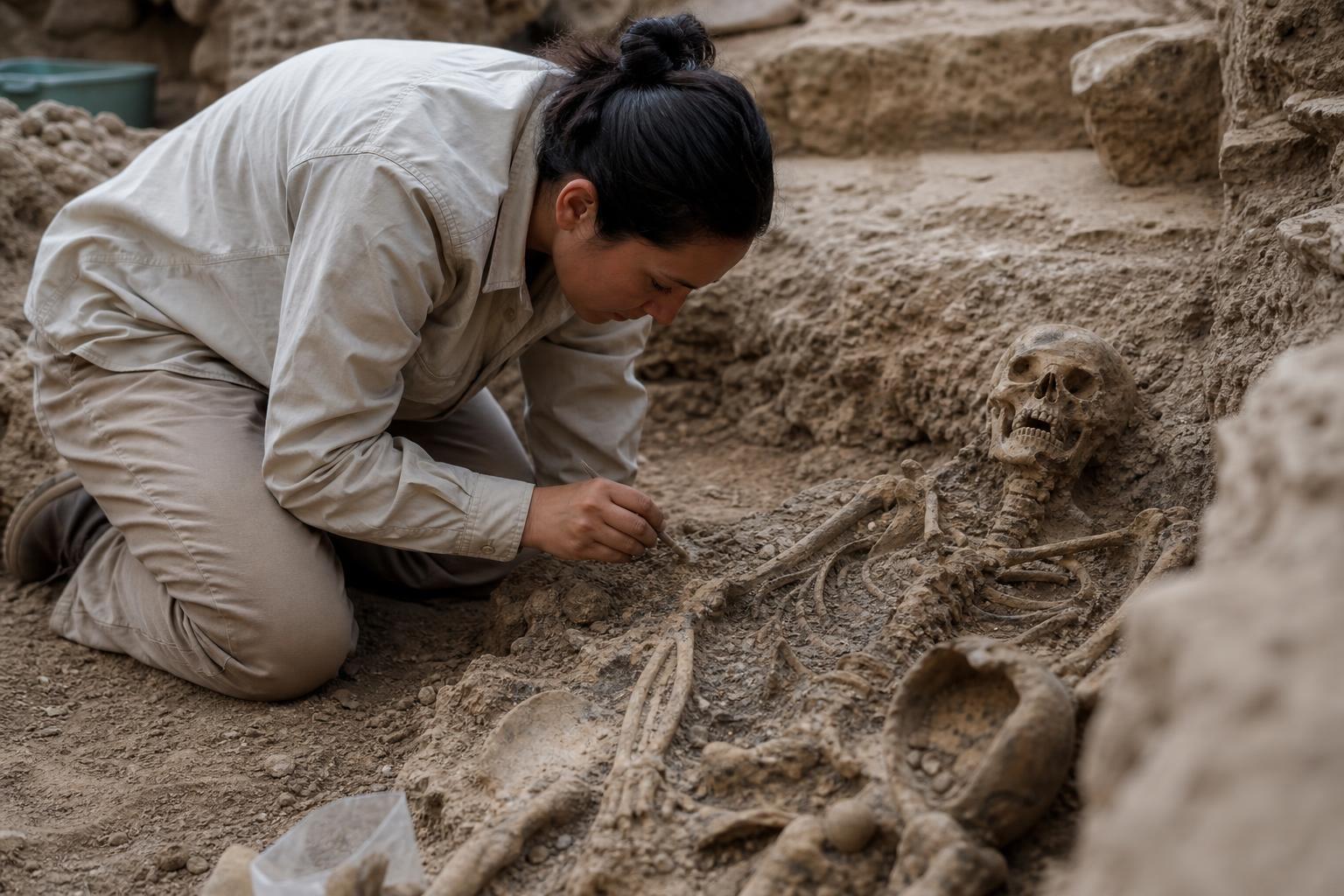
The desert morning was so still that even the brush seemed to hold its breath. Under a pale sky, a small team of archaeologists eased a sandstone cover from a sealed chamber, the work slow, deliberate, and almost whispered. A century of blowing sand had stitched the seam shut, but inside waited air last breathed a millennium ago—and with it, a surprise no one on the crew had imagined.
What the Earth Had Kept
They had mapped every shard, every faint discoloration in the soil, expecting a modest interment from the early Puebloan period. The plan, shaped with Tribal partners, was to open, learn, and then return everything with care. "We moved with consent at each step," said field director Lena Carver. "A site is a relative, not a resource."
Beneath the slab, cotton fibers still clung to a body laid on a reed mat. The dryness, that relentless Southwestern thirst, had preserved organics like a vault. But it was what lay at the right shoulder—wrapped separately, tied with yucca cord—that slowed every hand.
The Find That Bent Expectations
The bundle unfolded to a ruffle of red and blue, brilliant even after a thousand summers. There, curled and intact, was a scarlet macaw, the tropical bird of rainforests and thunder, not high desert and saltbush plains. Beak to tail, it had been placed as if asleep, a companion as carefully positioned as any beloved kin.
"We’d have guessed a few imported feathers, maybe," said Carver, her voice both gentle and dazed. "But a complete bird, carefully wrapped, tells of a relationship, not a trinket."
The macaw rewrites what this small community was connected to, hinting at routes that ran deep into what is now Mexico, where such birds were raised and revered. Isotope testing will trace where it grew, and ancient DNA may reveal if it was captive-bred or wild—each path a thread back to people who traded stories, not just goods.
Networks, Meanings, and Messenger Birds
Macaws have flashed through Southwestern iconography for centuries, their feathers braided into ceremony, their colors tied to rain, sun, and distant monsoons. To find one in a humble grave suggests more than wealth; it suggests obligation, care, and a bond that marked identity in both life and memory.
"This isn’t about exotics for prestige," said Aiyana Nakai, a Tribal cultural advisor who monitored the dig. "It’s about kin, responsibility, and how you keep the world in balance. We read a story of reciprocity, not acquisition." Her words moved like water through the trench, cooling the professional excitement with requirements of respect.
Fragility Meets Science
The team shifted from trowels to breath, working with sable brushes and a small lifting cradle. Feathers—those vanishing miracles—were stabilized with a mist of reversible consolidant. The bundle went straight to a mobile lab, where micro-CT scanning will map bones without a cut, and residue swabs may find pollens from a last meal or final ritual.
Alongside the macaw lay objects that now feel different in the light of this companionship:
- A coil of turquoise beads, a shell bracelet, a painted ceramic cup, and a notched wooden staff streaked with red ochre.
The list may look ordinary, yet together they become a kind of chord—color, sound, motion—meant to send someone on with more than silence.
Ethics, Care, and Returning
From the first survey, agreements shaped every decision. The burial was opened with permission, witnessed by Tribal monitors, and documented to allow reburial according to community protocols. "Discovery isn’t a destination," Nakai said. "It’s a point where listening begins." The macaw will be studied in ways that do not strip its dignity, and then it too will go home.
The crew’s field journal, smudged with dust and graphite, reflects a mix of wonder and restraint. "We have to hold both awe and accountability," Carver wrote that evening. "It’s easy to chase answers and forget we’re holding someone’s story."
Rethinking a Map We Thought We Knew
For decades, long-distance trade in the Southwest has been tied to monumental centers, where exotic goods piled like thunderheads. This grave, unassuming from the surface, tugs that map wider. It suggests the bright lines of exchange were not just highways for elites, but footpaths of obligation that threaded through small villages, weaving deserts to tropical forests.
In that reframed landscape, the macaw becomes not a novelty but a messenger, proof that ideas rode as far as storms do. People sang, traveled, made promises, and kept them with living beings whose presence remade the horizon. What feels impossible—an Amazon bird in a desert grave—steadies into the older truth that community has always outrun distance.
By late afternoon, the chamber was quiet again, its story now on careful paper and in cautious minds. The slab would go back, the mound re-formed by the same hands that opened it, and the site would return to listening. Somewhere out past the cottonwoods, a raven threw a bright laugh into the heat, and the team stood a little straighter, reminded that the past is still near, and still very much alive.
