
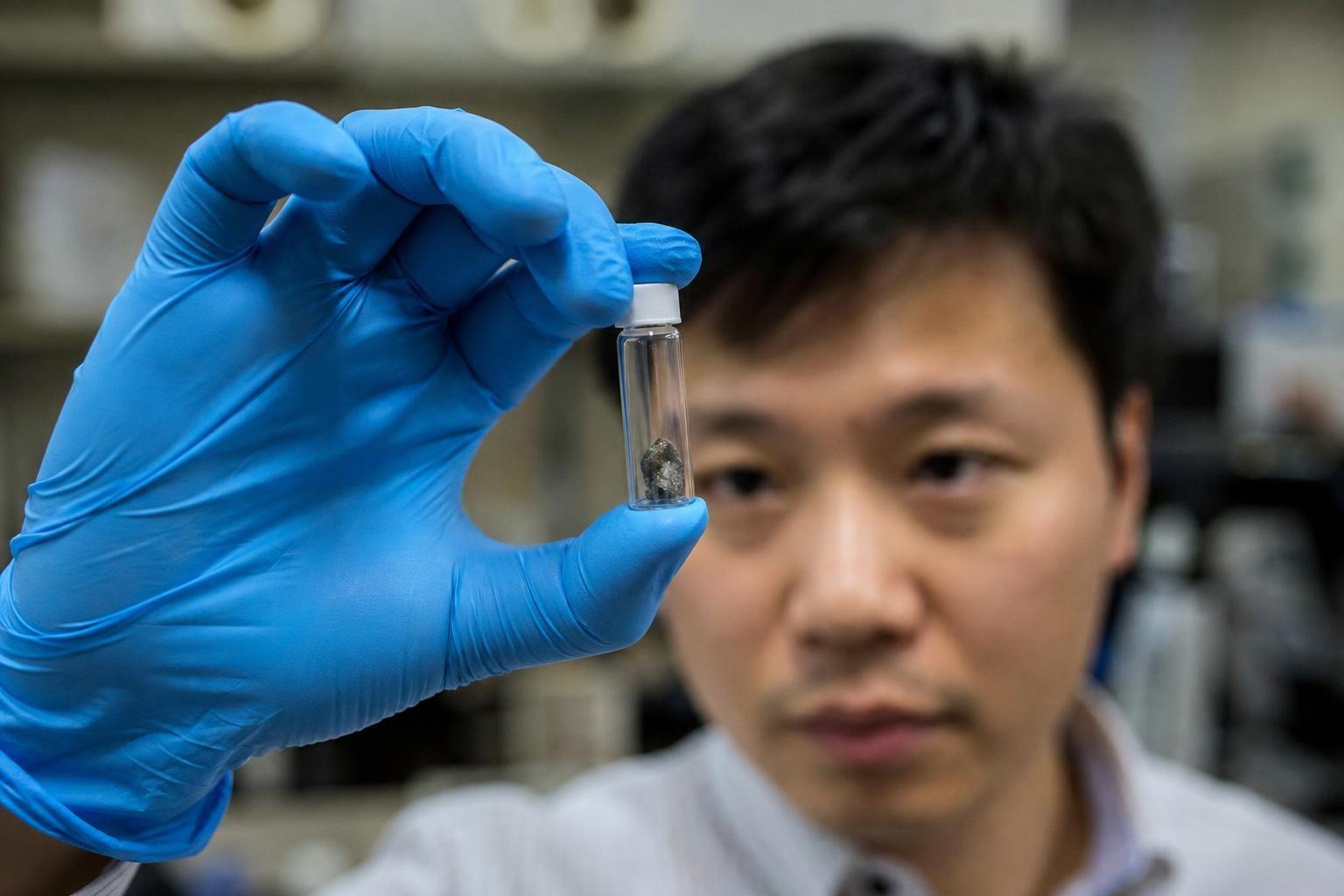
A speck that costs more than a mortgage payment sounds like science fiction, but the most precious stuff we know isn’t a jewel or a metal. It’s something we can make only in pinpricks, hold only in fields, and watch vanish if it ever touches the ordinary world. In laboratories, this elusive substance is painstakingly born—then constantly at risk of disappearing.
Meet the most expensive substance: antimatter
Antimatter is the mirror twin of matter: for every electron, there’s a positron; for every proton, an antiproton. When one meets the other, they annihilate in a flash of energy—a fireworks display at the smallest possible scale.
“Make a mistake with antimatter, and it makes you a void,” quips one researcher, half serious, half awed. That fragility is the core problem and the key to its staggering value.
Why the price per gram is astronomical
Producing antimatter requires colossal machines—particle accelerators that slam beams together to birth a vanishingly small number of antiparticles. The process is brutally inefficient: you pour in mind-bending energy and gather a microscopic harvest.
Storing it is even harder. Antimatter can’t touch a container, because any contact means annihilation. Scientists corral it in magnetic and electrostatic traps—“bottles” made of fields, not steel. Keep the trap stable, keep the vacuum pristine, keep the particles cold, and you get to keep your sample—for a while.
Estimates vary, but they routinely land in the “unthinkable per gram” category, a figure so high it stretches the ordinary imagination. No surprise: the electricity, the infrastructure, the expertise, and the time all pile into the final bill.
What could we do with it?
Even a whisper of antimatter can do work. In hospitals, positron emission tomography (PET) uses positrons from short-lived isotopes to map the chemistry of organs. The positrons aren’t stockpiled; they’re made on demand, annihilating within minutes to produce images with uncanny clarity.
Physics labs use antimatter to test the foundations of reality: Does antihydrogen fall up or down? Do matter and antimatter obey the same subtle symmetries? Each experiment is a magnifying glass pressed to nature’s instruction manual.
Dreamers eye propulsion and power. Antimatter reactions release the ultimate bang for your buck—more energy per mass than any chemical fuel. But the gulf between theory and practice is wide: you would need safe, bulk production, robust storage, and foolproof handling. For now, those are bold goals, not purchase orders.
Why it outprices every luxury you can name
The brutal arithmetic is about scarcity, difficulty, and risk. A gram isn’t just a quantity; it’s an engineering Everest, a stack of hard problems from accelerator uptime to cryogenic stability. Every extra second of confinement is an invoice; every extra particle recovered is a miracle of control.
“Antimatter is expensive because the universe doesn’t want it to exist,” says a veteran physicist—a poetic summary with a technical truth: the cosmos is overwhelmingly matter, so we’re manufacturing a minority species against the grain of nature.
How it compares with other ultra-pricey substances
For perspective, several materials command staggering prices, but for very different reasons:
- Californium-252: made in specialized reactors, prized for neutron sources in industry and medicine.
- Scorpion venom (purified components): extraordinarily hard to collect, researched for biotech applications.
- Rare isotopes and lab-grown ultra-pure crystals: essential for precision instruments and quantum devices.
Impressive as they are, these markets hover many orders of magnitude below an antimatter gram. They’re expensive the way a supercar is expensive; antimatter is costly the way a small nation is.
The quiet payoff: tools, not trophies
Striving to make and tame antimatter forges spin-offs. Ultra-high vacua, extreme lasers, cryogenic mastery, and exquisite sensors—these capabilities slip into other fields, from semiconductor fabrication to space instrumentation. The headline figure grabs attention, but the hidden dividends upgrade the world’s toolbox.
There’s also a cultural dividend. Pushing against the edge of the impossible sharpens our collective ingenuity. “Price is what you pay; insight is what you own,” say the pragmatists in the control room, watching a trap’s heartbeat flicker across monitors.
Why it matters even if you never buy a milligram
We chase antimatter not to lock it in a vault, but to ask better questions. Each captured particle is a note in a cosmic duet, matter singing to its mirror. The melody is faint, the cost is dear, and yet the music keeps drawing us closer.
Because sometimes the most valuable things aren’t things at all—they’re the methods, the maps, and the courage to keep turning the hardest knobs we can build.
