
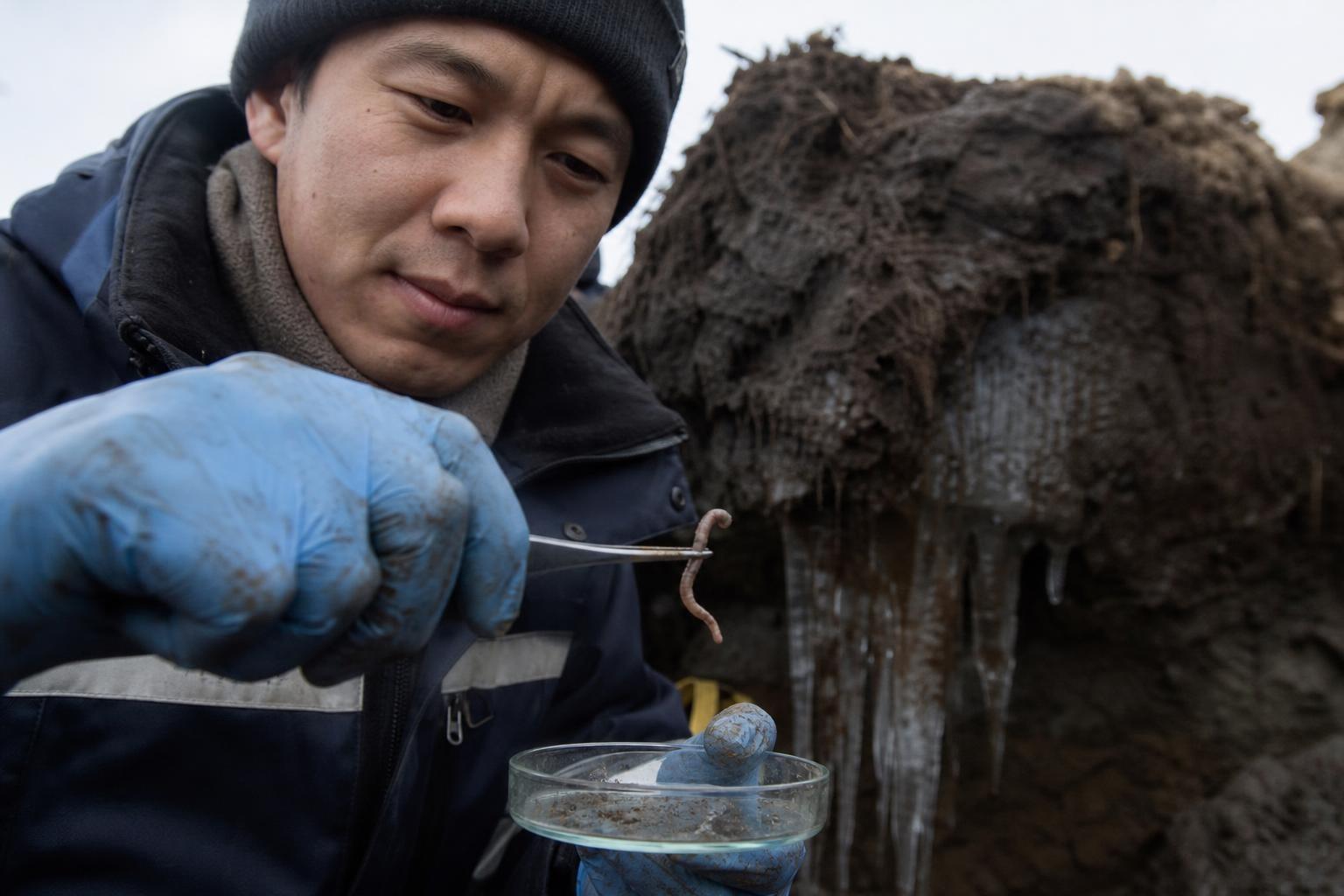
A tiny nematode, sealed inside Siberian permafrost since long before the pyramids were built, has returned to motion—and to motherhood. After thawing in carefully controlled laboratory conditions, the ancient worm resumed life, producing offspring without a partner. It’s a snapshot of patience at a planetary scale, a quiet reminder that time can be both hammer and harbor.
“Think of it as a pause button on existence,” said one researcher, marveling at a creature that endured where almost every other line of life would fail. Another quip catches the spirit: “It’s less a resurrection than a resume.”
A long sleep beneath the ice
Beneath layers of frozen earth, sediments along the Kolyma River held the worm’s resting chamber, protected from liquid water, sunlight, and hungry microbes. Radiocarbon dating of nearby plant material places the burial at around forty-six millennia, a time when woolly mammoths trudged across the steppe. The animal belongs to the Panagrolaimus lineage, a group of hardy nematodes already known for extreme tolerance. Its body, barely a millimeter long, rode out glaciations, storms, and entire civilizations—by doing almost nothing at all.
Researchers found not a fossilized shell, but a living organism in a suspended state. The permafrost acted like a vault, locking away moisture, oxygen, and decay. Once thawed with gentle precision, the worm stirred, then fed, then bred.
The art of almost living
This is cryptobiosis: a controlled collapse of metabolism so deep it looks like death, yet remains technically life. In that near-zero gear, cells avoid chemical damage, proteins stay folded, and membranes hold their shape. Sugars like trehalose can glassify the internal milieu, forming a molecular scaffold that prevents catastrophic ice injury. The body becomes a library in a fireproof case, pages intact, ink unfaded.
Creatures as diverse as tardigrades, rotifers, and some brine shrimp know this trick, but the timescale here resets the bar. “Life isn’t fragile; it’s patient,” goes a line passed around the lab—a tidy summary of the strange stamina on display. Survival is not always about fighting; sometimes it’s about waiting.
Switching reproduction back on
What startled scientists wasn’t only the return to movement, but the immediate return to reproduction. The worm produced offspring via parthenogenesis—a form of asexual reproduction where no mate is required. In practical terms, one survivor becomes a population fast. For a creature waking into an empty niche, that’s an evolutionary shortcut: no time lost searching for company when every calorie counts.
Generations followed swiftly in the lab, each tiny body a proof that the genetic script stayed readable across staggering time. Life didn’t just restart; it picked up where it left off.
Careful science in a fragile system
Reviving ancient organisms demands caution. The team used sterile technique, monitored for modern contaminants, and dated the surrounding material, not just the worm’s own tissues. In permafrost studies, the context is the clock: only well-preserved, sealed sediments earn serious confidence. “We didn’t wake a monster; we woke a survivor,” as one cautious voice put it, emphasizing both biosafety and humility.
While nematodes are not human pathogens, the work highlights a broader reality: thawing permafrost can release organisms and molecules from far earlier ecosystems. The lab is one story; climate change is a larger one.
Why this matters now
From cryobiology to astrobiology, this result opens doors. If a multicellular animal can endure deep time by suppressing metabolism, which other lineages might manage similar feats? Insights into cellular stabilizers, DNA repair, and vitrification could inform organ preservation, seed banks, and therapies against freeze–thaw damage.
- For medicine: better tissue preservation without toxic cryoprotectants.
- For conservation: hardier protocols to store endangered species’ embryos or gametes.
- For space biology: models for surviving long transits or extreme environments.
- For Earth systems: a clearer picture of what permafrost might release as it melts.
The technical takeaway is as practical as it is poetic: life can put itself on hold, safeguarding instructions for the future. By mapping the worm’s genome and stress-response pathways, researchers can test which protective switches matter most—and whether similar switches can be flipped in more complex tissues.
A mirror held to deep time
Forty-six thousand years is a human myth made real: a bridge from Ice Age winds to the data-rich hum of modern labs. The revived worm doesn’t warn of doom; it whispers about endurance. In a warming world, its story is both a scientific spark and an ethical prompt—to study with care, to thaw with purpose, and to remember that the planet’s oldest archives are quiet, small, and very much alive.
