
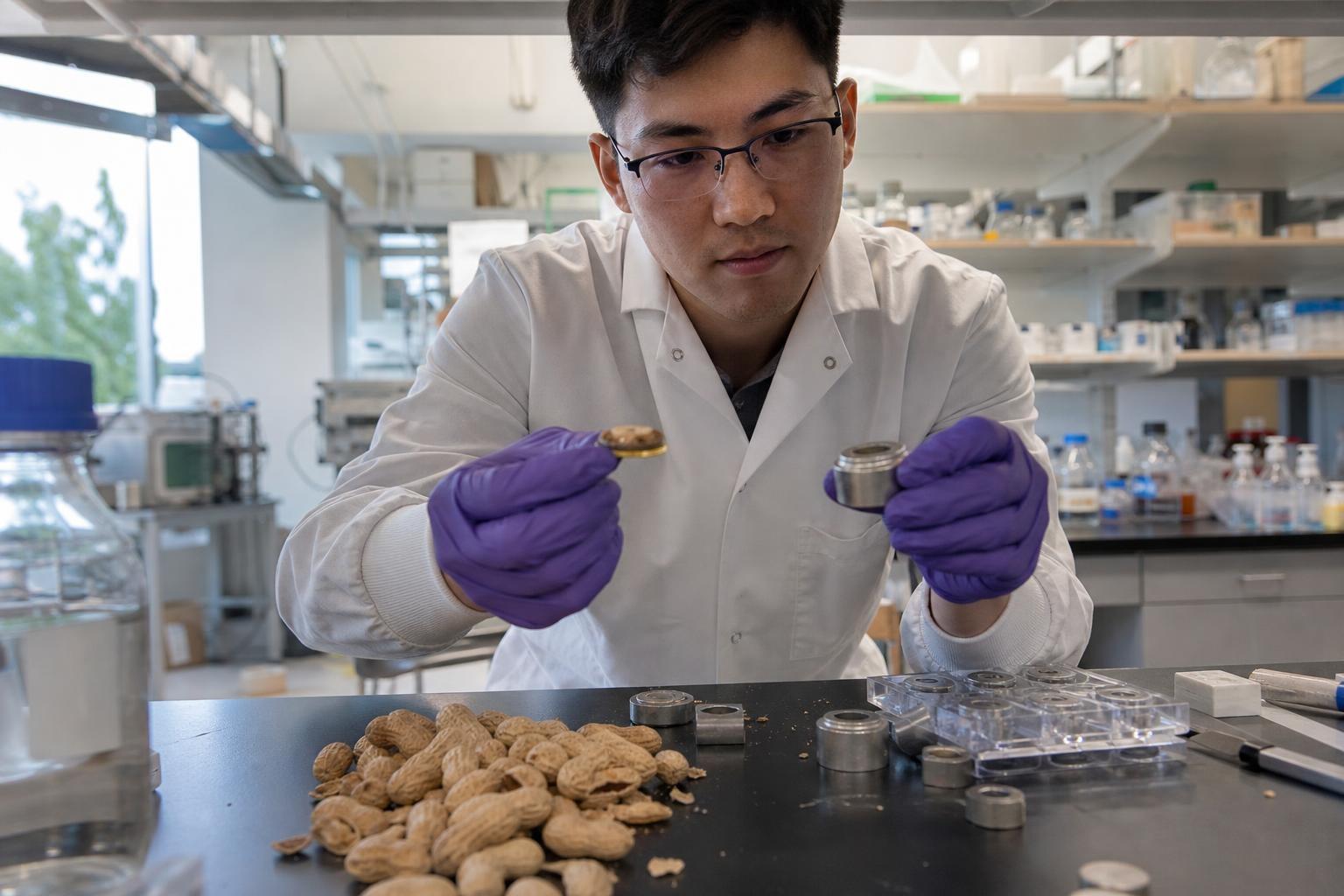
The humble peanut shell, once tossed aside as waste, is being remade into a surprisingly powerful ingredient for the next generation of batteries. In lab tests, researchers have converted these crisp, cellulose-rich husks into hard carbon that supports long-lived sodium-ion cells, delivering cycle life that can run for thousands of charges without major fade. “It’s a low-cost feedstock with an unusually high-value outcome,” one scientist said, calling the result a rare blend of performance and planet-first thinking.
From snack scrap to serious storage
Peanut shells are packed with lignocellulose, a complex matrix of carbon-rich polymers that carbonize into porous, durable structures. Through controlled pyrolysis, activation, and mild doping, the shells transform into hard carbon with a maze of micro and mesopores that welcome sodium ions. The carbon’s architecture manages volume changes, tempers surface reactions, and preserves electrical pathways under relentless cycling.
Unlike graphite, which prefers lithium, this bio-derived carbon creates more hospitable sites for larger sodium ions, allowing stable insertion and extraction over extended use. The process leverages waste that’s globally abundant, avoiding the fragile supply webs tied to mined materials and solvent-intensive graphs.
Why “outlasting” matters
Cycle life isn’t only about bragging rights; it determines how many times a battery can be charged and discharged before capacity slips below useful levels. The peanut-shell carbon forms a robust interface—the solid electrolyte interphase—that resists cracking, parasitic reactions, and cumulative losses. Pair that anode with a sodium cathode engineered for structural stability, and you get cells that shrug off daily use where many lithium-ion packs would demand early retirement.
“Think of it as fatigue resistance designed from the atom up,” a team member explained. The microstructure reduces stress concentrations, while heteroatom sites—from nitrogen or phosphorus—improve wettability and ion kinetics, keeping impedance creep in check. The result is boring in the best way: endlessly repeatable cycles with minimal day-to-day drama.
Performance without pyrotechnics
Sodium-ion chemistry typically trades some energy density for better safety and supply-chain resilience. Peanut-shell carbon doesn’t magically break the physics, but it tilts the system toward longevity, power stability, and cost control. In practical terms, that means fewer replacements, more predictable lifecycle costs, and a friendlier risk profile for homes and the grid.
In internal reports, researchers describe “multi-thousand cycles with high capacity retention,” noting that separators stayed clean and impedance growth remained tame. “We kept it cycling long after a comparable lithium-ion cell had tapped out,” one engineer said, emphasizing durability over sheer wh/mass glory. For many use-cases, that’s the better equation.
The supply chain story
Peanut shells are cheap, renewable, and widely available, which means less exposure to critical minerals and volatile commodity curves. Sodium is abundant in Earth’s crust and seawater, avoiding the geopolitical tangles that can shadow cobalt or class-1 nickel. Activation can use water-based binders and solvent-light routes, shaving both cost and environmental burden.
Early life-cycle assessments suggest lower emissions versus conventional graphite, particularly when waste heat and bio-energy are integrated into the process. “Every kilogram of shell diverted from landfill or low-value combustion is a small win that adds up,” the lead analyst noted, pointing to circular-economy benefits.
Where it fits best
These cells shine where stability, safety, and repeatability outrank absolute energy density. Expect first-wave deployments in sectors that crave dependable cycling and predictable costs.
- Grid-tied storage, home batteries, and commercial fleets of stationary packs
Engineering the scale-up
Turning lab curiosity into mass production demands steady feedstock quality. Peanut shells vary by region, farming practice, and processing, affecting ash content, particle size, and residual salts. Teams are building preprocessing lines for washing, grading, and controlled carbonization—often at 900–1100 °C with recipe-specific soaks—to keep microstructure within tight tolerances.
Binder systems aim for water-based slurries, roll-to-roll coating, and fast calendering without crushing the delicate pores that enable rapid ion traffic. Electrolyte tweaks are tuned to form a thin, elastic SEI that resists solvent attack at elevated temperatures. “The trick is to preserve the shell’s beneficial hierarchy while upgrading it for factory life,” one process lead remarked.
What it could change
If validated at pack scale, peanut-shell carbon helps decouple energy storage from fragile global mining chains, letting utilities and manufacturers lean on agricultural byproducts instead. That shift lowers entry barriers for emerging markets, supports local value-add, and reduces the carbon penalty of storage at scale.
Most importantly, this pathway reframes how we think about materials. Waste becomes workhorse, and overlooked biomass steps into a role long reserved for heavily processed minerals. “The shell was always there,” a researcher smiled. “We just had to listen to what the carbon wanted to be.”
