
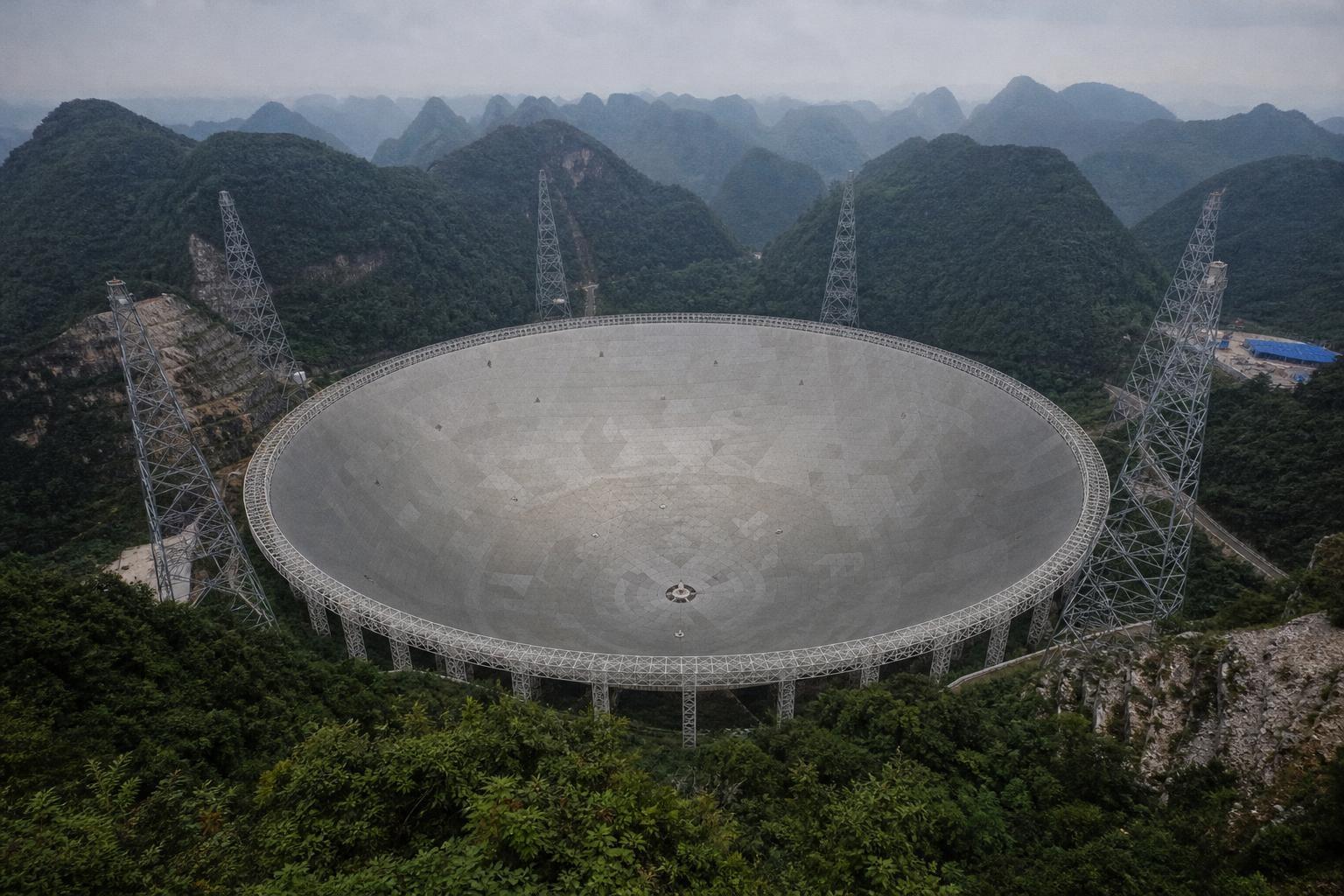
Silence has a texture here, a hush so deep that even a whisper would feel loud. In a limestone basin of Guizhou, metal and cables meet mountains and mist. An ear to the cosmos rests where rivers once pooled, drinking in the faintest signals. And in a world drenched with wireless chatter, its greatest ally is enforced quiet.
A valley turned into an ear
China’s Five-hundred-meter Aperture Spherical Telescope, better known as FAST, occupies a natural bowl carved by time. The karst landscape cradles a dish so broad that clouds cast moving shadows like gentle hands. With the ground itself as foundation, engineers sculpted a reflector that seems to merge with stone and sky.
At the center hangs a cabin like a lantern on steel threads. It rides a choreography of cables and real-time controls to find the sweet spot of celestial focus. Beneath it, thousands of panels reshape subtly, converting a spherical basin into a momentary parabola.
Why silence matters
Radio astronomy is a game of listening for whispers beneath a hurricane of human-made noise. A single phone ping can masquerade as a cosmic burst. As observers say, “In radio astronomy, silence is data.”
The site enforces a strict radio-quiet perimeter, because even a tiny transmitter can overwhelm. Within several kilometers, everyday devices become forbidden companions. “One rogue ringtone can look like a galaxy,” technicians like to quip, only half in jest.
What it’s listening for
This colossal ear tunes to hydrogen’s ancient hum, mapping structure across cosmic time. It hunts spinning corpses called pulsars, their beams ticking like metronomes in the dark sea. Sudden cosmic flares, fast radio bursts, arrive unannounced and depart without apology.
The telescope’s sensitivity lets it probe faint sources others only suspect. It refines pulsar timing for gravitational-wave clues. It catalogs turbulence in ionized gas, traces the skeleton of galaxies, and tests magnetism on interstellar scales.
The craft inside the craft
Nothing this big can be static, so the surface subtly flexes to stay sharply focused. A lattice of actuators nudges nodes by millimeters, turning curvature into precision. Laser metrology reads the mesh like a living, breathing blueprint.
Above, a cable-suspended cabin darts with dancerly poise. Algorithms predict the tug of wind, temperature, and motion to keep the feed unwaveringly still. It’s metal ballet, performed in slow grace.
The human quiet zone
Around the valley, life has learned to switch off to let the heavens switch on. Residents observe radio discipline that would make an old librarian proud. Buses detour, appliances are vetted, and tourists lock their gadgets before stepping onto sacred ground.
This quiet has a cost, and it has benefits. Jobs emerged, schools pivoted to science, and night skies reclaimed their studded velvet. People here measure progress not in decibels but in discovered signals.
A shortlist of superlatives
- The largest filled-aperture single-dish radio telescope ever built.
- A remote karst basin chosen for natural shielding from errant waves.
- An actively shaped reflector that remakes its own geometry.
- A cable-borne feed cabin stabilized with robotic finesse.
- Sensitivity that turns faint murmurs into readable messages.
Science without borders
Since commissioning, this ear has opened to global collaboration. Teams bring questions; the valley offers exquisite, disciplined listening. Proposals arrive from every longitude chasing different pieces of the same great puzzle.
International time on the dish mixes methods and ambitions. Some search for alien technosignatures with disciplined skepticism. Others derive cosmic constants from the drumbeat of spinning stars.
The ethics of listening
To hear the universe, we restrain ourselves, a small vow of modern monasticism. The rule is simple: fewer transmitters, richer data. “Turn it off” becomes an instrument as important as any cooled receiver.
There’s a lesson in that restraint that feels both ancient and new. In yielding a little, we gain something immeasurably vast. The bargain is fragile, yet astonishingly productive.
What comes next
As upgrades refine surfaces and calibrations, the dish grows even more attentive. Surveys expand, catalogs thicken, and the map of neutral hydrogen gains contours. Each year of quiet yields years of interpretive work.
Maybe the future brings pulsar clocks that rival atomic standards. Maybe a repeating burst becomes a Rosetta stone. Maybe a pattern appears that forces us to rewrite a cherished theory.
The paradox is irresistible: humanity’s loudest century has built its most patient listener. In a green basin framed by cliffs, a machine of exquisite silence leans into the static. The cosmos does not shout, but it is always, always speaking.
