
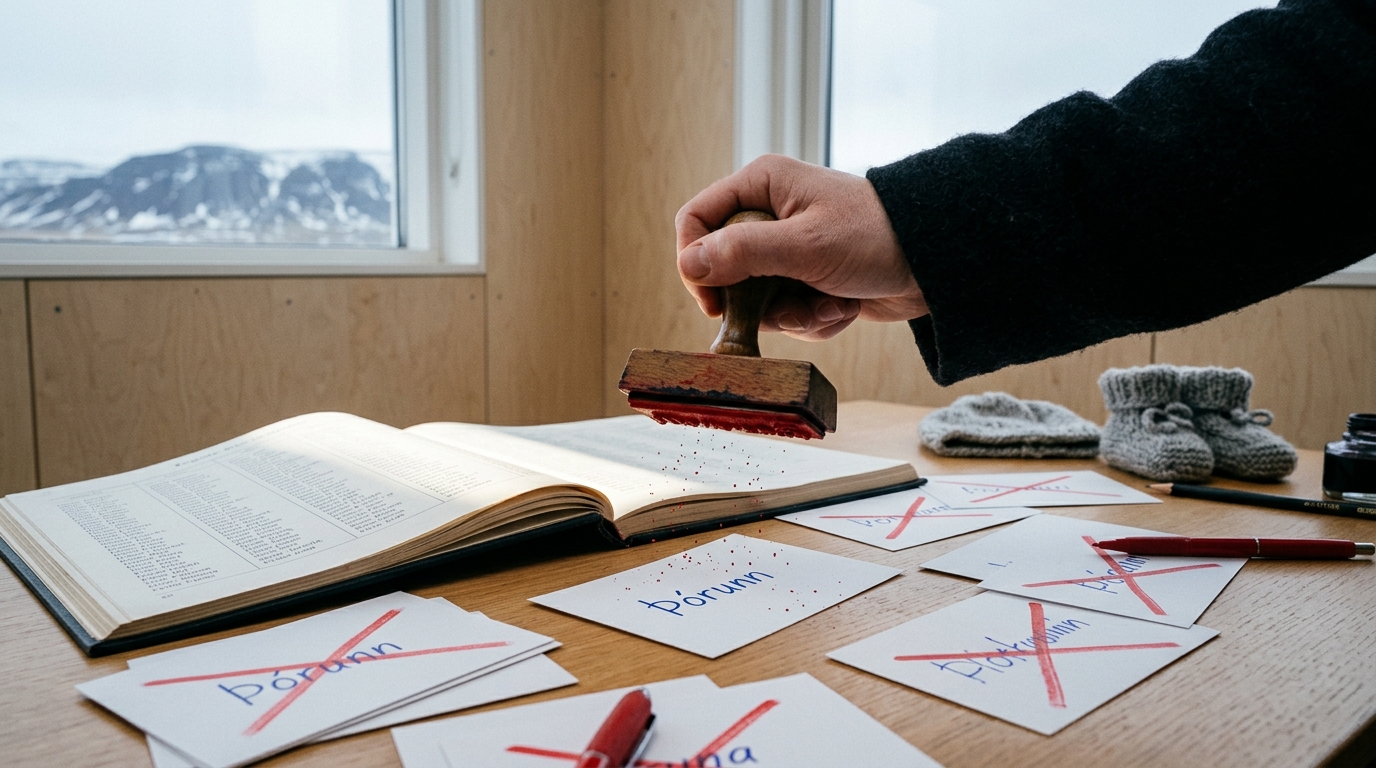
People often think, wrongly, that parents have the final say over their child’s given name, everywhere in the world and without exception. In France, this has largely been true since the law relaxed the rules in this area. But in Iceland, that notion simply does not hold. There, a child cannot receive just any name, even if the parents have dreamed of it for months. There exists an official, locked list that sets the names allowed at birth. And what happens to every name not yet on it is not the father or the mother who decides, but a little-known committee whose role captivates as much as it raises questions. Let us dive into this unique system, inherited from a determined will to preserve language and culture.
- The official Icelandic list comprises roughly 4,866 approved names, and any name outside the list must be examined by the Mannanafnanefnd, a three-person committee created in 1991.
- To be accepted, a name must comply with Icelandic grammar (notably it must be declineable in the genitive), use only the Icelandic alphabet, and not expose the child to ridicule; the review takes between four and twelve weeks.
- A bill introduced in June by the Icelandic government could abolish this committee by simply requiring that a name be declineable in Icelandic.
- A list that frames the identity of every Icelander from birth
- The Mannanafnanefnd, this little-known committee that has the final say
- The criteria that make a name accepted or refused
- Precedents that demonstrate the rigor of this world’s only system
A List That Frames the Identity of Every Icelander from Birth
In Iceland, you cannot improvise your child’s name on a whim or a burst of inspiration. The country maintains a closed list of names allowed for the civil registry, a kind of official catalog from which parents draw. This database is far from trivial: it lists about 4,866 approved names, divided into 2,298 masculine names and 2,568 feminine names, according to a count updated recently. All told, there is plenty to choose from, yet the underlying logic remains fundamentally different from what we know in France.
If the desired name is already on this list, there is no difficulty: the parents declare it and the matter is settled in a few minutes. However, as soon as a name strays from the beaten path, whether it is an original creation, a foreign name, or an unseen variant, the situation becomes much more complicated. One must then go through a very particular examination procedure, entrusted to an institution that few visitors know but which weighs heavily in Icelandic administrative life.
The Mannanafnanefnd, this little-known committee with the final word
Its name is difficult to pronounce for a French speaker, but its influence on the daily lives of Icelandic families is very real. The Mannanafnanefnd is the official Icelandic committee charged with examining names that are absent from the civil registry’s list. In practice, whenever a name does not appear in the existing database, it is these few individuals who decide its fate, and thus, in a way, the future identity of the child concerned.
This body was created in 1991 and remains attached to the Ministry of Justice. It is composed of three main members and three alternates, appointed for renewable four-year terms. Its mission, according to official texts, is to safeguard the child’s best interests and ensure that names are compatible with Icelandic tradition and language. Its legitimacy rests on a precise legal basis, the Persons’ Names Act, also known as Mannanafnalög, numbered 45/1996 and updated in 2019. Far from being fixed, the list evolves regularly, since the committee adds names at the request of parents, as dossiers are filed.
The Criteria That Determine Whether a Name Is Accepted or Refused
The committee’s work does not hinge on administrative whim; it rests on precise linguistic criteria designed to preserve the coherence of the Icelandic language, renowned for its complex grammar and its attachment to Nordic roots. Any name candidate must thus conform to Icelandic grammar, which notably means it must be declineable in the genitive—this form of the language that marks possession. A name incapable of adapting to this logic simply has no place on the list.
Another major constraint: only the Icelandic alphabet is accepted, which automatically excludes the letters C, Q, W, and Z, absent from this script. A name like Charles or William, for instance, may still be allowed, despite this linguistic barrier. But language is not the sole filter. The committee also rejects names deemed likely to cause difficulties or mockery for their bearer, a way to shield the child from a social burden the child did not choose. Once the dossier is submitted, you should expect roughly four to twelve weeks before receiving an answer, as the committee members review each request with due seriousness.
Precedents That Demonstrate the Rigor of This World’s Unique System
To gauge how this screening works in practice, one can look at the committee’s recent decisions. In a list of eleven additions published on a Wednesday, several new names received the green light, including Angelína, Luna, Hofdís, Eilíf, Eyjar, and Kíran. These validations illustrate the system’s logic well: names from elsewhere or slightly altered can join the list, provided they meet the grammatical and alphabetic requirements mentioned above.
This mechanism, as rigorous as it is, could nonetheless be approaching its final years. The Icelandic government released in June a bill that would render this committee obsolete, by simply requiring that a name must be declineable in Icelandic, without undergoing a case-by-case examination. If this bill were to be adopted, it would mark the scheduled end of an institution created in 1991 and would symbolize a notable loosening in a country long regarded as the strict guardian of its linguistic heritage in the realm of names.
Between linguistic tradition and evolving mindsets, Iceland stands at a crossroads. This small nation, known for its volcanoes and geysers, has shown for more than three decades that a given name can be more than a personal choice; it can also embody a real societal issue where language, identity, and the child’s well-being are closely intertwined.
