
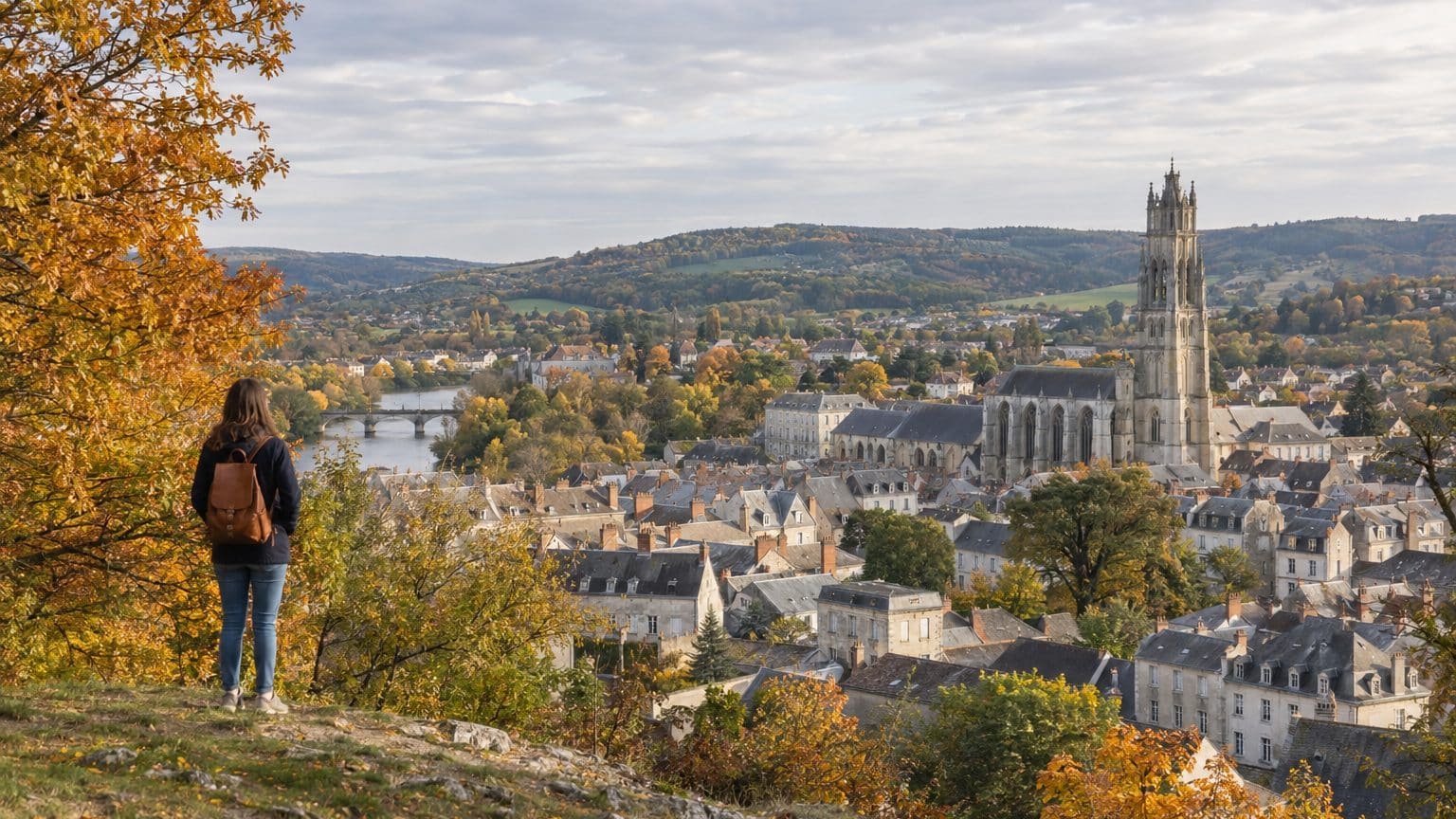
A view of Agen where the Saint-Caprais Cathedral stands out, in color, dated 1877: the 19th century was not always gray. Louis Ducos du Hauron achieved it with three photographs, taken through three different color filters—green, orange, and violet. The three shots, recombined, reproduced the hues of the scene.
No colorization involved here, only chemistry and optics.
- Louis Ducos du Hauron takes three photographs of Agen Cathedral through green, orange and violet filters.
- The three pigment-positive prints, layered, reproduce the colors of the scene in 1877.
- The 1868 patent predates by several decades the Lumière brothers’ Autochromes.
Three Filters, Three Images, a Single Color
The technique was called heliochromy with carbon pigments. The photographer photographed the same scene through a green filter, then an orange filter, then a violet filter, each negative retaining only what passed through its filter. He then produced three positives on bichromated gelatin pigment prints, one red, one yellow, one blue. When layered, they formed a multilayer image.
The method is subtractive: each pigment layer absorbs part of the light that passes through it, and the combination of the three layers reconstructs the colors. Your inkjet printer works on a similar principle, stacking color inks on paper. Yet there is a difference in scale, since Ducos du Hauron worked the gelatin by hand, pigment by pigment, and three films had to be aligned to the millimeter.
The discovery of chromatic sensitization by Hermann Wilhelm Vogel in 1873 greatly facilitated the three-color analysis on which all his methods depended. Four years later, the Agen view left his workshop.
An 1868 Patent, a Session Shared with Charles Cros
Louis Arthur Ducos du Hauron was born in Langon, Gironde, on December 8, 1837, and died in Agen on August 31, 1920. Agen is therefore not a mere backdrop of his life: it is the town where he died, 43 years after the cathedral view. It is there that he left the bulk of his photographic work, including the three prints that the George Eastman Museum preserves today.
On November 28, 1868, he filed patent No. 83061. He published it in 1869 under a title without modesty, “Colors in Photography, a Solution to the Problem.” On May 7, 1869, he presented his process to the French Society of Photography, the same day as Charles Cros. Cros, trained as a poet, is recognized as one of the pioneers of color photography by tri-chrome selection.
The Lumière brothers’ Autochromes relied on one of the methods Ducos du Hauron had patented in 1868. The Lumières presented them to the Academy of Sciences on May 30, 1904.
What is Known About the Image, and What is Unknown
The George Eastman Museum houses several prints linked to this view. Its catalog lists a print titled “[Agen, France]”, dated 1877 (No. 1981.0285.0001), and two prints titled “Panoramic view of the town of Agen… St. Caprais”, dated around 1877 (Nos. 1980.0077.0001 and 0002). The “ca.” stands for “circa”: the curators do not commit to more than an approximation for these two.
Only the year, 1877, is firmly established.
The question of the vantage point remains. According to Wikipedia, the shot would have been taken from an attic window, while the Ducos du Hauron association and the Lot-et-Garonne tourist office place it on the Ermitage hillside. Both versions agree on a height overlooking the city, and neither allows a final decision. The precise address of the house from which the shot was taken has not been established.
Another trap for those searching for the image online: not all versions date from 1877. There exists an enhanced version, printed in the 20th century from the original negatives. Beside it, a very worn old print, probably from the 1870s, also circulates.
Should one speak of the “world’s first color landscape photograph”? The shortcut circulates widely, but it goes beyond what the sources establish. The Agen view is the most widely reproduced of its preserved color photographs, which makes it one of the oldest color landscape photographs to have survived to the present, a less spectacular but defensible formulation.
What Remains to Be Seen in Agen
Saint-Caprais Cathedral has not moved: built in the 12th century, it has been listed as a historic monument since 1863. It was therefore already protected 14 years before the photograph was taken. It is today part of the UNESCO-listed Routes of the Santiago de Compostela in France.
The Ermitage hillside also exists, and it is one of the two candidates for the vantage point. You can go there, look at the city and compare it with the 1877 view, keeping in mind that the exact location remains debated. The confrontation is worth the trip, if only to measure the distance between an 1877 plaque and a smartphone.
One last fact, and it will interest archive enthusiasts: in 2018, CNRS Le Journal indicated that the Agen Museum preserves about 20 photographs by the inventor in its reserve.
Sources: fr.wikibooks.org | picryl.com
