
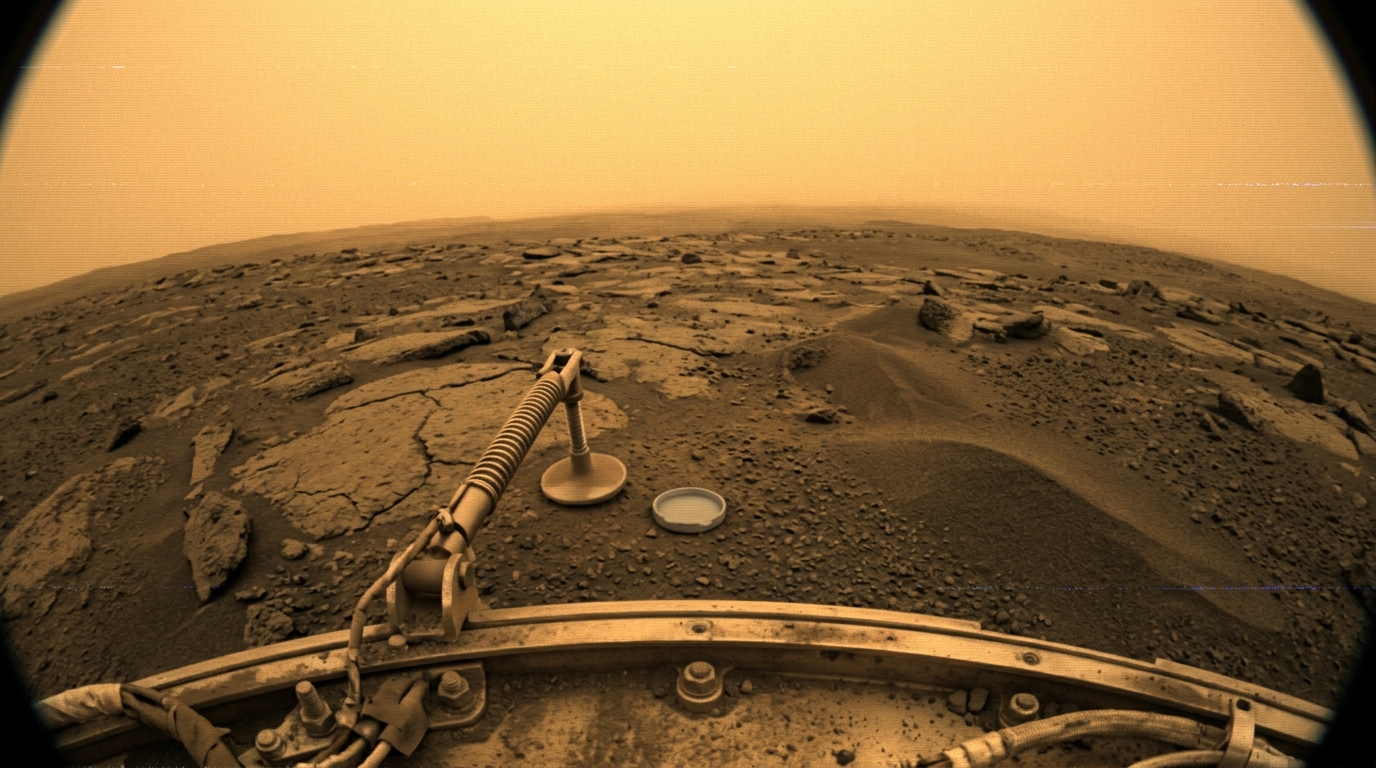
In 1982, the Soviet Union achieved a feat etched into the annals of space conquest: landing a lander on Venus, the most hostile world in the Solar System. Venera 14, the twin of the probe Venera 13 launched a few days earlier, touched down to the east of the Phoebe Regio region after a long voyage through space. Its mission appeared straightforward on paper: photograph the surroundings, analyze the chemical composition of the soil, and measure its hardness with a deployable arm equipped with a compressibility instrument. But what this device actually touched was almost a cosmic gag, and this little-known anecdote deserves attention as it wonderfully illustrates the hazards of space exploration.
- In 1982, the compressibility arm of Venera 14, by error, measured a camera cover that had been ejected and fell exactly beneath the instrument, rather than the Venusian soil
- Despite this incident, the lander survived 57 minutes in extreme conditions (465°C, pressure 90 times that of Earth) and still provided valuable data, notably about the soil’s basaltic composition
- The onboard microphones and geophones allowed measuring wind speed and recording a seismic displacement, suggesting possible geological activity on Venus
- An improbable sequence of events on a 465°C surface
- How a camera cap sabotaged a scientific experiment
- 57 minutes of survival in the Venusian hell: what the probe did manage to capture
- The mistake that revealed the limits of Soviet space exploration
An improbable sequence of events on a 465°C surface
To grasp the scale of the problem, one must imagine the hellish conditions under which Venera 14 had to operate. On landing, the probe encountered a surface temperature around 465°C, enough to melt lead without effort, and an atmospheric pressure 90 times higher than Earth’s. Add to that sulfuric acid clouds that render Venus’s atmosphere utterly unbreathable and corrosive. In these extreme conditions, each second of instrument operation already constitutes a technical feat.
The lander, weighing about 760 kilograms in a dry state, was nearly identical to Venera 13, which allowed the engineers to double their chances by building two craft from the same blueprint. The camera windows, crafted from heat-resistant quartz, were shielded by caps designed to eject just after descent to clear the field of view for the lenses. It was precisely when everything seemed to unfold as planned that fate intervened in the most absurd fashion.
How a camera cap sabotaged a scientific experiment
The spring-loaded arm tasked with measuring the compressibility of the Venusian ground was supposed to extend toward a precisely calculated point to make contact with the surrounding rock. Or almost comically, it was exactly at that spot that one of the camera’s protective caps fell back to the surface, ejected moments earlier. The instrument, programmed to probe the hardness of the terrain, ended up evaluating the mechanical properties of a simple plastic cap instead of the planet’s soil.
The most ironic aspect of this tale is that there was no technical malfunction to blame. The camera worked flawlessly, the pyrotechnic ejection of the cap occurred as planned, and the compressibility probe performed its task with exemplary accuracy. It is precisely because each system functioned perfectly that this scientific experiment was completely compromised. The camera cap dropped by Venera 14 landed exactly beneath the compressibility probe, which measured the cap rather than Venusian soil, leaving Soviet researchers with unusable data about that specific portion of their mission.
57 minutes of survival in the Venusian hell: what the probe did manage to capture
Fortunately, this mishap did not render the entire mission moot. The lander endured 57 minutes before being crushed by the immense surface pressure of Venus, and during those precious minutes, the other instruments managed to yield valuable data. The X-ray fluorescence spectrometer aboard, for instance, indicated that the soil’s composition bore a striking resemblance to tholeiitic basalt found on the floors of Earth’s oceans, offering a fascinating clue about the planet’s volcanic past.
Acoustic microphones, originally designed to record the ambient atmospheric noise, were able to determine the wind speed at the surface—a piece of data still rare today. Moreover, geophones deployed on Venera 13 and Venera 14 operated for the entire duration on the surface, and Venera 14 even managed to register a seismic displacement, suggesting that the planet might not be as geologically quiet as it seems.
The mistake that revealed the limits of Soviet space exploration
This misadventure with the camera cap illustrates, with striking clarity, how space exploration often hinges on an almost nonexistent margin for error. Soviet engineers had anticipated most hazards associated with Venus’s corrosive atmosphere and brutal heat, but no one had imagined that a simple object ejected by the spacecraft itself could compromise an entire experiment. This seemingly minor detail reminds us that even the most carefully prepared missions can be derailed by an almost random grain of sand—or, in this case, by a camera cap that ends up in the wrong place.
Beyond the anecdote, this episode also underscores the rigor and ambition of the Venera program, which nevertheless succeeded in delivering unprecedented images and data about a world long shrouded in mystery. The Soviet teams learned from each mission, progressively refining their instruments for subsequent missions, proving that even partial failures can fuel future scientific advances.
This story of a camera cap falling in the wrong place remains one of the most charming anecdotes in Venus exploration. It reminds us that, even in the Solar System’s harshest environment, it is sometimes the smallest details that write the finest pages of space history, straddling technological triumph and a nearly burlesque twist of fate.
