
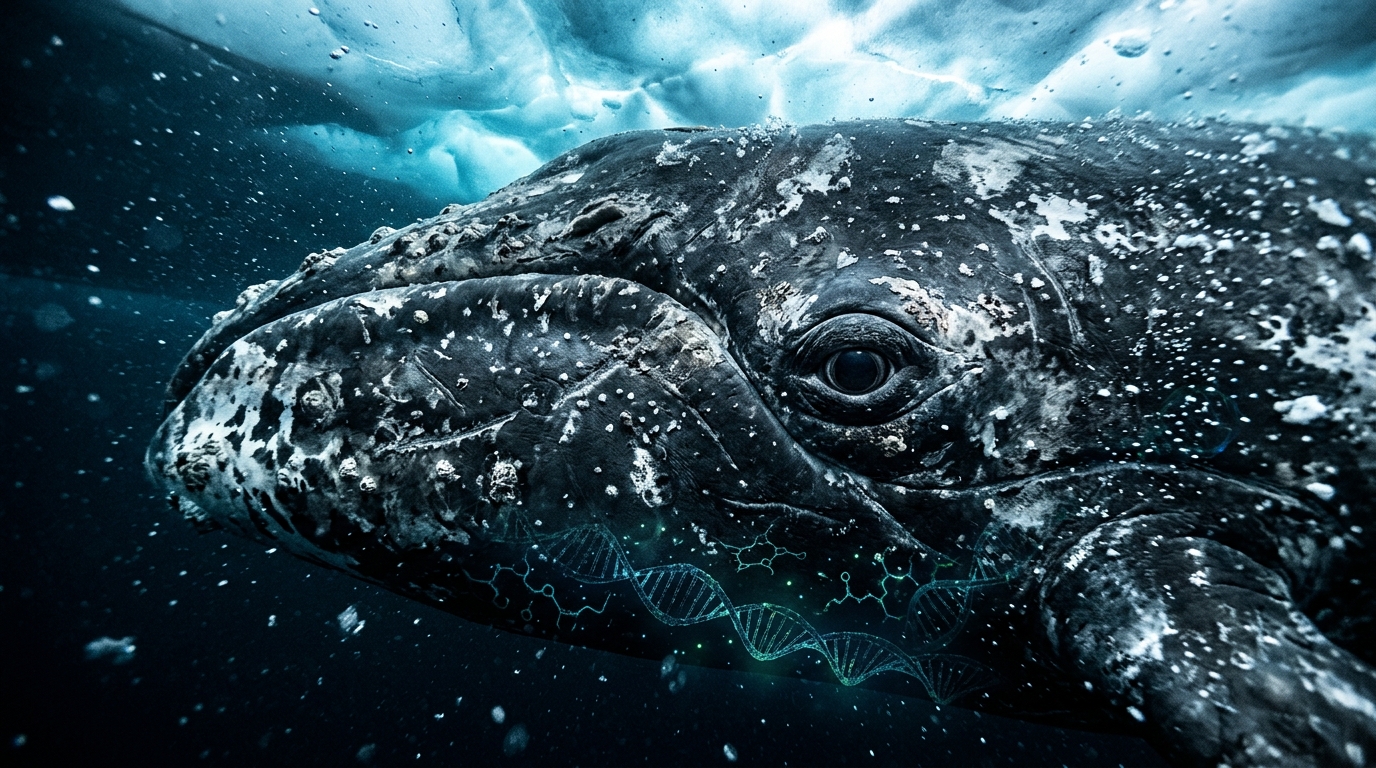
Imagine a creature born before the Battle of Waterloo, still gliding peacefully beneath the Arctic ice today. This isn’t science fiction but the reality of the bowhead whale, which can live for more than two centuries without developing cancers that would, in theory, overwhelm it much earlier. Because the bigger an organism and the longer it lives, the more cells it contains and the more cell divisions occur, thus increasing the chances of cancer-causing mutations. Yet this ocean giant seems to have found a workaround, and American researchers have finally begun to understand how.
- Bowhead whales can live over two centuries without cancer, defying Peto’s paradox
- The Arctic cold stimulates the production of CIRBP, a protein that repairs double-strand DNA breaks
- CIRBP works with the p53 protein to prevent mutation buildup, offering avenues for human cancer research
- A Whale Swimming Since the Napoleonic Era
- Polar Cold, the Secret Fuel for Cellular Repair
- CIRBP, the Protein That Corrects DNA Errors
- What These Ocean Giants Teach Us About Our Own Aging
A Whale Swimming Since the Napoleonic Era
Hard to believe, but some bowhead whales currently observed in the icy Arctic waters would have been born more than two hundred years ago. This astonishing longevity makes them one of the most time-tested mammals known, far ahead of humans and even most other cetaceans. Such an age naturally raises a central question in biology: how can a massive animal, built of billions of endlessly dividing cells, avoid the statistical cancer explosion typically seen in long-lived large mammals?
This phenomenon has a name in evolutionary biology: Peto’s paradox. It predicts that the more cells an organism has and the longer it lives, the higher its cancer risk should be. Yet in bowhead whales, this risk remains strikingly low, as if the species had developed particularly effective cellular protection mechanisms through its evolution. This is precisely the mystery that Vera Gorbunova’s team at the University of Rochester sought to unravel.
Polar Cold, the Hidden Fuel for Cellular Repair
Living in the Arctic’s frigid waters is not merely a feat of thermal insulation. According to Gorbunova’s team, the extreme cold to which these whales are constantly exposed would play a direct role in how their cells handle DNA damage. In most mammals, cold slows biological processes, but in bowhead whales it seems to stimulate the production of a particular protein involved in cellular repair.
The researchers conducted laboratory experiments on animal tissues to quantify the phenomenon precisely. Their results show that the levels of this protein rise significantly under conditions close to those encountered by the animal in its natural habitat. In other words, the cold is not just a constraint the whale has adapted to, but indeed a factor that activates its most sophisticated internal repair defenses, somewhat like polar cold serving as a trigger for a genuine repair factory inside.
CIRBP, the Protein That Corrects DNA Errors
The name of this miracle protein is CIRBP. Published in the scientific journal Nature, Vera Gorbunova’s team’s work reveals that bowhead whale cells contain a quantity far higher than that found in other mammals. This abundance is not incidental: CIRBP excels at repairing double-strand breaks in DNA, the most severe lesions the genetic material can suffer, those which, if not correctly fixed, often pave the way for cancer-causing mutations.
But the story does not end there. According to Gorbunova, instead of simply eliminating cells that become malignant as many species do, the bowhead whale favors a subtler strategy: keep its cells in good condition so that they simply do not accumulate mutations in the first place. CIRBP works hand in hand with another well-known protein among biologists, p53, often nicknamed the guardian of the genome, capable of triggering programmed cell death in precancerous cells. This duo acts as a double-check system, both preventive and corrective, which drastically limits the appearance of tumor cells.
What These Ocean Giants Teach Us About Our Own Aging
This discovery aligns with Vera Gorbunova’s ongoing research over the years, including work on cancer resistance in the naked mole-rat, another longevity champion in the animal kingdom. By studying these extraordinary species, scientists hope to identify universal mechanisms that could potentially be translated to other mammals, including humans.
The aim, obviously, is not to plunge us into icy waters to boost our CIRBP production, but to understand the biological pathways activated by this protein so that, ultimately, therapies could be developed to strengthen our own resistance to cancer. While the approach remains exploratory, it opens exciting prospects for aging research and the prevention of age-related diseases—areas that would greatly benefit from insights already tested and refined by millions of years of evolution.
Ultimately, the bowhead whale reminds us that nature still teems with secrets capable of challenging our certainties about aging and disease. While we search for answers in our laboratories, these silent giants have sailed beneath the ice for centuries, bearing a biology we are only beginning to decipher. There is little doubt that the years ahead of CIRBP research and its associated mechanisms will yield many more surprises for the scientific community.
