
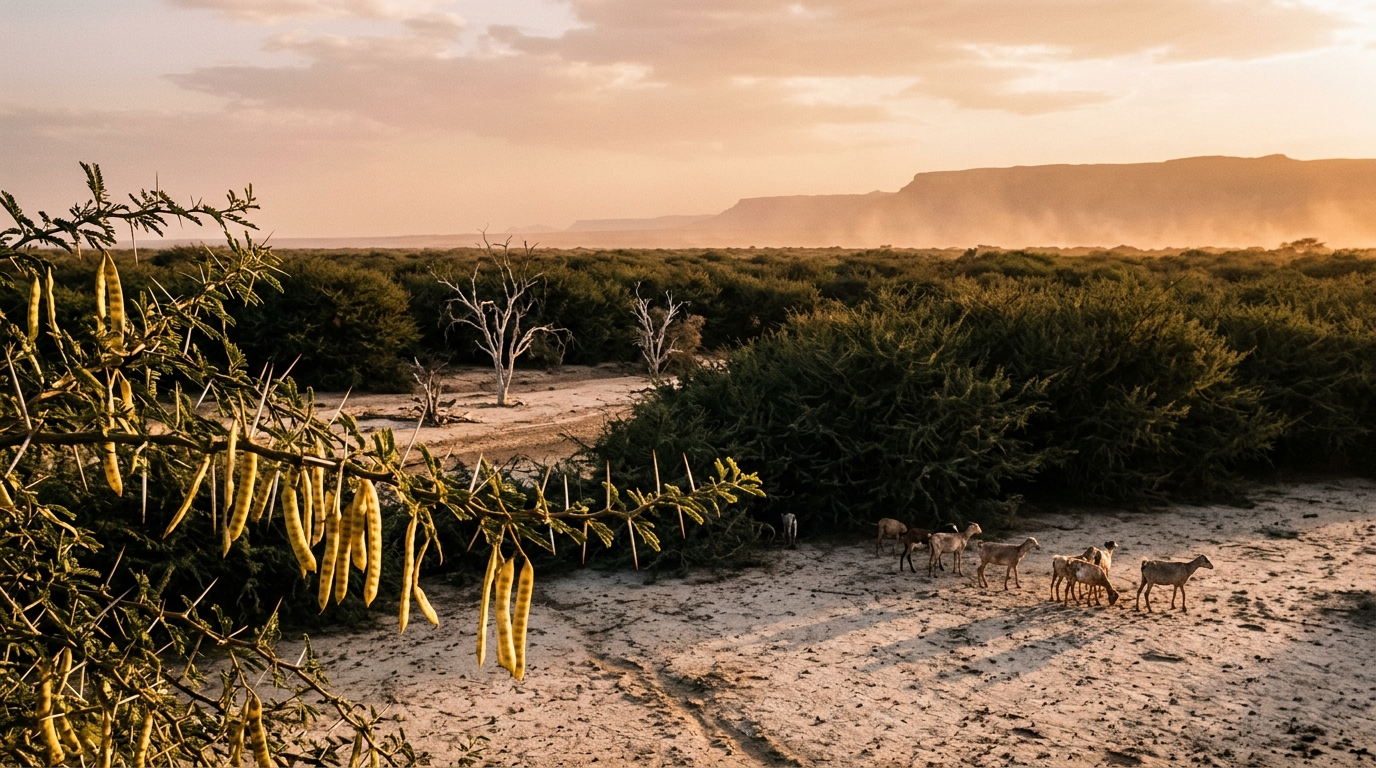
There are ideas born of good intentions that end up turning against those they were meant to help. That is exactly what happened in Ethiopia with Prosopis juliflora, a shrub native to Mexico imported in the 1970s to halt the desert’s advance. Nearly fifty years later, this same plant has colonized 1.2 million hectares of grazing land, dried out soils and deprived entire communities of their pastures. A story that could be mistaken for a remedy that turned out worse than the disease, and one that deserves careful consideration to understand its drivers.
- Introduced in 1979 to stabilise soils, Prosopis juliflora naturalised in the 1990s and has advanced by around 31,000 hectares per year.
- The shrub consumes between 3.1 and 3.3 billion cubic metres of water annually in the Afar region alone, drying soils and threatening 23 local plant species.
- Local initiatives such as the NGO FARM-Africa have eradicated 280 hectares and built three mills to process the plant’s pods.
- A shrub that came to save the desert ends up consuming Ethiopian pastures
- Why Ethiopia imported a Mexican shrub in the 1970s
- 31,000 hectares per year: the silent spread of Prosopis juliflora
- Dry groundwater and a grass that no longer regrows
- Afar herders trapped by a shrinking territory
In the Ethiopian lowlands, soil erosion and the advance of arid zones had already become a major concern for local authorities several decades ago. To counter this process, agronomic engineers of the time turned to a solution with proven results elsewhere in the world: plant a drought-tolerant shrub capable of growing in extreme conditions and stabilising land threatened by desertification. The choice fell on Prosopis juliflora, a hardy species native to Mexico and parts of Central America. On paper, the idea seemed sound. In practice, it opened the door to one of the country’s most notable plant invasions.
What stands out most is the scale of the mismatch between the initial intention and the result observed decades later. Far from simply stabilising fragile soils, the shrub gradually nibbled away at entire territories, eventually becoming a major ecological and economic problem for the country’s herders.
Why Ethiopia imported a Mexican shrub in the 1970s
To understand the reasoning behind this introduction, one must recall the context of the time. The Ethiopian lowlands, particularly in the Afar region, were suffering accelerated soil degradation worsened by overgrazing and harsh climatic conditions. Prosopis juliflora, with its deep roots able to anchor the soil and its exceptional drought tolerance, appeared as a natural solution to restore damaged areas.
In 1979 the operation really gained momentum. Thousands of plants were brought from a nursery set up in Hirna, in the Harerge region, and distributed throughout the Awraja Assebeteferi, especially in Amibera, Gewane, Afdem and East Awash. The objective was clear: stabilise soils, reduce erosion and give back an agricultural purpose to lands deemed lost. For several years the shrub seemed to perform its role. But what had not been anticipated was its ability to break free from human control.
31,000 hectares per year: the silent progression of Prosopis juliflora
From the early 1990s onward, only about twenty years after its introduction, Prosopis juliflora ceased to be a mere agricultural ally and became a full-fledged invader. The species naturalised and began to spread on its own, taking advantage of its remarkable resistance and its prolific seed production. According to Shiferaw et al. (CABI, 2019), the Mexican shrub expanded by about 31,000 hectares per year across the pastures belonging to Afar herders, at the expense of aquifers and grass. That growth rate becomes dizzying when accumulated over decades.
Today’s result stands at 1.2 million hectares invaded, i.e., between 3 and 5% of the country’s total area. In the Afar region alone, this invasion accounts for 12.3% of land surface, a substantial figure for a zone already stressed by difficult climatic conditions. It is far from the small experimental plot of the 1970s.
Dry groundwater tables and a grass that no longer regrows
If Prosopis juliflora poses such a problem, it is primarily due to its voracious water appetite. Accustomed to the arid environments of its native Mexico, the plant has developed a particularly effective root system to tap deep groundwater, well beyond what local grasses can access. A study showed that the shrub consumes between 3.1 and 3.3 billion cubic metres of water each year across the 1.18 million hectares invaded in the Afar region alone. The economic impact has also been estimated, ranging from $465,000 to $500,000 per year, merely for water resources diverted to a plant that has become uncontrollable.
This massive consumption does not come without consequences for surrounding vegetation. By exhausting available water reserves, the Prosopis literally starves other plant species of the resources they need to survive. In Amibara, the shrub ended up dominating at least 15 square kilometres of land, directly threatening 11 tree species, 6 shrubs and 6 types of grasses that historically sustained local herders and the region’s wildlife. It is an entire ecosystem that is being disrupted by the invasive presence of this plant, even though it was introduced to preserve something.
Afar herders trapped by a shrinking territory
For the pastoral populations of the Afar and Somali regions, who have long relied on extensive herding, the proliferation of Prosopis juliflora has tangible consequences on daily life. Traditional pastures, essential for feeding flocks, shrink year after year, gnawed away by dense, thorny groves that livestock cannot cross. Herders are consequently forced to travel ever greater distances to find forage, in an area where resources were already scarce.
In response to this worrying situation, local initiatives did arise. The FARM-Africa NGO notably supported residents in organising eradication campaigns, enabling the cleaning of 280 hectares in the region. Three mills intended to crush the pods of Prosopis were also built in Amibara and Gewane, turning what was seen as a nuisance into a potential resource for animal feed. Modest solutions in light of the magnitude of the problem, yet they demonstrate a readiness to regain control over a territory once thought to be restorable simply by planting a shrub from elsewhere.
This Ethiopian tale illustrates how human interventions in ecosystems can trigger cascading effects that are impossible to foresee at the moment of initial decisions. A shrub meant to hold back the desert ended up creating a new desert—filled with impenetrable thickets and dry soils where grasses once nourished livestock. A lesson that resonates far beyond Ethiopian borders, at a time when other countries continue to introduce exotic species in the hope of solving their own environmental challenges.

Sindre Halvorsen
I write about space exploration, frontier science and the technologies that are quietly shaping the future. From Norway, I follow the missions, discoveries and ideas that connect life on Earth with what lies beyond it. My goal is to make complex subjects clear, useful and worth paying attention to.