
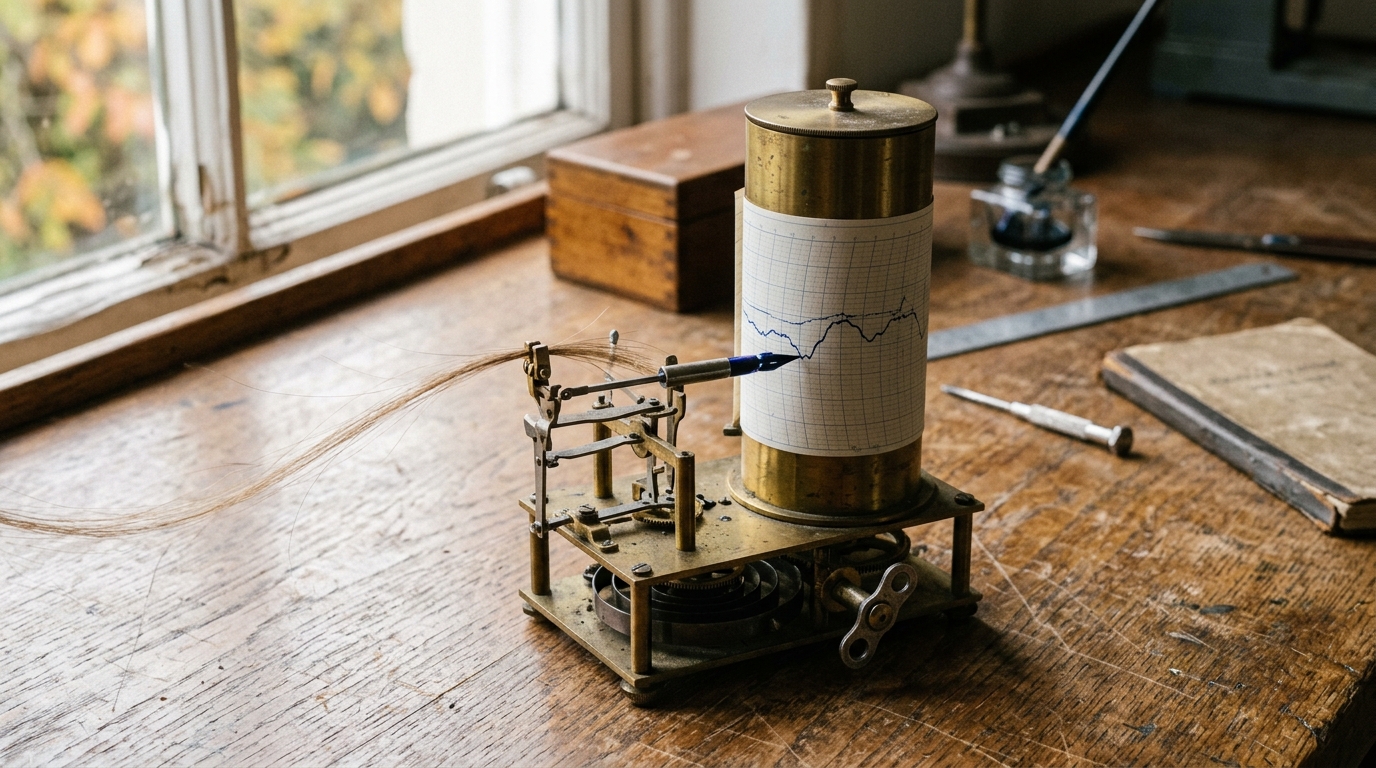
A hair hygrometer is an instrument that measures the humidity of the air using a simple strand of natural hair. The principle can be summed up in one line: the hair lengthens when the air becomes humid, and shortens when it dries. Nothing magical here, just a well-known physical reaction, exploited by meteorologists for more than two centuries. Behind this simple mechanism lies a device that long governed weather monitoring before electronic sensors arrived. Here is how a strand of hair could literally write the weather for an entire week.
- The hair is hygroscopic: it lengthens with humidity and shortens as the air dries.
- A lever system amplifies this movement and transmits it to a nib that traces a curve on a rotating cylinder over a week.
- This principle, described as early as 1783 by Horace-Bénédict de Saussure, equipped weather stations for decades before the advent of electronic sensors.
- A strand of hair capable of sensing the air’s humidity
- How the nib turns these variations into a weather record
- A faithful instrument that has accompanied decades of forecasts
A strand of hair capable of sensing the air’s humidity
The human hair holds a precious property for meteorology: it is hygroscopic, meaning it absorbs or releases the moisture present in the air. When the humidity level rises, the hair absorbs water molecules and lengthens very slightly. When the air dries, it loses this moisture and retracts. This variation remains tiny, on the order of a few percent of the total length, but it is sufficiently regular and predictable to be exploited. This is the whole point of the hair hygrometer: the hair doesn’t guess anything; it reacts physically to its environment. Météo-France preserves in its collections a hygrograph equipped with a 25-centimeter wick, chosen precisely for its sensitivity and regularity to humidity variations.
How the nib turns these variations into a weather record
A strand of hair that moves by a few millimeters is difficult to observe with the naked eye. That is where an amplifying mechanism comes in, the technical heart of the device. This lever system multiplies the tiny movement of the hair to transform it into a clear and readable displacement. This amplified motion is then transmitted to a nib, positioned at the end of a hinged arm. The nib then traces a continuous line on a cylinder wrapped with millimeter paper. This cylinder completes a full revolution in one week, allowing a continuous record of humidity variations over several days without human intervention. The result resembles a sinuous curve, where every dip and bump tells of a drier or more humid episode. The air, in a sense, writes its own history on the paper.
A faithful instrument that has accompanied decades of forecasts
This principle is far from a recent trick or a trivial invention. EPFL indeed preserves a hair hygrometer of the type described by Horace-Bénédict de Saussure in 1783, proof that the idea of using a hair to measure humidity goes back more than two centuries. For decades, these hair hygrographs equipped weather stations and observatories, providing reliable readings without electricity or electronics. Their robustness and simplicity made them reference tools long before the arrival of digital sensors today—more precise but also more fragile in the face of failures. Yet one thing to keep in mind: a response to humidity is not a forecast of rain. The hair hygrometer informs about the state of the air at a given moment; it does not predict tomorrow’s shower. It is a measuring instrument, not a crystal ball, and it is precisely this rigor that allowed meteorologists to build reliable long-term histories.
Behind this almost artisanal object lies a precision mechanism capable of turning a biological phenomenon into usable scientific data. The hair hygrometer reminds us that modern meteorology was built on patient observations and ingenious solutions, long before the era of all-digital. A simple hair, a nib, and a week of silent writing: this is how the air concretely told what was brewing in the atmosphere.
