
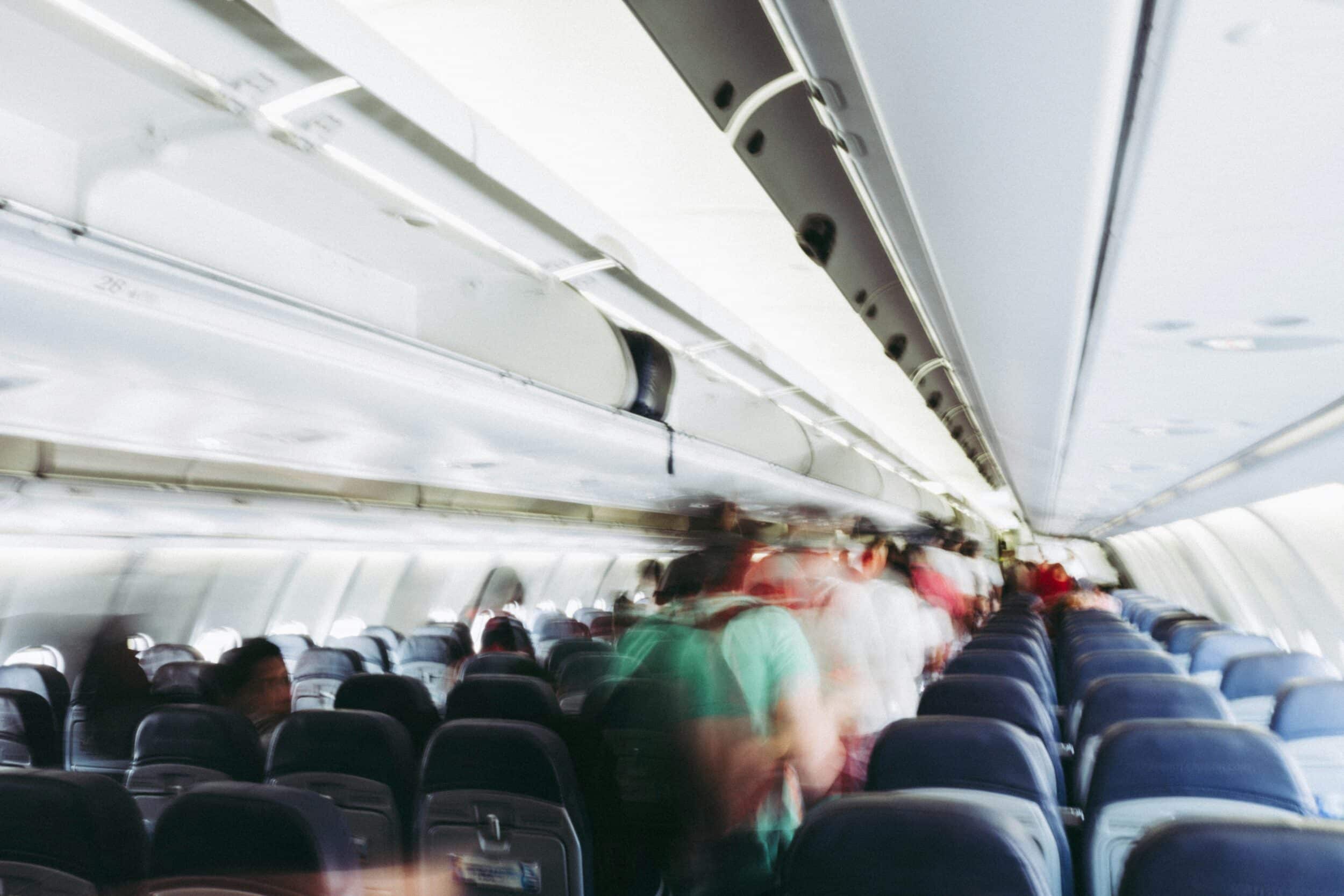
In 1970, boarding a plane took 15 minutes. Today, the same operation often takes 40. A master’s student at the University of Florida has simulated three boarding methods on a 186-seat Airbus A320 — and the results directly contradict what almost all airlines do. The problem isn’t technical. It is deliberate.
What you will learn
- What Adam Jacobs’s viral simulation reveals about the three major boarding methods
- Why airlines deliberately maintain an inefficient system
- What the Steffen method is and why it is still not implemented
Forty minutes to board a plane: an organized regression
Boarding has not always been this grueling journey. In the 1970s, fifteen minutes was enough to fill a plane. Today, the same operation takes on average two to three times longer, and the trend has been worsening year after year.
This decline isn’t the result of chance or collective incompetence. It stems from precise economic decisions made by airlines that turned a simple logistical procedure into a revenue stream.
The simulation that everyone agrees on
Adam Jacobs, a master’s student at the University of Florida, designed a computer model simulating the boarding of 186 virtual passengers onto an Airbus A320neo. Three methods were compared in real time: random, back-to-front, and the Steffen method.
The results are unequivocal. The random method — where everyone boards whenever they want — filled the aircraft in 17 minutes and 59 seconds. Back-to-front boarding, intuitively perceived as the most logical, required 31 minutes and 15 seconds. As for the Steffen method, it completed the operation in 11 minutes and 16 seconds.
The most logical method is actually the worst
Zone-based boarding — back-to-front — is the one most travelers deem the most rational. The simulation demonstrates the opposite in spectacular fashion.
The problem is structural: when several passengers from the same row reach the aisle at the same time, they block each other while stowing their bags. The hallway becomes a permanent bottleneck, with each row reproducing the exact same blockage.
The Steffen method: brilliant in theory, inapplicable in practice
Developed in 2005 by Jason Steffen, an astrophysicist at the University of Nevada, this method rests on a counterintuitive principle: board the window-seat passengers first, in alternating rows, so everyone can stow their bags without blocking the aisle.
By spacing passengers in time and space, the method halves boarding times according to simulations. Steffen had adapted to aviation the modeling tools he used to study exoplanets.
But the method stumbles on human realities. It forces family members to board separately. It requires a meticulous pre-boarding sorting of passengers at the gate — an operation in itself that consumes time. And it assumes each traveler behaves like a perfect mathematical point, without oversized luggage, without reduced mobility, without children.
The true reason nothing changes
The real explanation comes down to a single figure: 2008. That’s the year when major American airlines started charging for checked baggage. Overnight, passengers overwhelmingly opted for carry-on luggage, saturating the overhead bins and turning boarding into a contest for space.
Facing this pressure, airlines came up with the idea of selling priority boarding. What was once a logistical advantage became a commercial product. Zones, groups, and priority statuses proliferated — not to speed up boarding, but to monetize travelers’ anxiety.
Massoud Bazargan, a professor at Embry-Riddle Aeronautical University, sums up the situation bluntly: airlines realized they could make money from luggage, and that made any improvement to boarding structurally impossible.
A problem of greed, not engineering
The science of boarding exists. The solutions are known, modeled, and published for twenty years. What’s missing isn’t technical innovation — it’s the will to apply it.
As long as priority boarding yields more revenue than the cost of minutes wasted on the tarmac, airlines have no incentive to change the system. Passengers, for their part, will continue to pay — in time and money — for a problem the industry itself created.
