
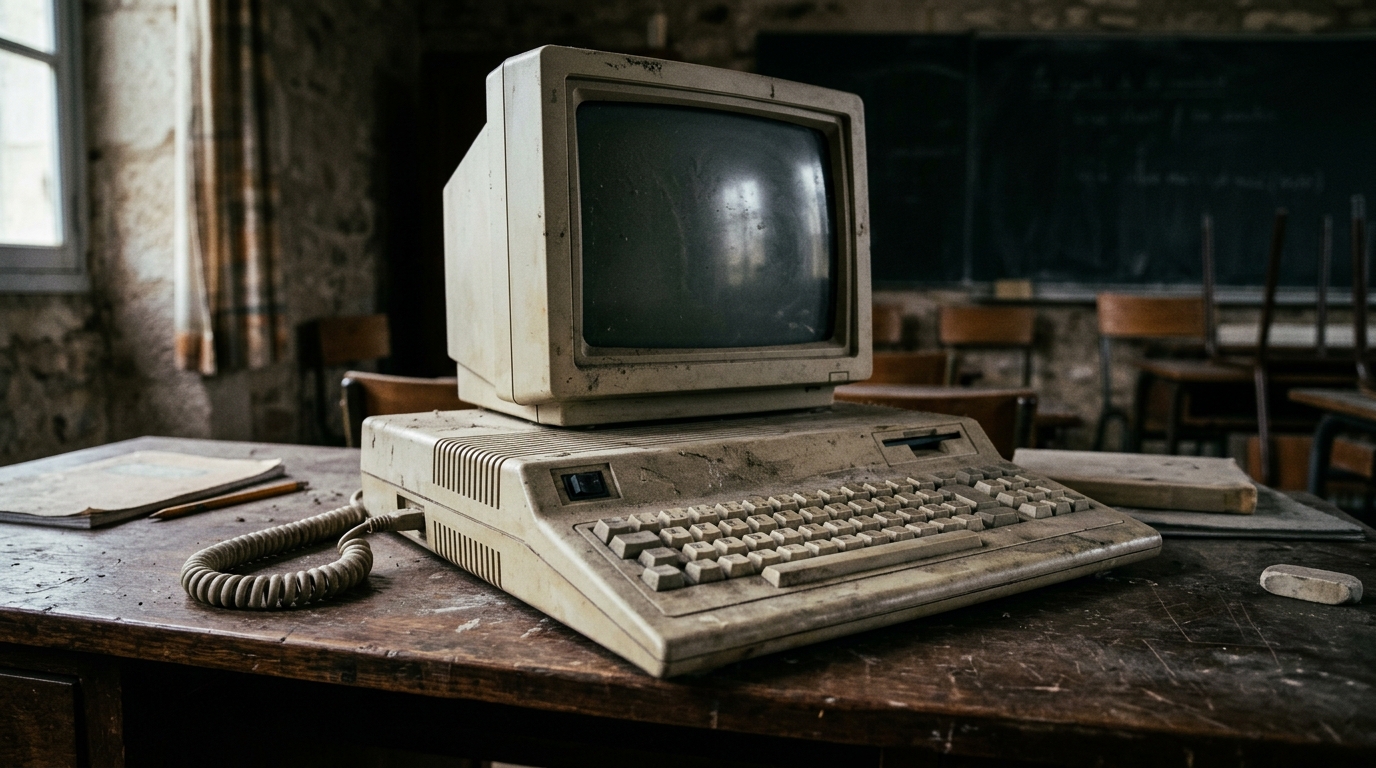
A grey and beige case, a pressed‑for‑space cathode-ray tube screen that hums, a compact keyboard bearing the Thomson logo: for an entire generation of French people, this image remains linked to the computer rooms of middle and high schools in the 1980s. Behind this somewhat dated silhouette lies, however, one of the most ambitious industrial and educational plans ever launched in France. Named Informatique pour tous, this program was designed to usher the entire country into the digital era by outfitting schools on a large scale and training tens of thousands of teachers. A plan as exciting as it was risky, whose history deserves to be told in detail, for it reveals a lot about our sometimes troubled relationship with technological innovation.
- Announced on January 25, 1985 by Laurent Fabius, the plan aimed to equip 50,000 institutions and train 110,000 teachers by the next school year
- Thomson (MO5, TO7/70) and Bull were chosen as suppliers, but the 8‑bit machines were quickly deemed outdated in the face of international competition
- In 1989, Thomson withdrew from microcomputing, triggering the plan’s definitive end after only four years of existence
- A political gamble worth 1.8 billion francs
- Thomson, the controversial choice that angered professionals
- Machines in classrooms, teaching to invent
- 1989, the brutal end of a national ambition
A political gamble worth 1.8 billion francs
On January 25, 1985, Laurent Fabius, then Prime Minister, officially presents this plan to the press. The stated ambition is colossal: to equip more than 120,000 machines across no fewer than 50,000 educational establishments, and this starting from September 1985, i.e., in just a few months. To give an idea of the scale of the project, it was not simply a matter of delivering hardware, but also of training 110,000 teachers by the same deadline—a logistical and pedagogical challenge absolutely considerable for the era.
Financially, the operation weighs heavily on the public budget: 1.8 billion francs in total, of which 1.5 billion is dedicated solely to computer equipment. Behind the numbers lies a clear political vision. It was not merely an educational project designed to introduce France’s 11 million students to the basics of computing, but also a tremendous boost to the national industry. In the midst of the international technological race, France intended to assert its digital sovereignty by relying on its own manufacturers rather than turning to foreign solutions.
Thomson, the controversial choice that vexes professionals
To bring this project to fruition, the State entrusted the delicate task of selecting industrial partners to Gilbert Trigano, cofounder of the Club Méditerranée. A choice that may surprise at first glance, given his background seems distant from the world of microcomputing, but it vividly illustrates the political will of the time to mobilize renowned entrepreneurial figures to carry a State project. Thus Thomson was chosen as the main supplier of the computer workstations, with its MO5 and TO7/70 models, while Bull was responsible for providing the network servers.
Technically, the system rested on what was called a nanonetwork, a solution allowing up to 32 machines to be connected at a speed of 500 kilobits per second. On paper, and indeed in practice, this network architecture was praised for its technical quality. The real weakness of the system lay elsewhere: in the choice of the terminals themselves. The Thomson MO5, based on an 8‑bit architecture, was quickly considered outdated by professionals in the sector, particularly in the face of international competition that already offered more capable and more intuitive machines. This technological gap would weigh heavily in the events to come.
Machines in classrooms, a teaching model to invent
Beyond the purely hardware questions, the Informatique pour tous plan raises a major educational challenge: how to turn teachers trained in the humanities, sciences, or literature into true pioneers of digital culture? Training 110,000 of them in only a few months was almost an impossible mission, given the wide disparities in skill levels and appetite for the computing tool within the teaching corps. Many discovered, at the same time as their students, the basics of programming or the use of these odd beige machines installed in a corner of the classroom.
This period remains nonetheless memorable for many students of the time, who learned during this period their first rudiments of computer logic, sometimes through the Logo language or simple programming exercises. If the pedagogical results varied according to schools and team commitment, the plan undeniably laid the first stones of a school digital culture in France, well before the personal computer entered homes.
1989, the brutal end of a national ambition
The final blow came from the industrial side rather than the pedagogical. In 1989, Thomson decided to abandon microcomputing altogether, unable to resist international competition and the rapid technological evolutions of the market. This decision effectively marked the end of the Informatique pour tous plan, deprived of its main hardware supplier just four years after its grand launch.
The assessment of this venture remains mixed. On the one hand, a massive investment of 1.8 billion francs, of which 1.5 billion was for hardware alone, which allowed thousands of establishments to be rapidly outfitted and a generation to become familiar with the computing tool. On the other hand, a poorly calibrated industrial choice, rapidly obsolete machines, and support for the national industry that ultimately was not enough to save Thomson from leaving the sector.
With hindsight, the Informatique pour tous plan appears as a powerful mirror of the tensions between political ambition, industrial realities, and accelerating technological change. Announced by Laurent Fabius on January 25, 1985, funded to 1.8 billion francs with 1.5 billion dedicated to hardware, the program lasted four years before fading away in 1989 when Thomson left microcomputing. A story that still resonates today, as France continues to question its digital sovereignty and the best way to equip its schools in the face of international tech giants.
