
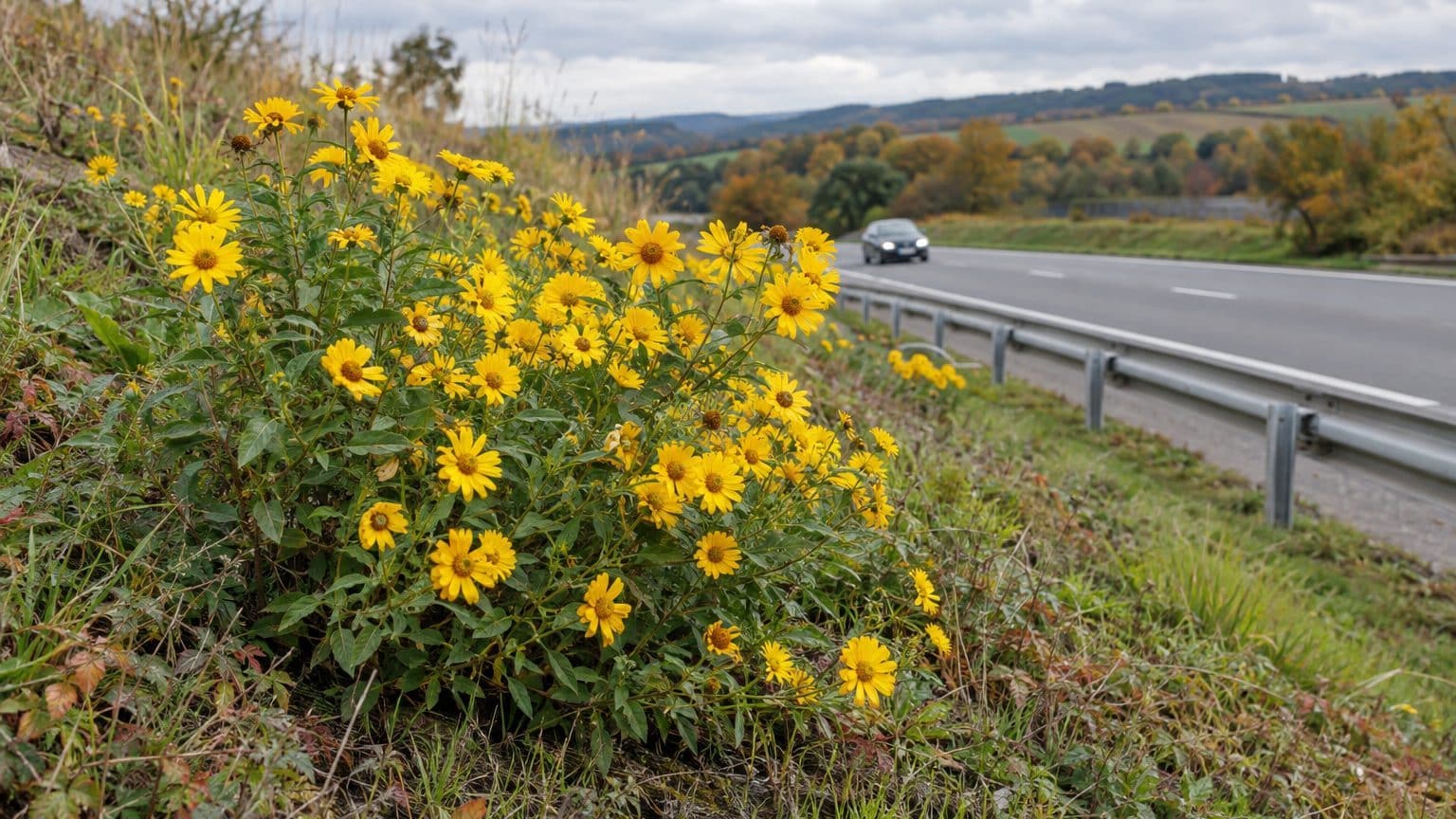
- Cape senecio arrived in France between 1934 and 1936 via South African sheep wool.
- The plant spreads along railways and motorways thanks to its light seeds carried by the wind.
- Its pyrrolizidine alkaloids are toxic to the livestock liver, hence the ban on mowing it for fodder.
Seeds hidden in South African wool
These yellow flowers that edge highway embankments did not always grow there. Senecio inaequidens, the Cape senecio, comes from South Africa. It arrived in France between 1934 and 1936 in the form of seeds attached to wool fleeces imported by the wool mills of Calais and Mazamet.
A clandestine journey, inside bales of wool.
Calais and Mazamet, in the Tarn, imported fleeces from South Africa to fuel their workshops. Bremen and Verviers, elsewhere in Europe, received the same type of cargo. The very light seeds cling easily to the fleeces, and the plant remained for a long time confined to port zones, wool transfer areas, and textile factories. No one saw them arrive, and it was near the factories that they germinated.
According to Wikipedia, the species was introduced to Europe for the first time in Germany in 1889, before France in the 1930s. France was thus not the first hit, but a town in Tarn gave the plant its second name—the Mazamet senecio.
Dates vary between sources. Some texts mention 1934 around Mazamet, others place it at the end of the 1930s, and still others speak of an arrival “around 1930.” In every account, the scenario remains the same: an accidental introduction linked to the wool industry.
From the factory yard to the roadside
For a long time, the plant stayed near its point of arrival. Then it took to the road, literally. In the 20th century, it spread mainly in southern and western Europe, using transport networks, especially railways. Beginning in the Mazamet region, it reached most southern departments, then climbed north along major highways.
Its seeds, equipped with a plume-like awn, travel with the wind.
On the D906, between Belleville and Mâcon, near Crèches-sur-Saône in particular, a band of tightly packed yellow flowers runs along the road. This carpeting isn’t composed of dandelions, but Cape senecio. The same scene repeats along kilometers of highway verges in certain regions.
The plant does the rest on its own. A perennial, it forms rounded clumps 30 to 150 cm tall, sometimes as tall as a child, and its capitula measure about 2 cm in diameter. Its flowering extends late into the season, as long as the frost does not get too severe, and some sources indicate it can bloom year-round.
As a pioneer species, it invades disturbed environments: waste grounds near stations, industrial wastelands, and road and highway edges. Its seeds are also dispersed by mammals with dense fur, giving it a second mode of transport.
Its advance does not stop at embankments. The city of Cergy-Pontoise recalls that its roots release substances that inhibit the growth of other species, and the vascular flora catalog of Île-de-France classifies it as invasive at level 3. It is even beginning to invade natural habitats.
The high plains of South Africa are its cradle. Researchers have taken an interest in its journey: a study published in September 2010 in the journal Molecular Ecology examined the genetic diversity of the species in its region of origin and in invaded territories. Its title speaks of the making of a fast invader. The authors are Susanne Lachmuth, Walter Durka and Frank Schurr.
A risk to the livestock liver
The plant contains pyrrolizidine alkaloids, compounds toxic to the liver, and livestock that feed on it in large quantities face acute poisoning. Several sources also describe it as toxic to humans, and Switzerland has placed it on its blacklist.
Mowing a slope infested with it should not end up becoming forage.
Pulling up or mowing: what managers recommend
According to the database on introduced species, pulling up and mowing are the interventions most frequently applied, according to the IUCN France in 2016. Pulling up is appropriate when colonization is just getting started, with only a few plants, and must be done before fruiting, before the end of June. The flowering stage of a pulled plant can fruit in 2 to 3 days, hence the instruction to bag the plants. Re-seeding with species that have a high covering power is recommended after pulling up.
Mowing does not kill the plant, but limits its spread by preventing it from producing seeds. After pulling up, seeds from previous years can germinate, so the operation must be repeated each year, for several years.
Sources: base-information-especes-introduites.fr | fr.wikipedia.org | natureenville.cergypontoise.fr
