
And what if one of the nineteenth century’s greatest feats of engineering had been halted not by a technical obstacle, but by a purely political anxiety? Imagine Welsh workers advancing meter by meter beneath the bed of the Channel, carried by a machine so far ahead of its time that it itself ventilated the gallery it was carving. We are at the dawn of the 1880s, and almost no one doubts that England and France will soon be linked by a submarine tunnel. Yet in the space of two years, this pioneering project stops abruptly, leaving behind roughly 1.8 kilometers of gallery cut into chalk, and a question that continues to fascinate industrial history enthusiasts: what on earth could have interrupted such a promising venture?
- The Beaumont-English machine, an air-pressure tunnel boring machine, bored about 1,893 meters of gallery beneath Shakespeare Cliff between 1880 and 1882 without major technical incidents.
- The project was abandoned not for technical or financial reasons, but due to British authorities’ fear that such a tunnel could become an invasion route for an enemy army.
- A portion of this Victorian gallery, including the adit A1, was ultimately reintegrated into the modern Channel Tunnel inaugurated in the 1990s.
- A Machine Ahead of Its Time Breaks Through the English Chalk
- When Technology Outpaces Political Confidence
- The Fear of Invasion That Derails the Project
- A Century Later, the Channel Tunnel Returns Through the Front Door
A Machine Ahead of Its Time Breaks Through the English Chalk
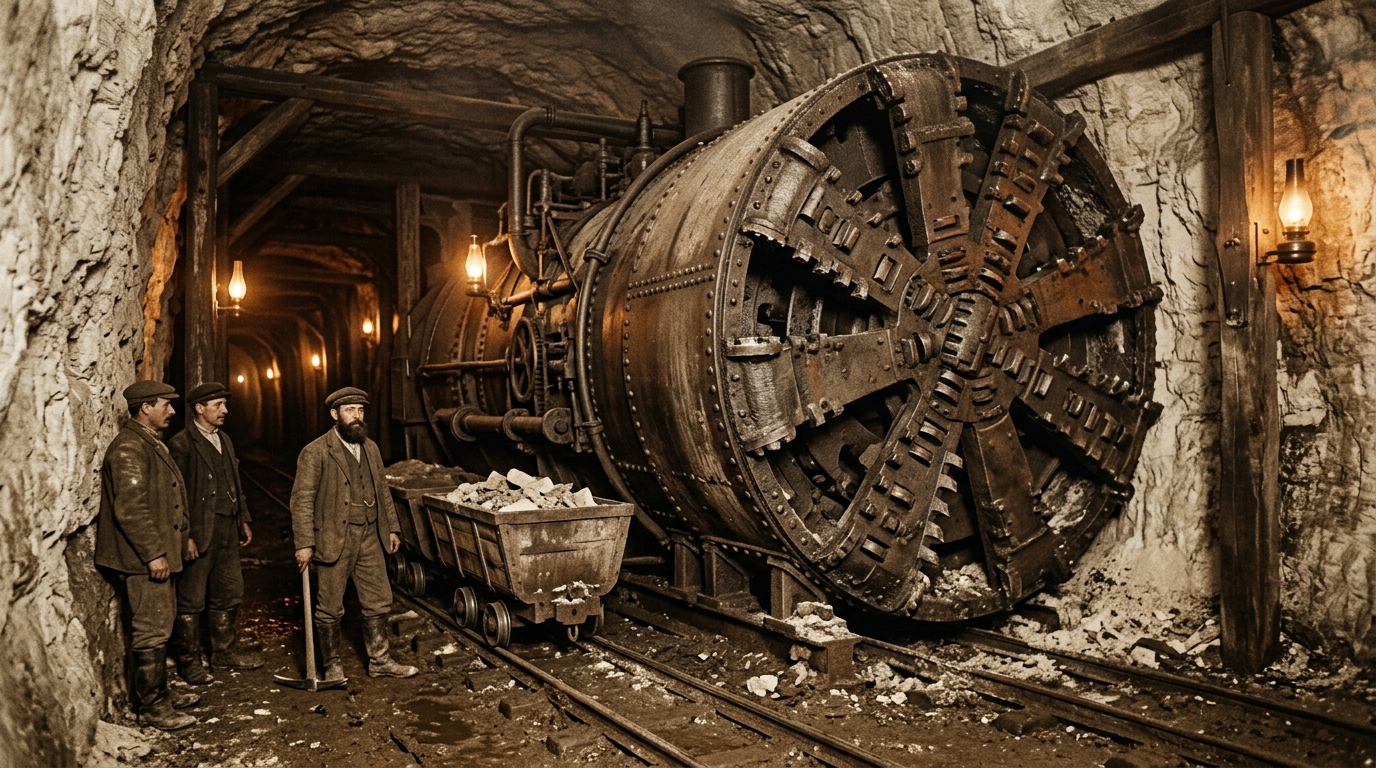
It all starts with an invention notable for its era: the Beaumont-English machine, a seven-foot-diameter air-compressed tunnel boring machine, just over two meters across. Patented under number 4347 by Captain Thomas English, this drill was activated on 14 October 1880, near Dover, during early trials at Abbots Cliff. The device looked unlike anything that had existed before: it boasted a rotating cutting head capable of gnawing rock and a conveyor belt to haul away the debris. It managed to dig roughly a meter of tunnel per hour—a pace impressive for the period—and did so with fewer than ten men at the controls.
In February 1881, after Welsh miners had already driven more than 240 meters of gallery, a second shaft was sunk at Shakespeare Cliff. The aim was ambitious: to begin from beneath the foreshore and reach, halfway across the Channel, the pilot tunnel driven on the French side. The machine’s major technical advantage lay in its energy source: compressed air produced no toxic smoke, unlike steam engines or the explosives used elsewhere. Even more, once the air was released after use, the mechanism naturally ventilated the gallery as it advanced, a crucial detail for the safety of workers laboring tens of meters below sea level.
When Technology Outpaces Political Confidence
On purely technical grounds, the project was a success. The Channel Tunnel Company, which carried the project, hoped to see the pilot gallery completed by 1886—a schedule that, given the machine’s performance, seemed entirely realistic. In total, the tunnel boring machine had drilled a gallery of 1,893 meters from Shakespeare Cliff, nearly two kilometers cut into chalk rock that was notoriously challenging to work.
Yet behind this technical achievement hides a small quarrel, almost anecdotal by historical standards, that deserves telling. The project carried Beaumont’s name rather than English’s, even though English held the patent. The technical press of the era, notably the magazine The Engineer, attributed the machine to Beaumont, despite protest letters from English. The editor stubbornly refused to correct the error, and Beaumont, for his part, did nothing to clarify the matter. Even today, this pioneering attempt at tunneling beneath the Channel is often credited to the Beaumont machine alone, a shorthand that reveals how reputations can form, sometimes at the expense of truth.
The Fear of Invasion That Derails the Project
This is where the story takes a almost surreal turn. While the machine advanced methodically, with no major technical setback, neither the rock nor the finances provided justification for a stoppage. The real cause of abandonment, in 1882, was strategic and psychological. In British military and political circles, a fear gradually outweighed enthusiasm for the innovation: the fear that this tunnel could someday become a route of invasion for an enemy army.
The idea might seem far-fetched now, in the era of the Eurostar and daily exchanges between Paris and London, but it perfectly reflects the geopolitical tensions of the Victorian era. England, islanded by geography and doctrine, viewed this subsea tunnel as a potential fault line in its natural defenses. No matter the security protocols imagined or the diplomatic guarantees offered: the mere possibility that an enemy army could, in theory, use a subterranean passage to reach British soil was enough to sway public opinion. The project, though technically accomplished, was abandoned before completion, with authorities preferring to sacrifice a major industrial advance rather than court any military risk. This fear-driven decision sealed the Shakespeare Cliff tunnel’s fate for nearly a century.
A Century Later, the Channel Tunnel Returns Through the Front Door
Yet the story does not end with this failure. The vestiges of the Victorian endeavor did not vanish entirely: a portion of the gallery dug during the 1870s and 1880s at Shakespeare Cliff was reintegrated into the works of the modern Channel Tunnel. The adit A1 and a short tunnel built in 1974 were incorporated into the new excavations carried out using the Austrian method, NATM, during the construction of the current Channel Tunnel, inaugurated in the 1990s.
There is something deeply symbolic in this continuity of technique. More than a century after the fear of invasion toppled Beaumont and English’s ambitions, 20th-century engineers literally took up the thread of this abandoned work, proving that the original vision was not chimerical, merely premature in the face of the political reticence of its era. What technology had made possible in 1882, diplomacy and mutual trust between the two nations ultimately rendered acceptable a century later.
Ultimately, the Shakespeare Cliff tunnel episode beautifully illustrates how an engineering feat can meet not the laws of physics, but the more intricate laws of distrust between nations. The Beaumont-English machine demonstrated that it was possible to dig beneath the Channel with striking efficiency for its time, without toxic fumes and with integrated ventilation. It was not the cost of the project nor the hardness of chalk that defeated it, but fear—deeply embedded—of an army someday emerging through the same passage. A historical lesson that invites us to wonder how many other innovations, even today, face obstacles not of technique but of profoundly human reluctance.
