
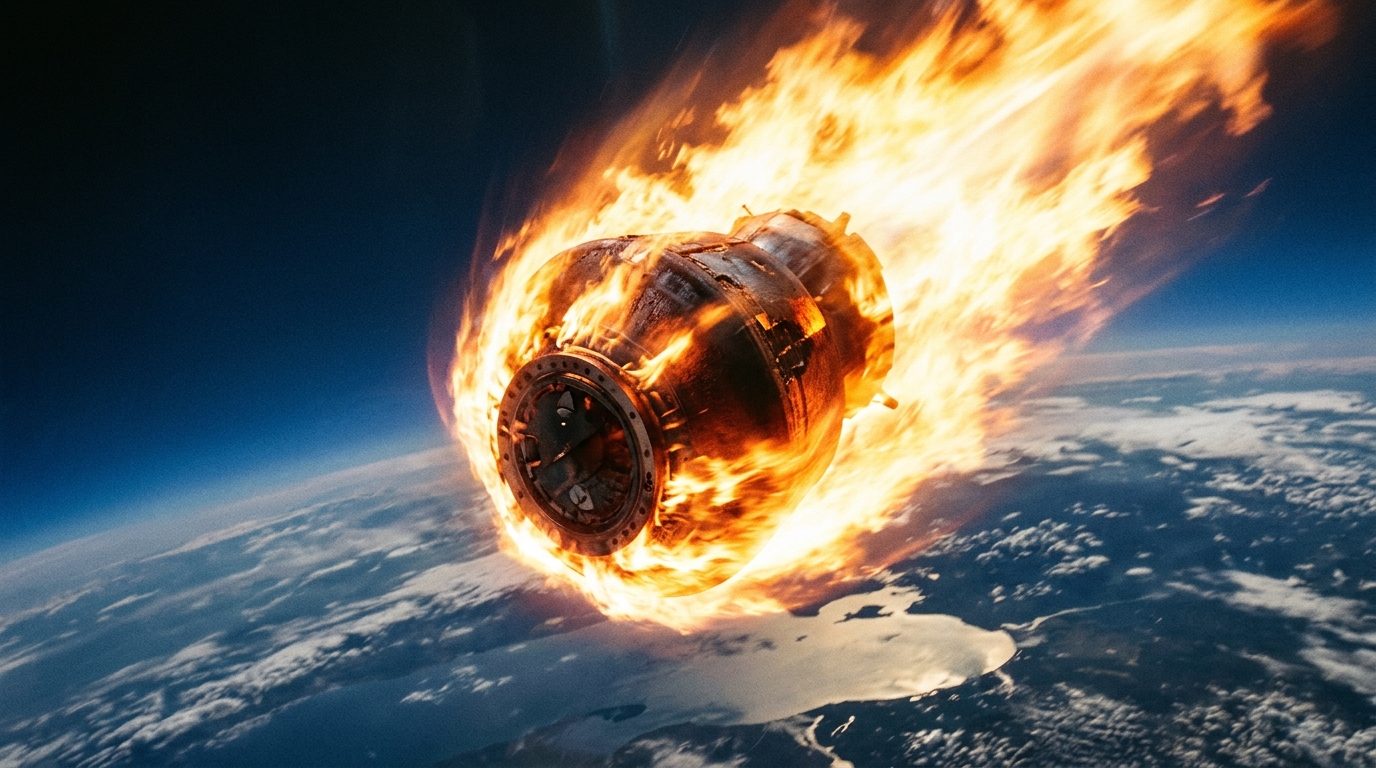
A Soviet cosmonaut literally walked through the flames to return alive to Earth, and it was neither his calm under pressure nor ground-based intervention that saved him. Boris Volynov found himself alone at the helm of a spacecraft that threatened to burn up around him, victim of a mechanical fault no one had anticipated.
- The Soyuz 5 service module did not detach properly, leaving the hatch exposed to the heat during reentry.
- It was the thermal stresses that eventually broke the connections between the modules, allowing the craft to right itself before impact.
- Boris Volynov broke several teeth during a brutal landing far from the planned zone, but survived and flew again in 1976.
- A Reentry That Was Destined to End Badly
- The Service Module Refuses to Detach
- An Improbable Rotation That Changes Everything
- The Landing That Breaks Teeth but Saves a Life
There are space missions that etch themselves into history thanks to technical prowess, and others that remain in memory for the fear they provoked. The Soyuz 5 flight clearly belongs to the latter category. Launched from the Baikonur Cosmodrome with Boris Volynov, Alexei Eliseev, and Evgeny Khrunov aboard, the craft first achieved a remarkable feat before an Earth return that unfolded like a catastrophe scenario. Between technical triumph and a brush with disaster, the mission beautifully illustrates how the early days of space exploration rested on a fine line between audacious engineering and sheer luck.
A Reentry Destined to End Badly
All seemed to start on a positive note. The day after launch, Soyuz 5 achieved the world’s first crewed docking with Soyuz 4, a feat that allowed Eliseev and Khrunov to join the adjacent spacecraft during an EVA. This maneuver, hailed at the time as a major milestone of the Soviet program, suggested a straightforward return for the three men. Yet fate had other plans for the man left behind.
Once his two teammates reentered Soyuz 4, Boris Volynov was effectively isolated inside the capsule, tasked with piloting the return to Earth solo. It was at that precise moment that trouble began, turning a routine procedure into a real fight for survival. No one aboard or on the ground could have imagined the magnitude of what would follow.
The Service Module Refuses to Detach
During reentry, a major technical incident occurred: the Soyuz 5 service module failed to detach properly from the descent module. According to information provided by Wikipedia, this failure stemmed from a malfunction of the explosive bolts intended to free the two parts of the spacecraft. A technical detail that, at first glance, might seem trivial, but proved absolutely critical in the context of high-speed atmospheric entry.
To grasp the gravity of the situation, imagine a spacecraft designed to shed its scientific section before facing the intense heat of atmospheric friction. Without this separation, the combined vehicle became heavier and, more importantly, poorly shaped to withstand the heat generated by friction. As a result, the craft began its descent nose-first, a completely unsuitable orientation that exposed the hatch—and thus Volynov himself—to the flames. The cosmonaut found himself suspended by his restraints, powerless to correct the trajectory as the heat swelled around him.
An Improbable Rotation That Changes Everything
At that moment, physics—not human piloting—decided Boris Volynov’s fate. Under the extreme thermal stresses acting on the structure, the still-attached links between the two modules finally gave way. This rupture, as abrupt as it was unforeseen, allowed the descent module to finally straighten into the correct configuration, heat shield forward, as it should have done from the start.
But this providential reversal did not come without damage. The connections between the modules burned away, and the capsule ended up resting on its shield, yet the brutal impact on the ground cracked Volynov’s teeth. Even before this final jolt, the hatch had already begun to be perforated by the extreme heat, a sign that the cosmonaut had been mere seconds from a far more tragic outcome. This vividly shows how the boundary between catastrophe and miraculous salvage could hinge on a sequence of mechanical coincidences, entirely independent of any human decision or intervention from the control center.
The Landing That Breaks Teeth but Saves a Life
As if the ordeals endured were not enough, the final phase of the descent brought further complications. The parachute system became tangled to some extent, reducing its effectiveness in slowing the capsule’s descent. To make matters worse, the retrorockets intended to ensure a gentle touch with the ground also malfunctioned. The combination of these two problems produced a shock of unusually high intensity at impact.
This brutal landing had direct, well-documented physical consequences for the cosmonaut, as several sources, including Wikipedia and EDN, confirm that Boris Volynov broke several teeth on impact. The capsule landed far from the initially planned zone in Kazakhstan, ending up in the Urals near Kostanay (present-day Kostanay City), according to Nimareja. Soviet authorities allegedly classified this episode for decades, as noted in an article on sciencepost.fr, highlighting the culture of secrecy that often surrounded space program incidents of that era.
What makes this story even more remarkable is Volynov’s subsequent career. Far from being so traumatized that he quit the profession, he returned to duty and flew again in 1976, this time aboard Soyuz 21, for a multi-week mission to the Salyut 5 station. A resilience that speaks volumes about the determination of the early cosmonauts in facing the substantial risks that still accompanied each crewed mission at the time.
This adventurous episode serves as a reminder of how the dawn of space exploration relied on technologies that were still in their infancy, where the slightest mechanical fault could transform a mission into a genuine struggle for survival. Boris Volynov’s tale remains today a striking testament to what space pioneers sometimes had to endure, far from the triumphant images usually associated with the early years of astronautics.
