
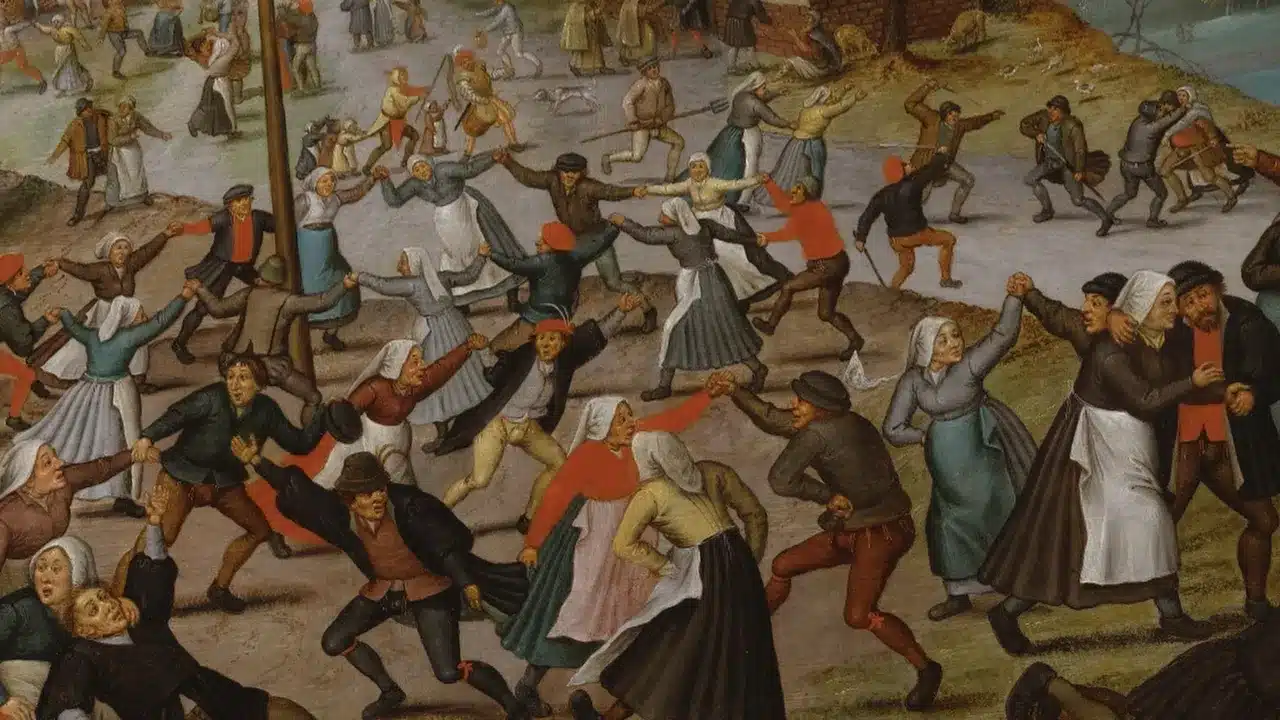
During the summer of 1518, in the city of Strasbourg, a woman began dancing alone in the street. She danced without stopping for several days. Then others joined her. Within a few weeks, hundreds of people were dancing unable to stop — some until total exhaustion, some to death. Local authorities responded by hiring musicians to accompany the dancers. Historians and physicians continue to debate today what really happened.
What you will learn
- What historical archives actually document about the dancing epidemic of 1518
- Which medical and psychological explanations have been proposed — and which one has today’s consensus
- What this episode reveals about the vulnerability of the human brain to social contagion under extreme stress
The archives leave no doubt about the facts
The Strasbourg dancing epidemic of 1518 is not a legend. It is documented by several independent contemporary sources — notes from Strasbourg’s city council, period chronicles, and medical observations — that the historian John Waller of the University of Michigan compiled and analyzed in his 2008 book A Time to Dance, A Time to Die.
According to these sources, it all began in July 1518 when Frau Troffea — whose full first name remains unknown — started dancing in a Strasbourg street. She danced for four to six days without stopping. Within weeks, between 50 and 400 people joined her — estimates vary by source.
The dancers did not seem joyful. Witnesses describe gaunt faces, exhausted bodies, people who continued to move despite evident distress. Some died from cardiovascular exhaustion, dehydration, or injuries. The city authorities, at a loss, initially rented dance halls and hired musicians — apparently believing that letting the dancers carry on would cure them.
This decision probably worsened the outbreak by giving it social legitimacy.
The ergotism hypothesis: alluring but insufficient
The first medical explanation proposed in the 19th century was ergotism — poisoning by the fungus Claviceps purpurea that contaminates rye and other cereals. This ergot contains alkaloids akin to LSD that can cause hallucinations, convulsions, and involuntary movements.
This hypothesis circulated for decades, notably applied retroactively to the Salem witch trials. It has a major problem: ergotism causes individual symptoms and convulsions, not a coordinated and contagious dance that spreads from person to person over weeks.
Furthermore, contemporary sources describe dancers who were aware of their state and unable to stop — not people hallucinatory and unaware of their surroundings.
Mass psychosis: the current consensus
The explanation that currently has consensus among historians and psychiatrists is mass psychosis — also known as mass psychogenic illness or collective hysteria.
John Waller, whose research published in The Lancet in 2009 provides the most comprehensive synthesis on the topic, argues that the dancing outbreak occurred within a context of extreme social stress. Alsace in 1518 faced repeated famines, outbreaks of syphilis and plague, and deep religious anxiety tied to belief in Saint Guy — a saint attributed with the power to curse people into dancing.
Within this context, Frau Troffea could have entered a dissociative trance — an altered state of consciousness produced by extreme psychological stress — that her culture interpreted as a Saint Guy curse. Other people sharing the same beliefs and stress would have developed the same symptoms through psychogenic contagion.
Psychogenic contagion: a real neurological mechanism
Psychogenic contagion is not a metaphor. Real physical symptoms — paralysis, convulsions, involuntary movements — can spread socially within groups that share a common belief and a common stress.
Documented cases analyzed in the New England Journal of Medicine and in the British Medical Journal show that this phenomenon still occurs today. In 2011-2012, several girls at a Le Roy high school in New York developed involuntary tics and spasmodic movements that spread socially — without an identifiable neurological cause, but with symptoms as real as those of organic diseases.
The underlying mechanism involves the motor cortex and the circuits that process emotions. Under sufficient stress, within a cultural context that provides an interpretive framework for the symptoms, the brain can generate authentic involuntary movements — not feigned, but produced by neural pathways normally reserved for conscious movement.
Why this could not happen again — and why it still happens
One might think that modernity and scientific medicine have eliminated this kind of phenomenon. That is not the case. Mass psychogenic outbreaks continue to be documented in communities under intense stress, sharing common beliefs about illness.
What 1518 illustrates with particular clarity is the brain’s capacity to generate real physical symptoms from shared social beliefs — and how culture determines the form that collective psychological distress takes. Today, that distress would take a different form. In Strasbourg in 1518, it manifested as a dance that no one could stop.
Sources
- A Time to Dance, A Time to Die — John Waller, Icon Books, 2008
- A Forgotten Plague: Making Sense of Dancing Mania — The Lancet, Waller, 2009
- Mass Psychogenic Illness — British Medical Journal, Boss
- Functional Neurological Disorder and Mass Psychogenic Illness — New England Journal of Medicine, Schrag & Trimble
