
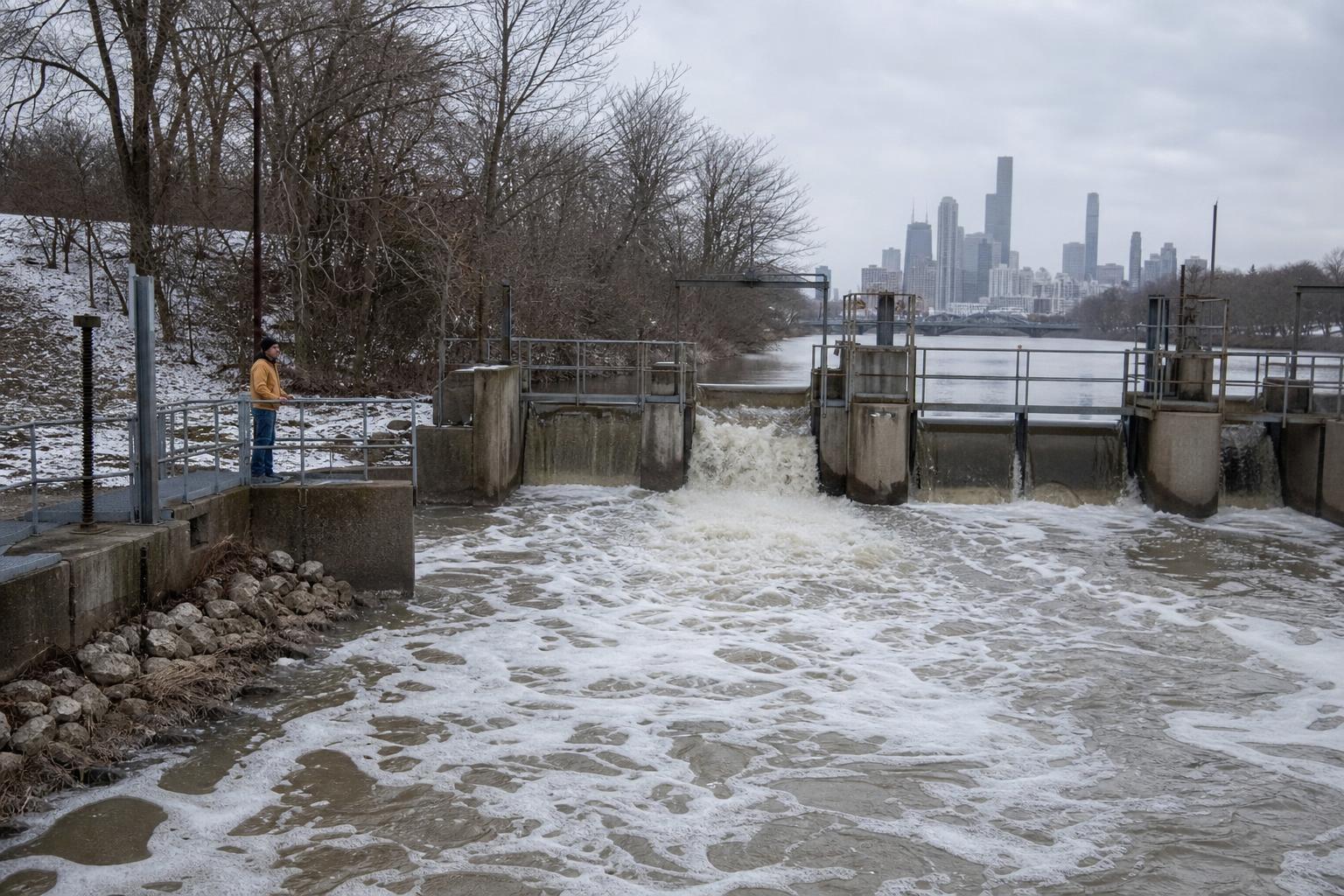
Chicago’s engineers pulled off a paradox in 1900, turning a fetid local river into a drain for a growing metropolis. The move felt like civic alchemy, a bold fix to a deadly public‑health crisis. It also felt like an insult downstream, a decision that would spark a lawsuit and a national debate over where one city’s responsibility ends and another’s begins.
A city in love with water, and poisoned by it
At the end of the nineteenth century, Chicago had speed, scale, and a river that reeked. The city pulled its drinking water from Lake Michigan while dumping its waste into the Chicago River. On hot days, “the river ran like a sewer,” and typhoid numbers told the truth. Engineers and politicians understood a hard fact: either clean the water or bury the city in disease.
So they sketched a fix as audacious as a skyline. If waste was killing people, send it the other way. If gravity was the problem, redesign the slope. “Turn the river around,” someone said, and the plan became law.
The flip that changed a watershed
The Sanitary and Ship Canal sliced through a shallow divide, tying the Chicago River to the Des Plaines and Illinois Rivers. Locks, sluice gates, and an engineered gradient made water obey a new master. Instead of creeping into Lake Michigan, the river now pulled lake water out, flushing city sewage toward the Mississippi.
The project was part plumbing, part promise. It would dilute waste, protect the lake intake, and open a freight corridor into the continental interior. One engineer called it a “machine for cleanliness,” another a “canal for commerce.” Both claims were true, and both reshaped the region.
- Core tricks that made the flip work:
- A deeper, straighter channel that set a persistent current
- Locks that managed levels and throttled the flow
- Enough through‑flow to carry waste far downstream, away from local pumps
Downstream anger, upstream confidence
St. Louis watched the new current with alarm, seeing Chicago’s cure as Missouri’s problem. River water fed St. Louis’s own intake, and residents feared a tide of northern filth. “Send us your sewage, and call it progress,” critics snapped, capturing the political mood.
Chicago answered with assurance. Dilution would be vast, travel times would be long, and river bacteria would die before they reached taps. Local leaders framed the canal as regional sanitation, not civic selfishness. The argument turned on evidence, and the evidence turned into a case.
Missouri sues, the Supreme Court hesitates
Missouri took Illinois and Chicago’s sanitary district to the Supreme Court, seeking to stop the new flow. The case asked an elemental question: could one state poison another and call it engineering? Expert witnesses fought over maps, microbes, and mortality tables.
The Court demanded scientific proof, not political heat. After years of wrangling and uneasy data, the justices found the record too thin. Causation, they said, wasn’t shown to a reasonable certainty, and the bill was dismissed. Upstream confidence hardened into precedent, while downstream outrage remained personal.
Public health wins, but not for everyone
For Chicago, the gamble mostly worked. Typhoid rates fell, the lake stayed drinkable, and the city bought time to build modern treatment. Industry gained a deep, straight artery, and the river lost its sulfurous reputation. The fix, however, exported risk, a truth that still shadows Great Lakes politics.
For St. Louis and towns along the Illinois River, the new normal was complicated. Dilution made pollution invisible, not magically harmless. Fisheries, floodplains, and shorefront communities absorbed a century of urban waste. The legal defeat didn’t make the water cleaner; it only said the proof wasn’t there yet.
Engineering as ethics, and the lessons that remain
This story reads like a parable about ambition and accountability. The canal treated a lake as a reservoir and a river as a municipal pipe. It reveals how nineteenth‑century cities solved problems by changing physics, then learned that ecosystems keep their own books.
Modern laws now demand treatment, monitoring, and hard limits on diversions and discharge. The Clean Water Act reframed rivers as shared assets, not just industrial conveyors. Chicago, for its part, built Deep Tunnel reservoirs and upgraded plants that scrub what the canal once merely diluted.
Still, the audacity lingers in the civic imagination. A city decided to reroute a watershed, and it did so with shovels, math, and political nerve. “A river that disobeyed gravity,” people said with equal parts pride and dread. The move saved lives upstream, unsettled lives downstream, and forced America to ask what shared waters truly mean.
