
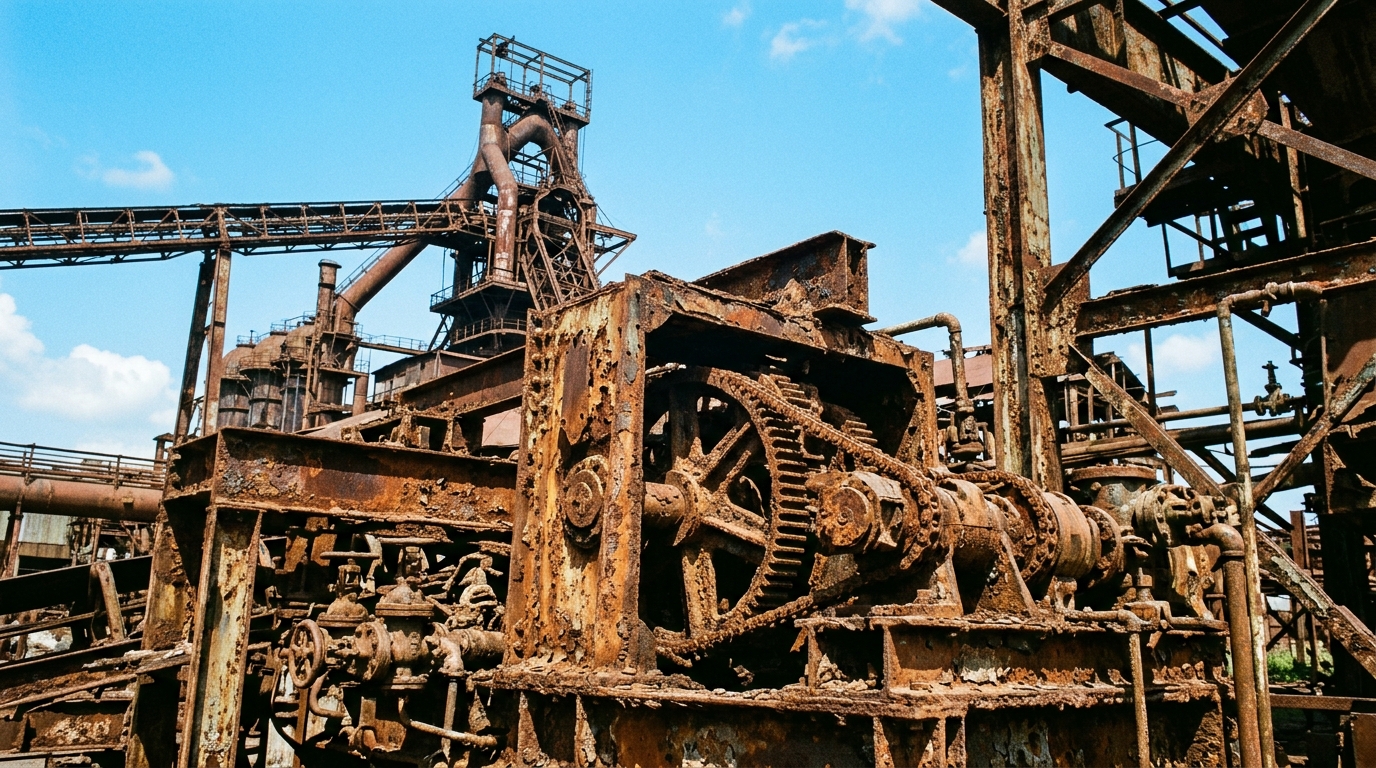
Imagine a tract as vast as the city of Paris, entirely dedicated to steelmaking, lined with blast furnaces, chimneys, and railways, yet completely silent for almost half a century. Not a single tonne of steel has ever left it, despite investments that now approach 10 billion dollars. This nearly surreal scene does exist, tucked away in Kogi State, at the heart of Nigeria. It is called the Ajaokuta complex, and its story resembles that of a giant we forgot to wake up.
- Launched in 1979 with Soviet help on 24,000 hectares, the Ajaokuta complex was to produce up to 5.2 million tonnes of steel per year, but today only the light rolling mills operate, the rest having been abandoned.
- Political instability, corruption and oil dependence are the main reasons cited to explain this industrial failure that has stretched on for nearly five decades.
- Since 2024, Nigeria has revived negotiations with the United Kingdom, China and Russia to try to restart the site, but economic benefits are not expected until around 2050–2060.
- A Soviet industrial gamble at the heart of Nigeria
- Billions squandered on steel that never flows
- Corruption, political instability and the oil curse: the fatal sequence
- Ajaokuta today: a steel giant still seeking a second wind
A Soviet Industrial Gamble at the Heart of Nigeria
Everything begins in 1979, within a Cold War backdrop where the Soviet Union sought to extend its influence across Africa by forging strategic industrial partnerships. Nigeria, buoyed by oil revenues and driven by a desire to industrialize rapidly, saw steel as the emblem of its future economic power. On a vast site spanning 24,000 hectares, Soviet engineers laid the foundations for what was intended to become one of Africa’s largest steelworks.
The stated ambition was dizzying: to produce 3 million tonnes of steel per year, with a planned ramp‑up to 5.2 million tonnes. It would cover nearly a quarter of the nation’s needs and, above all, serve as the backbone for wide-ranging sectors of the Nigerian economy—from shipyards to the automotive industry, and through construction and transport. Ajaokuta was not conceived as a mere factory but as the engine of an entire industrial revolution.
Billions Spent on Steel That Never Flows
The construction proceeded, infrastructures rose from the ground, and Soviet machines were installed piece by piece. But over the decades, delays accumulated, funding ebbed and flowed, and responsibilities dissolved among successive administrations. The result: the complex was never completed in its full configuration. Three-quarters of the installations remain abandoned today, rusting and overgrown, while only the light rolling mills continue to operate, confined to small‑scale fabrication and the production of reinforcing bars, far from the project’s original purpose.
What is most striking is the gulf in money involved. Nearly $10 billion have been poured into Ajaokuta across the years, with not a single tonne of saleable steel ever produced. A figure that shivers when contrasted with the country’s urgent infrastructure needs. Nigerian writer Chinua Achebe famously captured the sentiment, describing Ajaokuta as the quintessential symbol of white elephants and of the corruption that plagues some major African undertakings.
Corruption, Political Instability and the Oil Curse: The Fatal Chain
How could a project so strategic remain unfinished for nearly five decades? The answer lies in several factors that stacked up like stones in a jammed mechanism. First, Nigerian political instability—cycling between civilian and military regimes—prevented any continuity in overseeing the site. Each new government arrived with its own priorities, often more oriented toward short-term gains than toward a project of this scale.
Next came the famous resource curse. Nigeria, rich in oil, long favored the rents from petroleum over diversifying its economy by investing in heavy industry. Ajaokuta thus became, in the eyes of many observers, a symbol of unfulfilled promises and of the embezzlement of public funds that has punctuated the country’s economic history. Recurrent accusations of corruption surrounding the project keep fueling the belief that part of the money invested never truly went to completing the works.
Ajaokuta Today: A Steel Giant Still Seeking a Second Wind
Since 2024, the Nigerian government has resumed discussions, notably with Chinese partners, to bring the complex back to life. In the spring, federal authorities secured an export-financing deal totaling around £746 million with the United Kingdom, specifically aimed at reviving Ajaokuta. Then, this summer, a new gas agreement was signed to power the plant’s electricity, a condition deemed essential by investors to ensure the site’s long-term operation.
Negotiations are also underway with a Chinese investor for a production-sharing agreement estimated at $2 billion, while talks with Russia appear to be deadlocked. A lingering question across these efforts is that some analysts believe repaying these new financings could push the real economic benefits of the project out to the horizons of 2050–2060. In other words, even with a successful revival, Ajaokuta could remain a bet on the future rather than an immediate success, underscoring the unique status of this steelworks once funded by the USSR and left idle for forty-seven years after the project’s launch.
Ajaokuta thus embodies more vividly than any other example the gap that can separate a grand industrial ambition from its execution on the ground. Between the Cold War legacy, political upheavals, and renewed hopes carried by new international partners, the complex continues to fascinate as much as it invites scrutiny. The question remains whether, this time, the blast furnaces will truly glow, or whether Ajaokuta will endure as a sleeping steel giant at the heart of Nigeria for years to come.
