
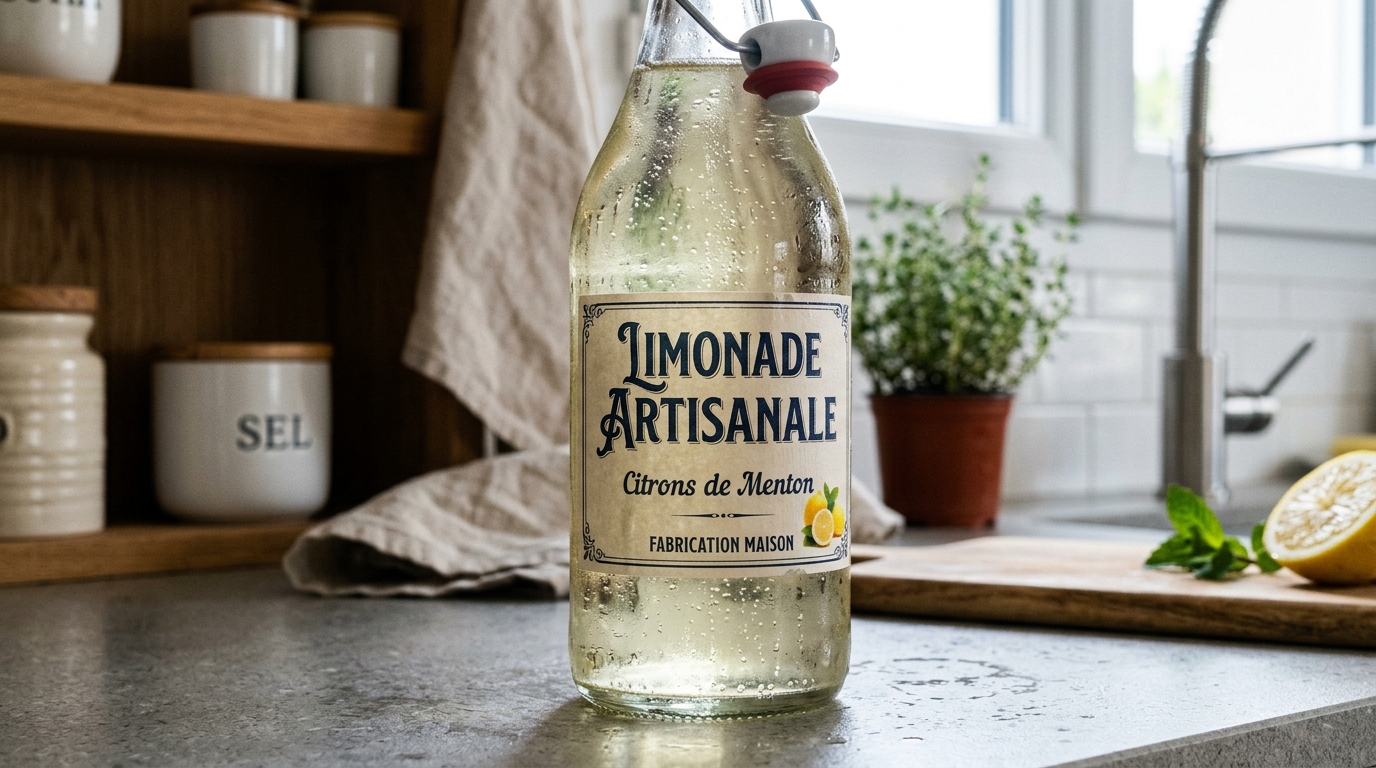
The reassuring little clink of a glass bottle set back on the table has always carried a certain virtue, as if this noble material safeguarded us from the excesses of modern plastic. Yet a study conducted by Anses casts doubt on that rosy image. By analyzing several everyday beverages, the researchers found that some glass bottles actually contain far more microplastics than their plastic- or can-packaged counterparts. A paradox, given how often glass is presented as the benchmark for healthy packaging. So, where does this surprising contamination truly come from, and should we now be wary of our favorite lemonade?
- Anses study shows that beverages bottled in glass contain five to fifty times more microplastics than those bottled in plastic or in cans.
- The paint on metal closures, scratched during storage and transport, is identified as the true source of contamination.
- No toxicological data currently allow assessing health risk, but cleaning the caps prior to sealing could easily reduce this contamination.
- What the Anses study reveals about glass-bottled beverages
- The true source of contamination: the paint on metal capsules
- Why water and wine largely escape this phenomenon
- A health risk still impossible to assess
- Simple solutions within reach of industry
- What this discovery changes in the perception of food packaging
What the Anses study on glass-bottled beverages reveals
The study was conducted by the SANAQUA unit of Anses, based in Boulogne-sur-Mer, under the direction of PhD student Iseline Chaïb, with support from the Hauts-de-France region, from the IDEAL State-Region Plan Contract, and from the ANR. The objective appeared simple on the surface: to measure the amount of microplastics present in five major families of beverages—water, sodas, iced teas, wine, and beer—depending on whether they are packaged in glass, plastic, carton, or can. The result, however, is explosive. For colas, lemonades, iced teas, and beers sold in glass bottles, the researchers measured an average of about one hundred microplastic particles per liter, i.e., five to fifty times more than in the same drinks packaged in plastic or in a can. In other words, the container long hailed as the most noble turns out to be the most contaminated, contrary to widespread beliefs.
The true source of contamination: the paint on metal closures
Faced with this unexpected result, the researchers sought to understand where these particles came from. Neither the glass—an inert material par excellence—nor the beverage itself could explain such contamination. The answer lay where no one had looked: the metal cap that seals the bottle. Its paint, invisible to the naked eye, shows tiny scratches caused by rubbing between caps during storage and transport. These micro-scratches would gradually release particles that end up in the liquid. To confirm this hypothesis, the scientists compared the color and composition of the microplastics found in the beverages with those of the paint on the caps, and the matches proved disturbingly precise. A seemingly innocuous detail like a metal closure thus emerges as the main suspect in this contamination.
Why water and wine largely escape this phenomenon
Not all liquids are treated the same. Water, regardless of its container, shows relatively low contamination, with only about 4.5 particles per liter in a glass bottle compared to 1.6 in plastic or carton. Wine, on the other hand, fares even better, including when packaged in a glass bottle sealed with a cork. These divergences continue to perplex researchers, who have not been able to precisely explain why some beverages seem better protected than others against this kind of contamination. Various hypotheses are mentioned to explain the differences, but they remain poorly understood and are to be explored further by researchers.
A health risk still impossible to assess
Before discarding your lemon-flavored lemonade in panic, it is important to stay level-headed. To date, no toxicological reference data allow us to determine whether these amounts of microplastics pose a real health risk. The study highlights a contamination source that had previously gone unnoticed, but it does not allow us to conclude that drinking from glass would be riskier than drinking from plastic or a can. That is precisely the nuance of this scientific work: it reveals a concrete, measurable phenomenon without establishing a verdict on its actual danger. A prudent approach invites keeping an eye on forthcoming research on the topic rather than succumbing to immediate concern.
Simple solutions within reach of industry
The good news is that this contamination appears easily correctable. Since the source of the problem has been clearly identified on the metal caps, researchers propose a straightforward and effective solution: cleaning the caps before sealing the bottles. This act, which might seem trivial, would significantly reduce the number of particles released into the beverage, representing a very low-cost measure. A concrete avenue for manufacturers, who could quickly adjust their processes to address the issue.
What this discovery changes in the perception of food packaging
This study serves as a reminder of an obvious truth too often forgotten: the container alone is not enough to judge a product’s safety. Between the material, the closure, storage, and transport, every step in the supply chain can become an unsuspected source of contamination, even for packaging long deemed the safest. Glass undoubtedly retains many advantages, but this research invites us to look beyond the bottle’s material itself. Further work will be needed to understand the variations observed across beverages and packaging and to refine our still incomplete understanding of this topic.
Until more is known, it’s hard to completely renounce your glass-bottled lemonade: the real culprit lies with the cap, not the container itself. A useful reminder that vigilance regarding microplastics can depend on the smallest details of daily life.
