
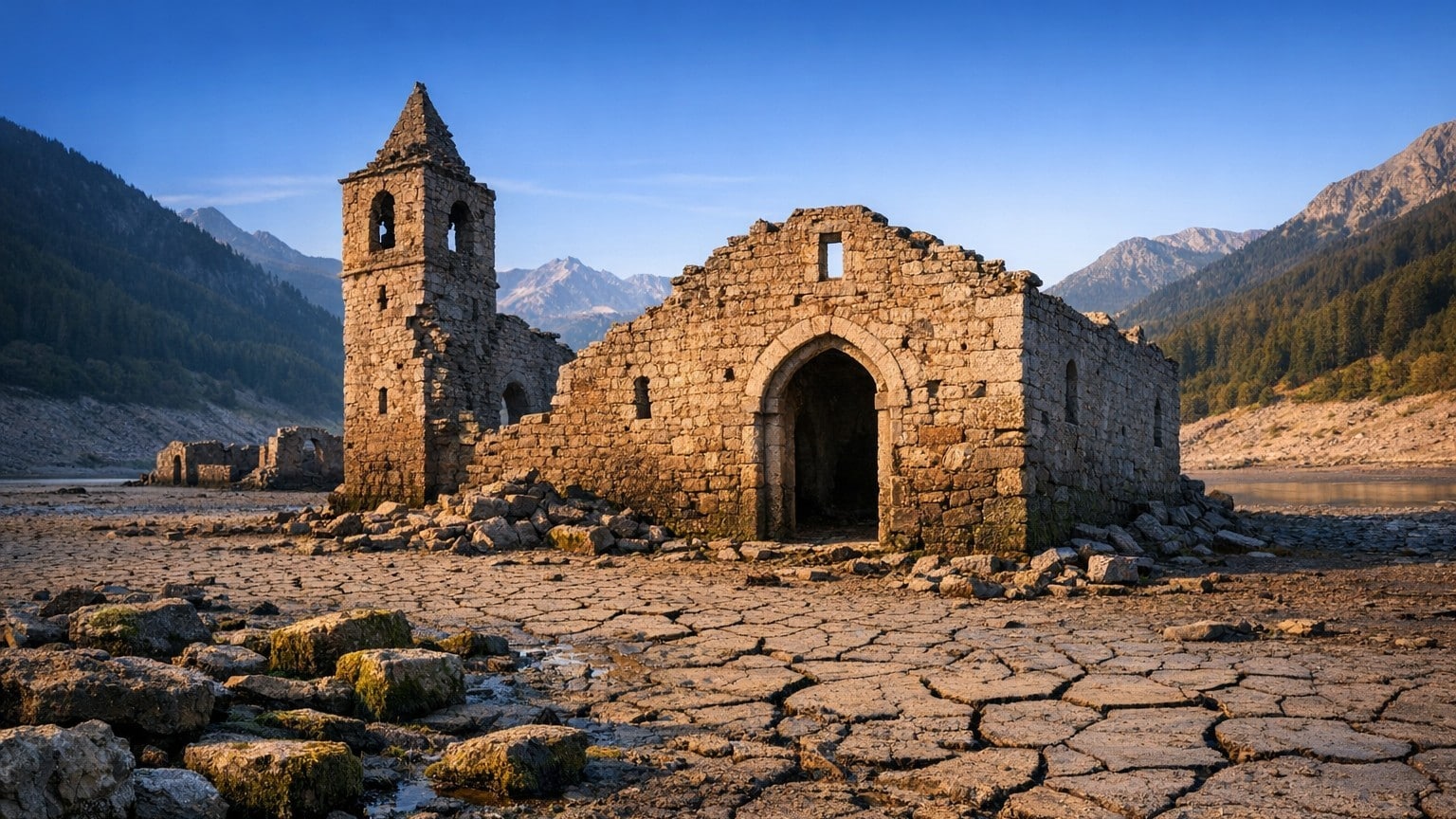
In April 2024, photos circulated on social networks and seemed to materialize as an apparition. At the bottom of a lake nearly dried up in Savoie, stone walls rose from a cracked silt bed. A century-old bridge. Foundations. The outlines of a full life, suspended since 1952. This isn’t a disaster-movie set: it is old Tignes, a French village swallowed alive, never rebuilt, reappearing each time the waters of Lake Chevril drop sufficiently low.
À retenir
- An entire French village disappeared beneath the waters in 1952 — but not forever
- Centuries-old stones still emerge during drainages, revealing forgotten stories
- Modern technology now prevents these spectacular apparitions, risking to erase the past for good
A village sacrificed on the altar of national reconstruction
The Chevril dam construction began after the war in 1947, as France’s thirst for energy grew ever more critical. The context was brutal: the country was still exhausted from conflict, its factories barely turning, coal in short supply. To attain energy independence, the government bet on hydroelectric power. The young EDF set out to tame the mountains and erected giant dams everywhere.
Tignes ticked all the boxes. EDF chose this site because the reservoir could act as a regulator over the Isère, spanning a drop of about 1,700 meters with 235 million cubic meters of water at stake. To visualize the amount of concrete required, imagine a block six times the volume of Notre-Dame de Paris. On the scale of a Savoy valley, it was utterly overwhelming.
In Tignes, the impact of the works was on a scale previously unseen, because for the first time a bustling village would vanish beneath the water. The 400 inhabitants of the time fought back with every means, including lawsuits and acts of sabotage. The municipality even pursued EDF in court to obtain compensation that would be acceptable. But it was in vain.
Expulsion, force, and the silence of the CRS
On April 21, 1952, the prefect of Savoie issued a stark notice to the residents: anyone who had not definitively left by April 27, 1952 would not receive any eviction indemnity. A harsh ultimatum that allowed for no ambiguity. CRS riot police were mobilized to force the last Tremos inhabitants to depart after the dam’s gates were opened.
A bulldozer cleared the way to the cemetery, followed by gravediggers who relocated the dead. Even the deceased were expropriated. The few hundred villagers were evacuated, and the buildings demolished. The church would be replicated at the entrance of the station built higher up—an exact copy, constructed farther away, as if a replica could erase the pain of the original destroyed.
For the generation living there, the uprooting was devastating. This is no empty phrase. Old Tignes was swallowed by the lake in 1952, and the dam was inaugurated by President Vincent Auriol in 1953. A national pride on one side, a collective trauma on the other.
What the water yields at every draining
Every ten years, EDF, operator of the dam, drains the lake completely to inspect the structure. The March 2000 draining allowed many Tignards, including some of the few who came from the old Tignes, to hold a mass in the ruins of the submerged church. A ceremony out of time, in a space officially dead for half a century.
The elders then walk down in procession toward the ruins of what had been the village. On that occasion, a thin cloak of vegetation briefly regrew, the bed of the Isère resurfaced, a few vestiges of the vanished village reappeared, and emotion surfaced. In April 2024, a partial draining for maintenance reproduced this phenomenon. The lake was partly emptied, and some ruins, which had resisted water and silt, resurfaced.
What is striking is the state of preservation. The stone walls stand up remarkably well underwater. Large sections of buildings remain upright, door lintels still hold, staircases lead to levels that no longer exist. Beneath a maximum of 180 meters of water, protected from frost, weather, and the tooth of time, these stones have aged better than many modern constructions left exposed to the air.
EDF now uses underwater robots to avoid draining the lake for inspections. This technological choice, as rational as it is, deprives descendants of Tignards of a rare ritual: walking through the streets of their ancestors, a pause between two fillings. The next full draining, if it occurs, may well be the last of this kind.
A ghost village that continues to haunt French memory
To enable the construction of hydroelectric reservoirs in France, 44 inhabited valleys had to be flooded. The artificial lakes swallowed many villages, chiefly in the Alps, the Massif Central, and the Jura. Tignes remains the most publicized case, but it is not isolated.
For a long time, submerged villages were a taboo subject for communities. Dam construction had caused painful expropriations, and no one wished to reopen those wounds. The situation began to change toward the late 2010s: several French municipalities began processes of listing or memorial protection, in collaboration with departmental archives and the General Inventory of Cultural Heritage.
The current village of Tignes was rebuilt by a few locals in 1956 with state subsidies near the natural lake of Tignes, giving birth to one of France’s highest ski resorts. The resort flourishes, tourists arrive, the ski lifts run. Meanwhile, at 150 meters beneath the surface of Lake Chevril, the stones of the old church tower wait for the next drop in the waters. Unwillingly transformed into one of the Alps’ most renowned ski stations, Tignes bears this paradox in silence: its success rests on the deliberate erasure of what it was before.
Sources: glisseavecplaisir.blogspot.com | ina.fr
