
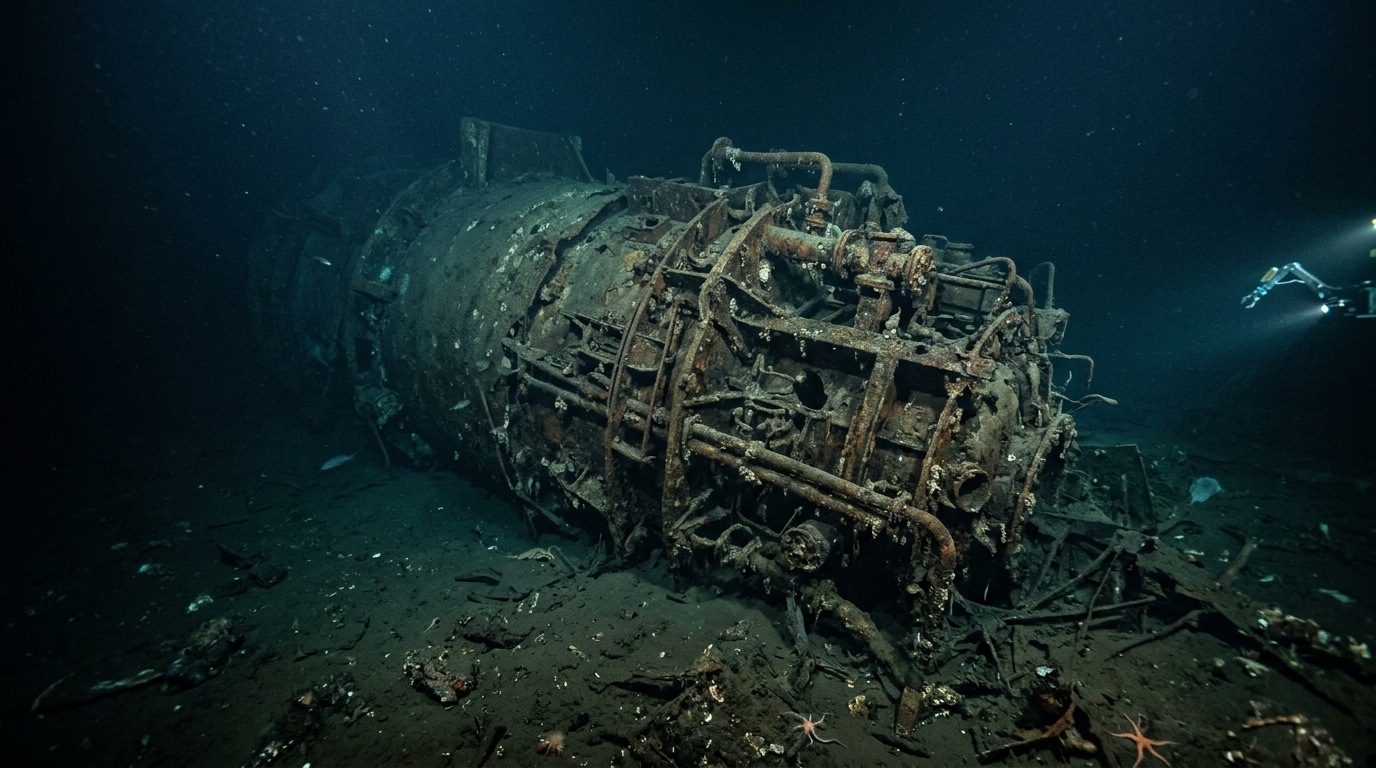
Be warned, what you are about to read is no urban legend. Beneath the frigid waters of the Kara Sea lie the wrecks of a secret nuclear accident that remained hidden for decades. The culprit is none other than the Lenin, the world’s first nuclear-powered icebreaker, today transformed into a peaceful museum in Murmansk.
- In 1965, the Lenin nuclear icebreaker suffered an accident with coolant loss, deforming 60% of its fuel elements, a secret revealed only in 1993
- Between 1965 and 1988, 16 naval reactor vessels, of which six contained damaged fuel, were sunk in the Kara Sea
- Decommissioned in 1989 due to hull wear, Lenin became a museum ship in Murmansk in 2005, while Russia is considering the raising of submarines K-27 and K-159 from 2027
- A nuclear accident hidden for decades
- Three reactors sacrificed on the Arctic seabed
- From nuclear catastrophe to a tourist attraction
A Nuclear Accident Hidden for Decades
It all began in February 1965, during the height of the Cold War, aboard a ship meant to embody the Soviet mastery of civilian atomic power. The Lenin, commissioned in 1959 after its launch in Leningrad, suffered a loss of coolant in one of its reactors. This was no trivial matter: the fluid is precisely what carries heat from the nuclear core to prevent overheating.
The consequences were serious. About 60% of the fuel elements ended up deformed under the influence of excessive heat. Extracting them individually as normally planned was impossible: Soviet engineers had to improvise a radical solution.
It would take until 1993 and the publication of the Russian government commission White Paper for the truth to be officially revealed. The document confirms that in total 16 nuclear reactors, coming from submarines and from Lenin itself, ended up submerged in the Kara Sea, some with spent fuel still inside. A secret kept for nearly thirty years.
Three Reactors Sacrificed on the Arctic Ocean Floor
Facing inextractable fuels, Soviet authorities opted for a brutal yet effective method: remove the fuel, the support grid and the control rods in one block. The entire assembly was sealed in containers and, in 1967, sunk in Tsivolki Bay off Novaya Zemlya.
But the story does not end there. After the 1965 accident, Lenin’s three-OK-150 reactor compartment was cut out and submerged in 1967 at Novaya Zemlya, later replaced by OK-900 units. Concretely, the reactors were detached directly from the hull using explosives, right above the chosen sinking site. The replacement operation concluded in early 1970 with the installation of two brand-new OK-900 reactors.
The most precise inventories even distinguish the various elements dispersed underwater. Lenin’s reactor compartment, submerged in 1967 in Sedova Bay, contains no fuel. In contrast, the shielding assembly of the same vessel, sunk the same year in Tsivolki Bay, contains spent fuel. A separate container, carrying roughly 60% of the damaged fuel from reactor No. 2, followed the same path.
This case is by no means isolated. Between 1965 and 1988, no fewer than 16 naval reactor vessels reached the Kara Sea depths, six of which still contained damaged fuel. A true underwater nuclear cemetery, far from prying eyes.
From Nuclear Catastrophe to Tourist Attraction
Despite this episode, Lenin continued its career for almost another two decades. It was not radioactivity that finally brought it down, but something far more prosaic: wear on its hull from repeated rubbing against Arctic ice. The ship was decommissioned in 1989.
It then joined Atomflot, the base of Russia’s nuclear icebreakers in Murmansk, where it remained moored. Its transformation into a museum ship was completed in 2005. Today, visitors can walk its corridors without realizing that part of its nuclear past still lies on the seafloor, hundreds of kilometers away.
The Lenin is only one example of this hasty handling of Soviet atomic waste. According to documents compiled by the Bellona organization, the comprehensive inventory of submerged wastes in the Kara Sea includes about 17,000 radioactive containers, 19 ships, 14 reactors of which five still contain spent fuel, and 735 heavily contaminated heavy machinery.
Facing this burdensome legacy, Moscow appears ready to act. The Russian federal budget proposal foresees funding to restore the Arctic seas, with preparations already underway and concrete work expected by 2027. A briefing note mentions 30 billion rubles over three years to plan the recovery of the Cold War’s most concerning submarines, the famous K-27 and K-159, deemed a Rosatom priority.
Whether these announcements will actually materialize remains to be seen. Bellona notes that no official communications have been relayed through Rosatom’s channels, and some analysts suspect a journalistically optimistic interpretation of what is actually funded.
While these projects materialize, Lenin’s reactors and their neighbors continue their quiet slumber beneath the Kara Sea. A burdensome legacy of the Soviet race for atomic power, reminding us that technological innovation always comes with its own shadowy sides, sometimes literally submerged.
