
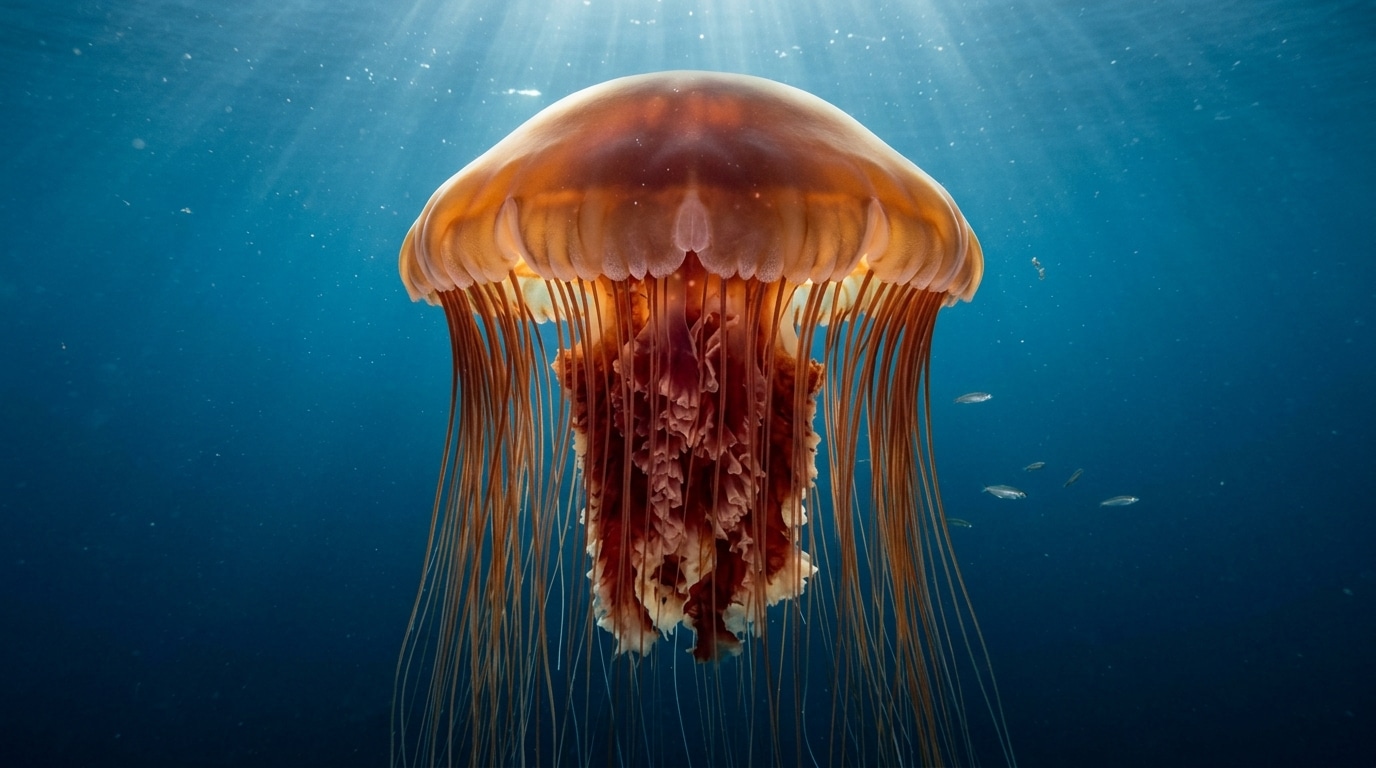
An animal capable of stretching to more than 30 meters in length while never exceeding 2 meters in width: that’s what lies behind the lion’s mane jellyfish. Its secret isn’t in its bell nor in its age, but in a structure far more discreet. Head to the cold waters where one of the longest animals on the planet hides.
- The largest documented specimen boasted tentacles reaching 36.6 meters, longer than an adult blue whale.
- The extreme length of the tentacles is explained by a hunting strategy aimed at maximizing the capture area, not by the animal’s age.
- Coated with stinging cells called cnidocytes, these tentacles release venom that paralyzes plankton and small fish.
- Thirty meters of tentacles: the real secret behind an extraordinary length
- Neither the bell size nor age are to blame: here’s why
- A network of venomous filaments longer than a blue whale
Thirty meters of tentacles: the true secret behind an extraordinary length
The lion’s mane jellyfish, or Cyanea capillata to scientists, wears its name with pride. Under its bell spreads a tangle of fine filaments that resemble a disheveled mane. But what stands out most is their length: according to the Marine Conservation Society, the largest specimen ever recorded carried tentacles measuring 36.6 meters.
To put it in perspective, that length exceeds the size of an adult blue whale, which is often cited as the largest animal by mass. The difference is that the jellyfish weighs virtually nothing compared to the cetacean. It bets everything on extending itself rather than increasing volume.
This particular architecture makes it one of the longest animals documented to date, alongside a few other slender sea worms. A title that surprises, given that the common image of a jellyfish is a round, compact shape.
Neither the bell size nor age are to blame: here’s why
One might suppose that the older a jellyfish gets, the longer it grows, much like some trees that rise higher with time. Yet that isn’t the mechanism at play here. Age influences the size of the bell, not the length of the tentacles in a directly proportional way.
The bell itself remains relatively modest compared with the rest of the animal. It can reach up to 2 meters in diameter in the most impressive cases, which is substantial, but it accounts for only a fraction of the creature’s total length.
The real explanation lies in the species’ hunting strategy. The tentacles elongate to maximize the capture area, much like a net that stretches to sweep a wider region. It is this predatory function, not the overall growth of the animal, that explains such extreme dimensions.
A network of venomous filaments longer than a blue whale
Each tentacle of the lion’s mane jellyfish is coated with stinging cells called cnidocytes. They release venom designed to paralyze small prey that cross their path, from plankton to small fish. With such an extensive network, the animal covers a vast hunting surface without needing to move actively.
In extreme cases, specimens can weigh more than 1,000 kilograms, tentacles included. This mass, spread across such an elongated frame, nicely illustrates why it is sometimes compared to a blue whale in terms of length, even though the two animals are not comparable biologically.
This proliferation of venomous filaments is not merely a biological curiosity. It has tangible consequences, particularly for human activities at sea. Recent episodes in France, near the Gravelines nuclear power plant, offered a striking glimpse.
In August 2026, a massive influx of jellyfish led to the shutdown of several reactors at Europe’s largest nuclear plant. The cooling water intake pumps became clogged, forcing EDF to temporarily halt production. A phenomenon already observed in 2025, which seems to be repeating with a worrying frequency, linked to the warming of coastal waters.
The lion’s mane jellyfish is by no means a menace at this scale, as it favors the cold waters of the North Atlantic and the Arctic. But it perfectly illustrates how an animal so unusual in form can both fascinate scientists and, for other jellyfish species more common along our coasts, disrupt major energy infrastructures.
