
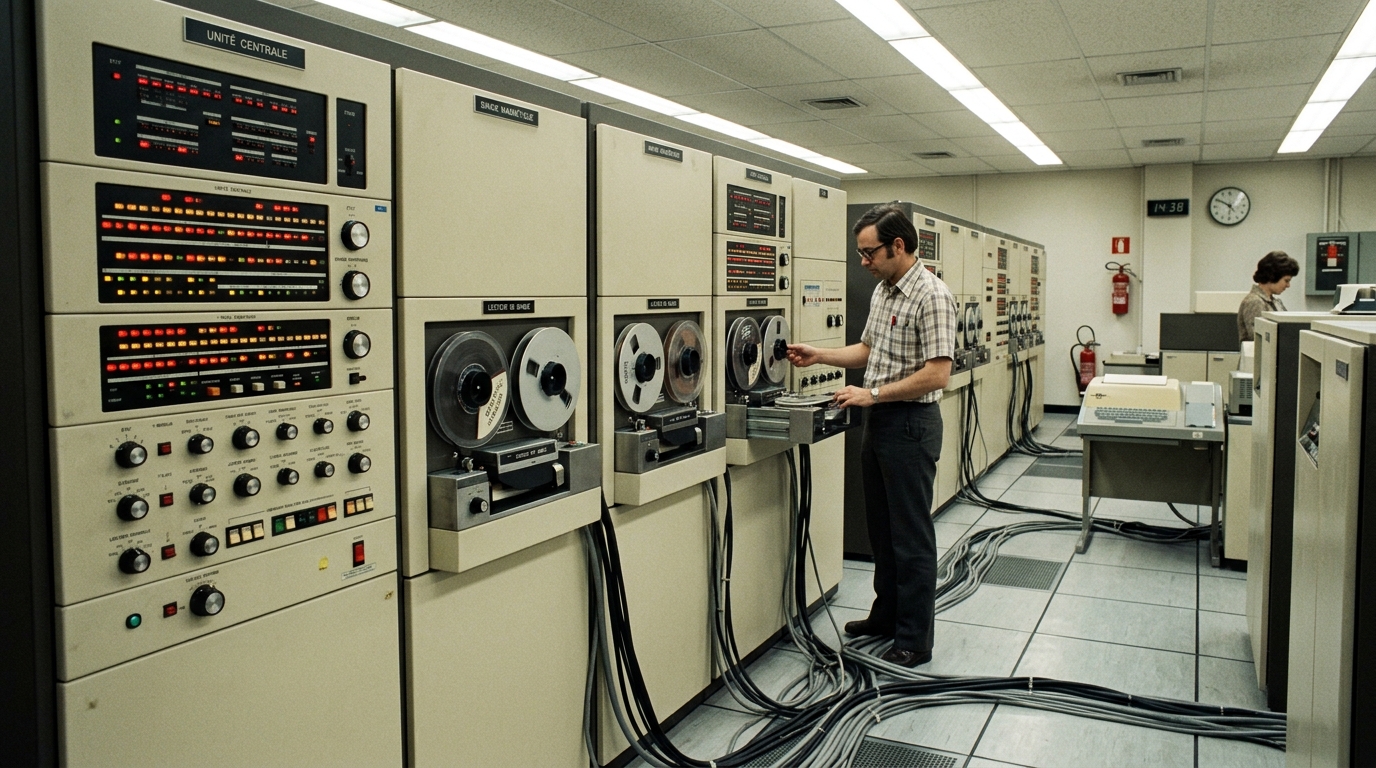
How can a country, with its own hands, sacrifice the industrial project meant to guarantee its independence? This is the question that threads through the little-known history of the Compagnie Internationale pour l’Informatique, the CII, a national champion created amid the technological Cold War to ensure France would no longer depend on American computers. For nearly a decade, the state poured substantial sums into this industrial venture, before watching, in 1975, it be absorbed by an American group. A look back at an episode that reveals much about the limits of political will in the face of economic and industrial realities.
- The Plan Calcul, launched in 1966 under de Gaulle, aimed to create with the CII a national champion in computing to face IBM’s American dominance.
- Despite achieving technical objectives, the state abandoned in 1974 the European project Unidata with Philips and Siemens, which could have offered a viable alternative.
- In May 1975, the CII finally merged with the American Honeywell-Bull, sealing France’s technological dependence despite the 13 billion francs invested.
- Thirteen billion francs poured into the dream of a French computing industry
- The Plan Calcul, an ambition born from fear of American hegemony
- The CII, a champion with no markets or real industrial autonomy
- A fiasco that seals France’s technological dependence
Thirteen Billion Francs Spent in the Dream of a French Computing Industry
According to a Senate report published in 1997, the total cost of the two successive conventions signed with the CII, as well as their exit, amounts to about 13 billion francs (in 1992 values), to be borne by French taxpayers. A colossal sum for the era, intended to enable France to build a player capable of rivalling the American giants of computing, led by IBM, which at the time held a near-monopoly on the global computer market.
The first agreement, signed at the launch of the project, already represented around 1 billion francs. The second, spanning from 1972 to 1975, cost more than double. On top of that come public subsidies, which rose from 300 million francs per year under Plan Calcul to almost 2 billion francs per year once the merger with the American Honeywell was agreed, to offset Thomson, staunchly opposed to this move. An enormous investment, therefore, but the final result leaves one puzzled: the independence long sought never came to fruition.
The Plan Calcul, an ambition born from fear of American hegemony
To understand this story, we must go back to the mid-1960s. At that time, the French government watched with concern as the American computer giants rapidly expanded, already dominating the world market. The trigger occurred when Bull, France’s computing flagship, fell under the control of the American General Electric. For Charles de Gaulle, eager to preserve a form of national independence, including in the military domain where computing needs are strategic, this loss of industrial sovereignty became unacceptable.
Thus, in July 1966, General de Gaulle approved Plan Calcul, an ambitious program to equip France with a national computing industry. Responsibility for the plan was entrusted to a specially created agency, the Délégation générale à l’informatique, which reports directly to the Prime Minister. A few months later, in December 1966, the CII officially came into being, born from the merging of the computing activities of Thomson-CSF, CGE, and Schneider. The ambition was clear: to build an actor capable of standing up to the Americans on their home turf.
The CII, a champion with no markets or real industrial autonomy
On paper, the early days of the CII looked promising. In 1971, the assessment prepared by Maurice Allègre, then head of the Délégation à l’Informatique, found that the company had met its technical and commercial objectives. But the same assessment also pointed to an inexorable reality: the $100 million invested by France was derisory in the face of IBM’s financial might, which alone weighed several times the combined budget of the entire European computing industry.
Facing this finding, the only viable path seemed to be European-scale collaboration. President Georges Pompidou launched a Franco-German rapprochement named Unidata, bringing together the CII with Philips and Siemens. This project, sometimes nicknamed the Airbus of computing, could have formed the only true European industrial alternative to the Americans. Yet this continental ambition would clash with political decisions that would hasten its outright abandonment just a few years after its inception.
A fiasco that seals France’s technological dependence
The conclusion of this story arrives amid a particularly tense economic context—the first oil shock and the ensuing recession. The Délégation à l’Informatique, the administrative pillar of Plan Calcul since its creation, was dissolved in October 1974. A few months later, in early 1975, the French government began direct negotiations with the American Honeywell-Bull group, without even involving Michel Barré, then CEO of the CII. An unequivocal signal of the end of the project’s autonomy.
The final merger was formalized in May 1975: CII-Honeywell-Bull was born, and the CII lost its status as an autonomous company in favor of an American group. Officially, this decision was justified by an economic necessity tied to the crisis. Yet the CII had indeed achieved the technical objectives set in its first convention. This paradox feeds a stubborn thesis: that of an industrial sabotage orchestrated by the state itself, which would have preferred to abandon its own champion rather than continue the financial and political effort needed to attain autonomy, especially by withdrawing from the European Unidata project in favor of a rapprochement with an American actor.
Ultimately, the history of the CII illustrates a painful paradox: France spent substantial sums to assert its technological independence, only to abandon, at the decisive moment, the option that could have truly guaranteed it—an European alliance. Thirteen billion francs later, the dream of a national computing industry ended with reinforced dependence on American players, a dependence whose effects are still felt today in the French digital landscape. This past lesson resonates particularly as the question of European digital sovereignty re-emerges as a central issue in industrial and political debates.
