
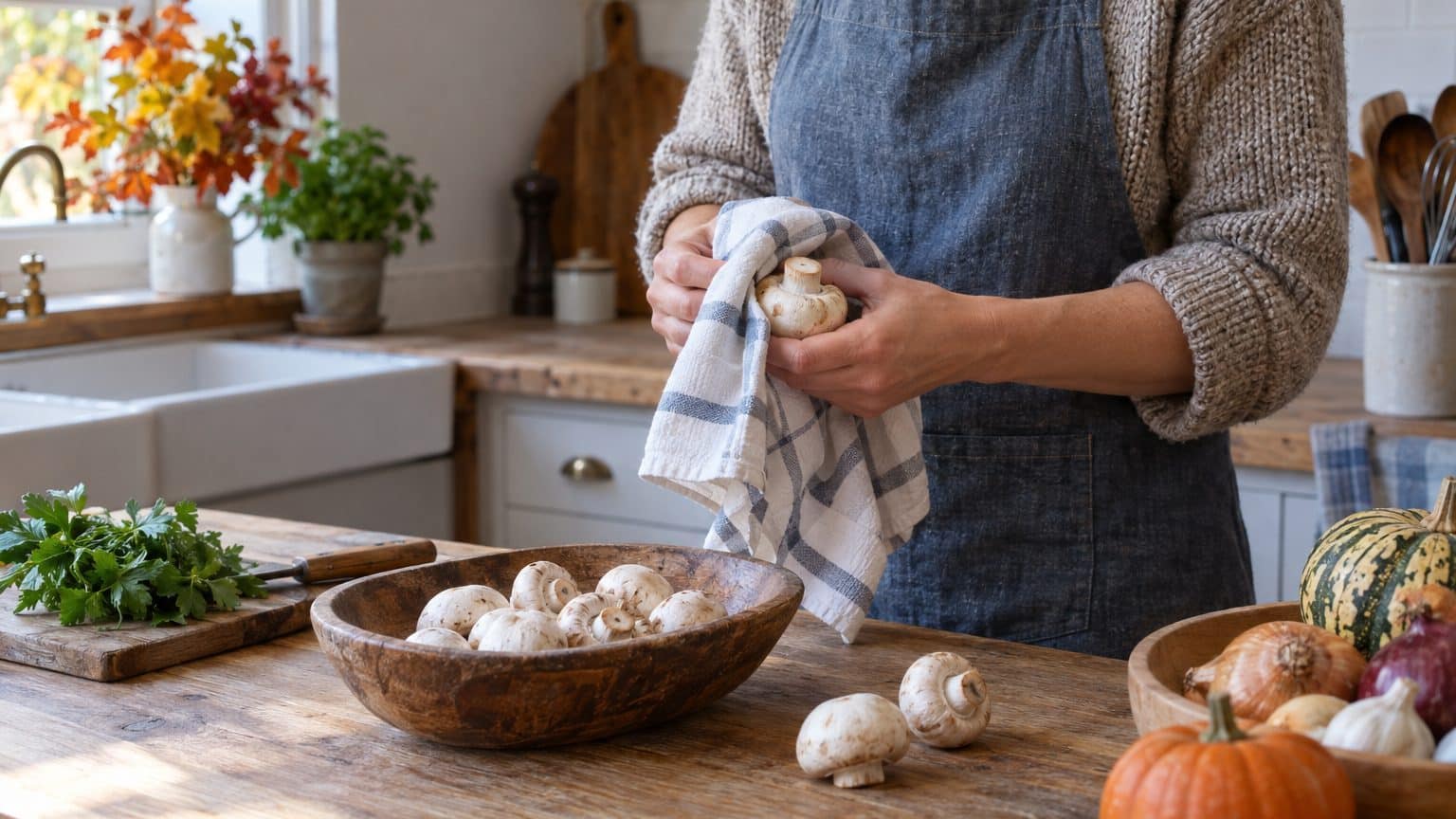
252 g before, 258 g after. Between them, 5 minutes in water, then draining and careful blotting before reweighing. The gain is 6 g, about 2.5% of the starting weight.
A sixteenth of a teaspoon of water per mushroom.
- Harold McGee soaked 252 g of mushrooms for 5 minutes and reweighed them at 258 g.
- Mushrooms already contain about 90% water, so the gain is small.
- For cooking, a quick rinse followed by thorough draining is sufficient, without meticulous brushing.
A weighing in 1990 against a cook’s reflex
The experiment is recounted by Harold McGee, an American writer specializing in the science of cooking, in his book The Curious Cook, published in 1990. He submerged 252 g of fresh mushrooms in water for 5 minutes. He drains them, blot-dries the surface moisture, and then reweighs: 258 g. Relative to the batch, 6 g of water corresponds to about 6 mL, a little more than a teaspoon for 252 g of mushrooms.
The rule this figure challenges is old. In 1937, Larousse Gastronomique published guidance from Prosper Montagné warning against rinsing cultivated mushrooms, in the name of their natural flavors. The reasoning rested on their porosity: too much water would dilute the taste, hence the instruction to brush, or even peel, carried for 89 years into today’s kitchens.
Robert Wolke, author of What Einstein Told His Cook, redid the experiment with white mushrooms, all closed button caps. Their water gain was limited to 2.7% of their weight, i.e., less than 3 teaspoons per pound of mushrooms, a result in line with McGee’s, achieved with a different method and batches.
The cost of the inverse gesture remains measured in minutes. In a Saveur article about mushroom cleaning, Beth Kracklauer argues that brushing each mushroom individually for a dish like mushroom moussaka would be a poor use of time. McGee’s balance vindicates her: 6 g of water at stake for 252 g of mushrooms. In October, the peak season for Paris mushrooms, picking and autumn dishes, whole trays pass through cooks’ hands as they wipe each cap individually for a gain of about this magnitude.
90% water before even the first soak
Mushrooms are already composed of roughly 90% water, notes the Swiss site 20 Minutes, and as high as 92.5% according to the USDA nutrition database cited by KitchenSavvy. On 252 g, that amounts to about 227 g of water before any immersion. After soaking, the batch weighs 258 g for about 233 g of water, still around 90%.
Even with a third more weight, they would stay under 95% water.
Everyone has observed this before a hot pan: mushrooms release so much water that they shrink to occupy only a fraction of their original volume. A specimen already so drenched has little room to reabsorb more, a fact confirmed by the five-minute weighing at kitchen scale.
On an online forum, McGee clarified that his tests used standard white mushrooms. Provided you shake out the water lodged in crevices well, fresh mushrooms absorb little to none. Since they already contain around 90% water, a bit more or less does not change cooking much afterward. This finding applies to rinsing or a brief soak, not to prolonged immersion that no one weighed here.
Regarding taste, McGee treats that separately. He concedes that flavorful amino acids could pass into the water, but they reside inside the cells, which surface water rarely penetrates, and aromatic molecules tend not to dissolve in water. His conclusion: he washes his mushrooms with a clear conscience.
What the scale does not measure
The test applies to rinsing or a short soak of cultivated mushrooms, such as McGee’s standard white mushrooms. For a long soak, none of the measurements cited here permit a conclusion, and another weighing would be required to discuss it.
Chanterelles and sheep’s-foot mushrooms were not measured here.
These wild mushrooms, very open, with more numerous gills and folds, therefore lie outside the scope of measurement. In Wolke’s tests, brown mushrooms retained more water than whites: 4.9% of their weight, i.e., 5 teaspoons per pound. Saveur notes that brushing makes sense for raw mushrooms, because rinsing can damage surface cells and cause browning. For cooking, a quick rinse under water followed by a good shake of the crevices suffices, according to McGee’s measurements.
During a demonstration in a McGee-focused course reported by the Cooking Issues blog, two batches were cooked side by side, one brushed, the other soaked. The soaked mushrooms collect some water, but it evaporates in the pan, and the soaked and packed batch turned to mush, while the dry mushrooms cooked quickly, absorbing all the oil. After soaking, the mushrooms must be drained well and not crowded into the pan.
Sources: archive.org | en.wikipedia.org
