
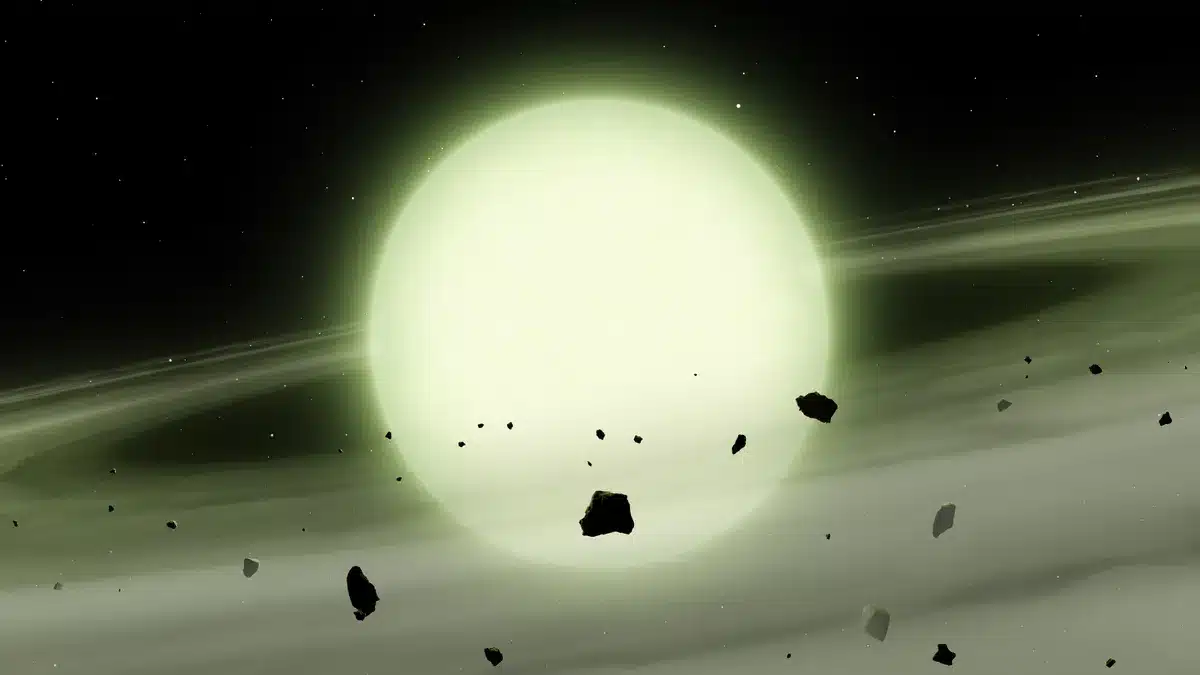
What if white dwarfs aren’t as white as they seem? It’s a question that has haunted astronomers, and the answer is surprising. A recent study reveals that one white dwarf in thirty would display unexpected hues: chartreuse green, salmon pink, pale orange. The culprit is contaminated atmospheres that upend everything we thought we knew about these stellar remnants.
- A study led by Dr. Mark Hollands observed 151 nearby white dwarfs, revealing that about one in 30 would display an atypical color on galactic scales.
- These unusual hues (chartreuse green, salmon pink) arise from contamination of the stellar atmosphere by planetary debris, such as sodium or carbon, which absorb certain wavelengths.
- The example of WD J1330+6435 illustrates this phenomenon: sodium in its atmosphere absorbs orange, red, and yellow light, producing a ghostly green color.
- One white dwarf in thirty hides an unexpected color
- From brilliant white to pale pink: how atmospheric pollution repaints these stars
- What our eyes would really see as we approach a white dwarf
One white dwarf in thirty hides an unexpected color
Credit: © Mark Hollands/University of Warwick
White dwarfs are the cores of dead stars that pack a mass about half that of the Sun into a sphere no larger than Earth. An object of staggering density, which shines not due to nuclear fusion but simply because it retains an immense heat built up during its formation.
Until now, they were thought to live up to their name: white, period. A team led by Dr. Mark Hollands at the University of Warwick sought to test this assumption by observing 151 white dwarfs within 20 parsecs of Earth, about 65 light-years away.
The result: most of them indeed displayed a median color close to the white of our screens. But a handful clearly stood out, with distinctly unusual hues.
Extrapolating these observations to the scale of the galaxy, researchers estimate that one white dwarf in thirty would show an atypical color.
From brilliant white to pale pink: how atmospheric pollution repaints these stars
To understand where these surprising colors come from, we must revisit the tumultuous life of a star. When a star like our Sun exhausts its hydrogen, it swells into a red giant before shedding its outer layers. Its core then contracts to become a white dwarf.
This red giant phase is not easy for the surrounding stellar system; some of the planetary debris from that system ends up crashing onto the newly formed white dwarf.
In theory, a white dwarf should consist only of hydrogen and helium. The presence of other chemical elements betrays this external contamination. And these elements do more than go unnoticed: they profoundly alter the star’s light spectrum, sometimes even in wavelengths visible to the human eye.
The most striking example remains WD J1330+6435. Sodium present in its atmosphere absorbs much of the orange, red, and yellow light, leaving behind a ghostly chartreuse green. Other white dwarfs, cooler ones, develop a convection zone that drives carbon molecules toward their outer layers. These molecules absorb light in specific bands, giving rise to pastel pink hues, sometimes salmon pink.
What our eyes would really see when approaching a white dwarf
« It’s a question I’ve always asked myself early in my career—what would these stars look like if we could see them up close, » Dr. Hollands told IFLScience. An almost childlike question, but terribly difficult to answer from Earth.
On the main sequence, stars display a rather narrow range of colors, dictated solely by their temperature: pale orange for the cooler ones, white for Sun-like stars, pale blue for the hotter ones. With white dwarfs, the game changes completely, as chemical pollution adds another factor to the equation.
« As an astronomer, like everyone, we wonder what these things actually look like, » the researcher adds. « We study them, try to understand the physics, but we can’t go there. »
And this line of research confirms that white dwarfs exist in a whole palette of colors, from pinks to oranges to blues.
Physics here does not merely unravel the mysteries of the universe: it makes the cosmos feel a bit more tangible, a bit closer to our senses. Pink stars, green stars—these ideas might seem straight out of a science-fiction novel. And yet these celestial bodies do exist somewhere in our galaxy, far from the once uniform white image we had assigned to them.
