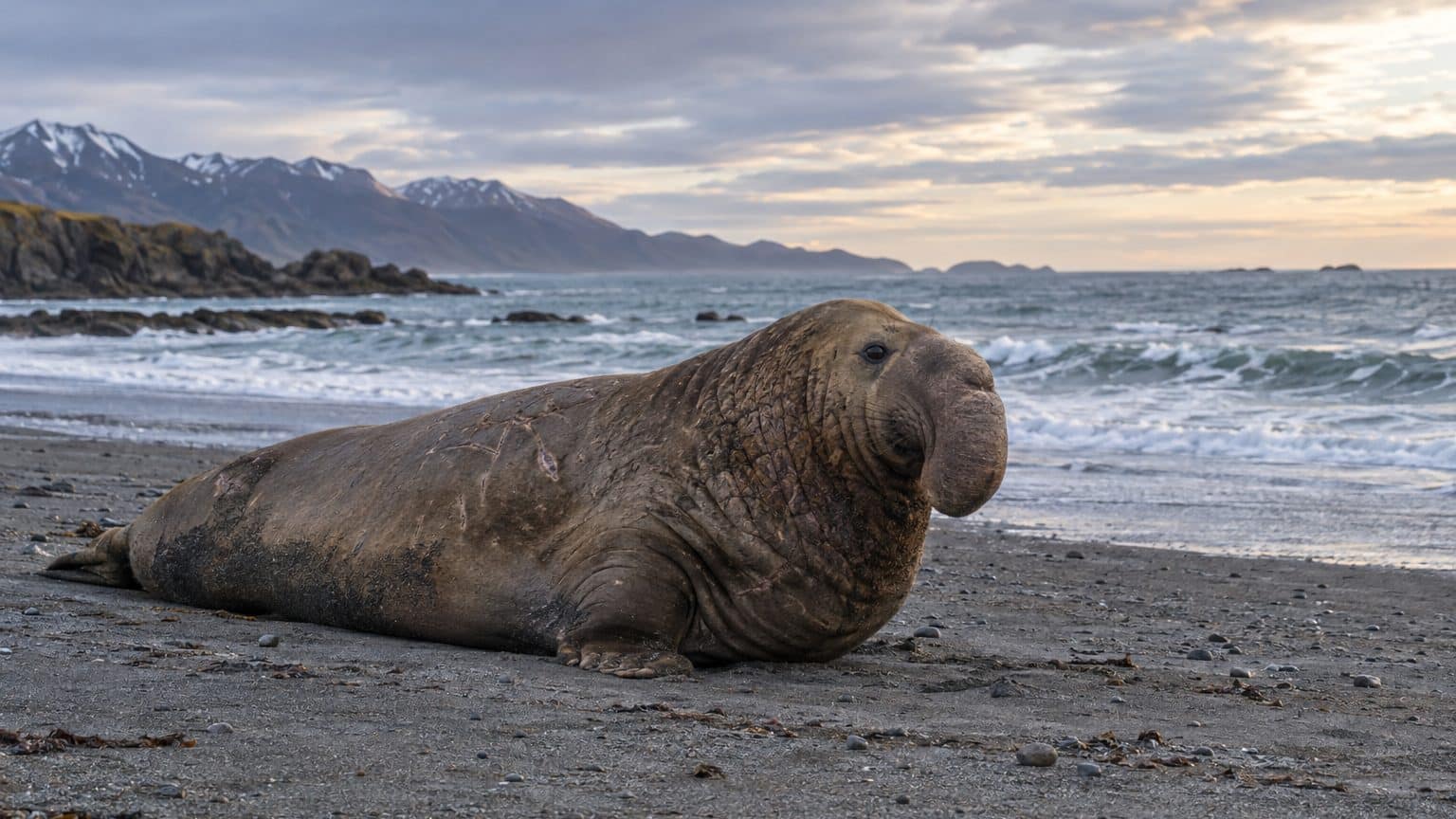
3-Ton Male Outshines Polar Bear as the Largest Carnivore on Subantarctic Beaches
October 15, 2026
The record does not belong to the lion, nor the tiger, nor the polar bear. It goes to a seal, the southern elephant seal (Mirounga leonina), whose adult males reach up to 3,000 kg. Against a male polar bear, which weighs 300 to 800 kg according to the Animal Diversity Web of the University of Michigan, the gap is roughly four to one.
Yes, a seal is a carnivore.
The classification is unambiguous. According to the Animal Diversity Web, the southern elephant seal belongs to the order Carnivora, in the family Phocidae, the same order as felines and bears. The word “carnivore” designates here a large group of mammals, not merely a way of eating. On the menu of this giant are squid and fish.
The reflex to think “bear” or “lion” is understandable. When you say carnivore, you picture claws, a maw, a hunt on land. A seal sprawled on a subantarctic beach does not fit that image, but taxonomy nonetheless places it in the same category.
Key takeaways
The male southern elephant seal weighs up to 3,000 kg.
A male polar bear weighs on average 300 to 800 kg.
The species is a seal and belongs to the order Carnivora.
Three tonnes against 800 kilograms: the gap in numbers
The Australian Antarctic Division provides clear figures. Adult males weigh up to 3,000 kg, while females range from 300 to 900 kg. To picture 3 tonnes, you would need roughly forty adults of 75 kg.
Some individuals go even further. According to the Animal Diversity Web, males can exceed 3,700 kg and 6 m in length. The calculation is simple: 3,000 divided by 800 gives about 3.75, i.e., nearly four times the weight of the largest male polar bear. With a male of 3,700 kg, the ratio climbs to more than 4.5.
Even the heaviest polar bear would still be short by 2,200 kg.
This excess is accompanied by spectacular sexual dimorphism. Females exceed just 2 m, while males surpass 6 m. The youngsters, meanwhile, weigh about 40 kg at birth and 120 kg at weaning, according to the Australian Antarctic Division: they tripled their weight before leaving their mother.
A colossus who spends his life beneath the surface
This heavyweight is also an extraordinary diver. The southern elephant seal descends to depths of up to 2 km and can hold its breath for up to 2 hours, according to the Australian Antarctic Division. Most of its dives, however, last about 30 minutes, between 300 and 800 m. Between two descents, it remains on the surface for only 2 minutes, which means it spends about 94% of its time underwater (30 minutes out of 32).
Two kilometers of depth is roughly six times the height of the Eiffel Tower. An polar bear, even an excellent swimmer, does not enter that register. The animal that holds the mass record among carnivores is therefore also a master of the abyss.
Two minutes to breathe, then it dives again.
On the beach, a giant’s fast
On land, the male changes pace. During reproduction, according to the Australian Antarctic Division, he does not leave his territory to feed and lives off his fat reserves. Part of the 3,000 kg he displays thus serves as fuel to hold his ground on the beach.
This constraint gives a tangible meaning to size. A male who stays in place without eating has every incentive to arrive with solid reserves, and body mass is part of the equation. The article does not detail the duration of this fasting, and it would be risky to state a figure without a precise source.
One last detail further dispels the received idea: ranges overlap. A female southern elephant seal can reach 900 kg, i.e., 100 kg more than the heaviest male polar bear (800 kg). Females of the species can thus, at the upper end of their range, exceed the heaviest polar bears, even though they are much smaller than the males.
I write about space exploration, frontier science and the technologies that are quietly shaping the future. From Norway, I follow the missions, discoveries and ideas that connect life on Earth with what lies beyond it. My goal is to make complex subjects clear, useful and worth paying attention to.