
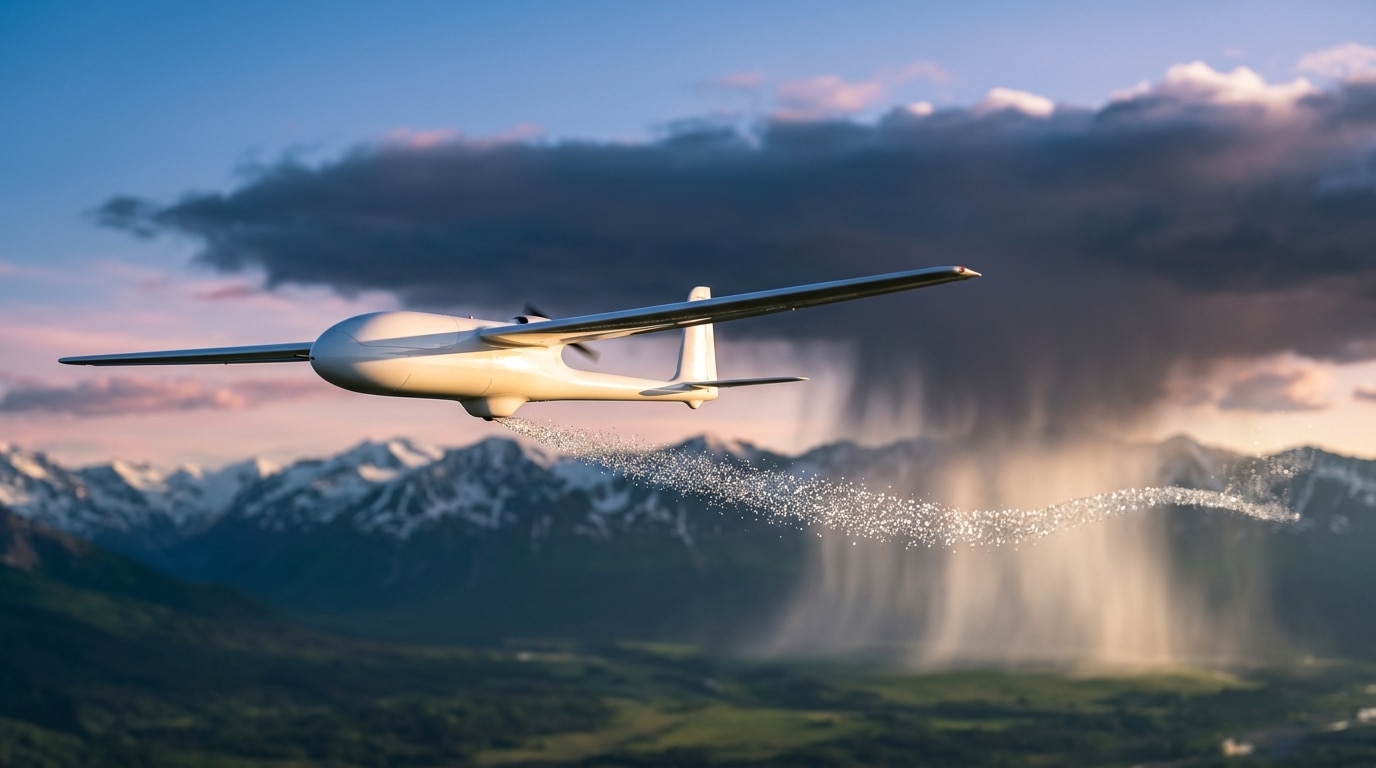
What if rain were no longer merely a climatic phenomenon, but a product that a company charges for on demand? In Alaska, the startup Rainmaker claims to have dropped nearly 70,000 m³ of water using cloud-seeding drones. An impressive figure, yet entirely self-reported, which raises a novel legal question: who owns this artificial rain?
- Rainmaker claims to have generated around 70,000 m³ of rain in Alaska via drone cloud-seeding, but this figure is an unverified statistical estimate, not confirmed by an independent agency.
- The company raised $100 million after these trials, prompting questions about its incentive to demonstrate the effectiveness of its technology.
- No legal framework currently defines who owns artificially triggered rain, while the pilots’ union ALPA already opposes these operations.
- Drones that make it rain on command: the electrifying promise in Alaska
- 70,000 m³ of water announced by the company: a figure to treat with caution
- Silver iodide and sky ownership: the old technique that raises a new question
Drones that make it rain on command: the electrifying promise in Alaska
Above the Kenai Peninsula in southern Alaska, the California-based Rainmaker company conducted an operation that sounds almost like science fiction. In the span of three hours, they say they coordinated seven cloud-seeding missions using drones, in response to a depressional system moving over the Gulf of Alaska.
The rationale behind this maneuver is far from trivial. Rainmaker seeks to prove that its technology can trigger or amplify precipitation where it is needed, whether to combat drought, fill reservoirs, or support agriculture. A seductive promise on paper, especially at a time when water is an increasingly contested resource.
Yet the operation, carried out near Homer, a small fishing town famed for its love of the natural environment, did not go unnoticed. Residents and local officials quickly expressed discomfort with this intervention on a weather system that, by definition, knows no property boundaries.
70,000 m³ of water announced by the company: a figure to take with a grain of salt
The figure that circulated through the American media deserves careful scrutiny. Rainmaker estimates that its operations produced between 45 and 65 acre-feet of net new precipitation, with an average claimed at 57.6 acre-feet. Converted, this amounts to about 71,000 m³, or nearly 18.8 million gallons by U.S. measurements.
The important detail, often overlooked in splashy headlines, is that this volume was never measured directly. The company says radar detected signatures of precipitation linked to the seeded clouds, then inferred the amount of extra water produced by calculation. In other words, this is a statistical estimate, not a ground-based rainfall measurement.
This methodological ambiguity makes sense when you consider who holds the figure. Rainmaker clearly has a commercial incentive to prove its technology’s effectiveness, especially since the company raised $100 million after its Alaska trials, with support from funds such as Lowercarbon Capital and Upfront Ventures. No independent agency has yet confirmed this result.
There is also a fundamental physical limit to recall: cloud seeding does not conjure rain from nothing. The technique requires clouds already carrying moisture and favorable conditions. In most cases, it aims to amplify precipitation that would likely have occurred anyway, which further complicates a precise assessment of its real impact.
Silver iodide and sky ownership: the old technique that raises a novel question
Technically, nothing entirely new is at stake. Cloud seeding with silver iodide is a known method that has been used for decades, dispersing tiny particles that can serve as condensation nuclei for water vapor. For this operation, two drones dispersed 19 silver iodide flares, each releasing about 19.7 grams of compound, for a total of roughly 374 grams.
What changes today is the scale and autonomy of these operations, made possible by drones that can fly near cloud masses without a human pilot. Alaska’s Department of Natural Resources noted that using a drone for research on state lands is permitted without a specific permit. The problem is that the same agency has no jurisdiction over cloud seeding as such and has issued no particular authorization for this practice.
This regulatory gap worries beyond Alaska’s borders. The American Airlines Pilots Association (ALPA) has asked the federal aviation authority to reject Rainmaker’s request, arguing that the company does not demonstrate a safety level equal to what is required for this type of aerial operation. Three U.S. states have even gone further by enacting laws that outright ban weather modification.
And this is where the real question emerges, one that extends far beyond the technical. If a company artificially triggers rainfall over a territory, who owns that water? The residents who receive it on their land? The company that produced it? The downstream communities that may have depended on that same depressional system for their reservoirs? Water law, long built around the notion of a natural resource, has never quite anticipated the idea of rain manufactured on demand by a private company.
Between technological wonder and legitimate concerns of Homer’s residents, this case illustrates a gap that will likely repeat elsewhere. The figures put forward by Rainmaker, as spectacular as they may be, remain corporate claims awaiting independent verification. But the question they pose will not disappear so easily: until the law decides who owns the sky and what falls from it, every new operation of this kind will continue to sow, literally and figuratively, far more than mere raindrops.
Source : Rainmaker
