
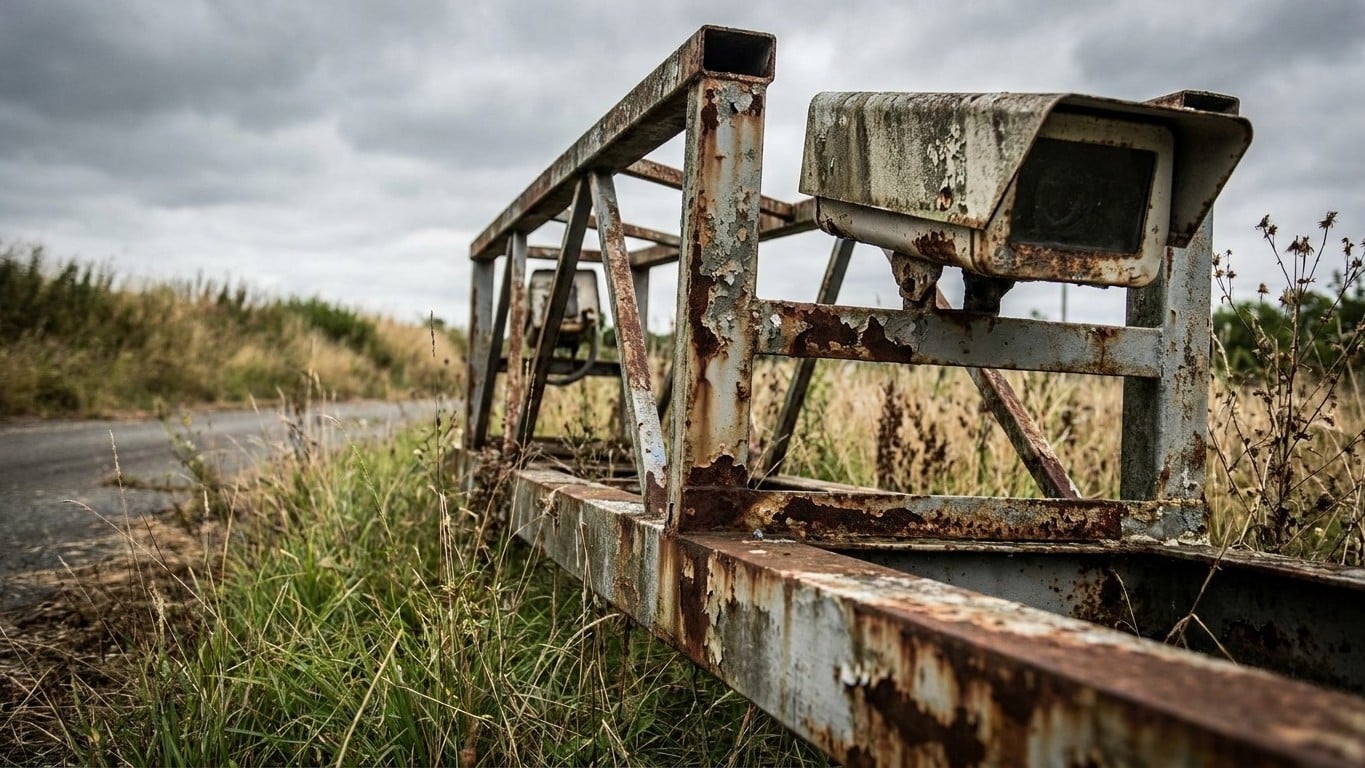
174 toll gantries. Set along France’s highways in the summer of 2013, fitted with cameras and linked to a cutting-edge information system. These steel frames crowned with surveillance cameras, erected to regulate the truck ecotax, never fulfilled their intended role even once. Twelve years later, the gantries continue to rust by the roadside, and it is still the taxpayer who shoulders their upkeep. This is not a quaint footnote of local politics: it stands as one of the most thoroughly documented bureaucratic blunders in French budgeting, which the Court of Auditors did not hesitate to call a “very costly” disaster.
À retenir
- 957 million euros paid to the Ecomouv’ consortium for a project that was never operated
- 174 gantries installed in 2013 but abandoned in 2014 without a single euro collected
- 9.83 billion euros in foregone revenues during the planned operational period
A Billion Euros for Nothing: The Brutal Tally
According to the Court of Auditors, the State actually spent close to a billion euros on this venture: 957 million euros paid as compensation to the Ecomouv’ consortium, tasked with rolling out the system, and 70 million euros committed by administrations. To put this into perspective, it equals the annual budget for maintaining France’s national roads, all poured into a project that never yielded a single euro in revenue.
On October 30, 2014, the State terminated its 2011 contract with the Franco-Italian Ecomouv’ consortium, under a public-private partnership. The bill for this termination was spread out: nearly 518 million euros in compensation paid in 2015, the remaining 440 million euros disbursed from 2016 to 2024, with an extra cost of 35 million euros tied notably to interest on the debt. The dispersion was designed to blunt political pain, but not the magnitude of the bill.
Beyond the contract termination, the physical tally is staggering. The 170 gantries, 230 control terminals for secondary roads, 720,000 devices intended for trucks, not to mention a state-of-the-art data center, cost 652 million euros, according to the Court of Auditors. What happened to their resale value? Some assets were sold, but at prices ranging from 2% to 30% of their value at the time the contract was terminated. The computer servers were hawked off at just 2% of their acquisition cost: the perfect symbol of an investment with no return.
Yet the most dizzying figure remains the foregone revenue. Over the planned ecotax operating period (2014-2024), the revenue that never materialized amounted to 9.83 billion euros. These receipts would have funded transportation infrastructures, notably through the French Infrastructure Financing Agency. The Court also warns of potential disputes from tolling companies, estimated at up to 270 million euros in indemnity claims. So the final bill may not yet be closed.
From bonnets rouges to phantom gantries: a look back at a political wreck
Business leaders, transporters, workers in the agri-food sector, and farmers opposed the ecotax for several weeks, a per-kilometer levy that targeted trucks using gantries on free motorways. The project originated from the Grenelle de l’Environnement, launched under Nicolas Sarkozy. In 2013, François Hollande’s government, led by Jean-Marc Ayrault, intended to implement it. The convergence of social anger and opposition to the tax carried the day.
Facing the Breton “bonnet rouge” protests, amid a crisis in the agri-food sector, the tax was suspended on October 29, 2013 by former Prime Minister Jean-Marc Ayrault. It was replaced by a transit toll planned for 2015, before a “sine die” suspension by Environment Minister Ségolène Royal on October 9, 2014, under pressure from road haulers. Two successive governments, two abandonments. The project persisted through five years of vacillation before being definitively shelved.
What worsened the picture is the very nature of the contracts signed. The former State Secretary for Transport, Frédéric Cuvillier, himself described these contracts as “completely armored” on TF1 (June 4, 2026). When the tax was abandoned, compensation to Ecomouv’ rose to 957 million euros, with no recovery of a single cent. The gantries were not intended to collect the tax but to verify that trucks using the roads were registered with Ecomouv. For a former deputy, the system was already obsolete at the moment of its implementation: “It was very costly and it served virtually no purpose!”
The Real Victims: Motorists and Local Authorities
The abandonment of the ecotax did not erase the need for funding. It simply shifted the burden onto the wrong shoulders. The government’s decision to offset the loss of ecotax revenue by raising diesel taxes was criticized by the Court of Auditors as a questionable policy move. An increase of 4 cents per liter of diesel (TICPE) was introduced for heavy goods vehicles starting in January 2015.
The structural flaw of this substitution? It hits the wrong targets. The TICPE raise increases the costs on French heavy goods vehicles, while foreign heavy goods vehicles, which account for nearly 40% of traffic, contribute only marginally (about 2% of receipts). The ecotax’s objectives therefore remain unmet. And this measure shifts roughly 650 million euros per year onto motorists, who were not subject to the ecotax and who, in effect, finance its abandonment.
The Ecotax’s cancellation left local authorities stranded as roads deteriorate. The State could offset the revenue loss by raising diesel taxes, but municipalities gained nothing. Meanwhile, the big beneficiaries are the 250,000 foreign heavy goods vehicles that pass through France but buy their fuel elsewhere and thus do not contribute to maintenance costs, even though they account for 40% of freight traffic.
What Our Neighbors Have Achieved, and What We Have Missed
The international comparison is telling. In 2005, Germany introduced ecotax, the LKW-Maut, initially on trucks over 12 tonnes. Since 2015, all heavy goods vehicles over 7.5 tonnes using motorways and some federal roads must pay tolls. Since July 1, 2018, Germany’s ecotax also covers all national roads. No political crisis, no phantom gantries, no billions swallowed in indemnities.
A notable positive aspect of Germany’s LKW-Maut is how price modulation by vehicle size reshaped the heavy-vehicle fleet. The share of Euro 5 trucks—the least polluting category—rose from 1% in 2005 to 49% in 2009. The German tax thus had a tangible environmental impact, where France produced nothing more than rusting steel frames along its national roads.
The Court of Auditors argues that this industrial and social failure prevents France from improving the funding of the costs of using its road network, especially since ecotax systems have achieved this goal in several neighboring countries—Germany, Austria, Poland, and Belgium. The paradox is clear: dismantling the 174 gantries still standing would cost TF1 estimates an additional 7 million euros. They are not taken down because it’s too expensive, yet maintenance continues, which also costs money. A stark illustration of a public decision that, at every turn, managed to find the most costly solution.
Sources: participationcitoyenne.ccomptes.fr | alsacenature.org
