
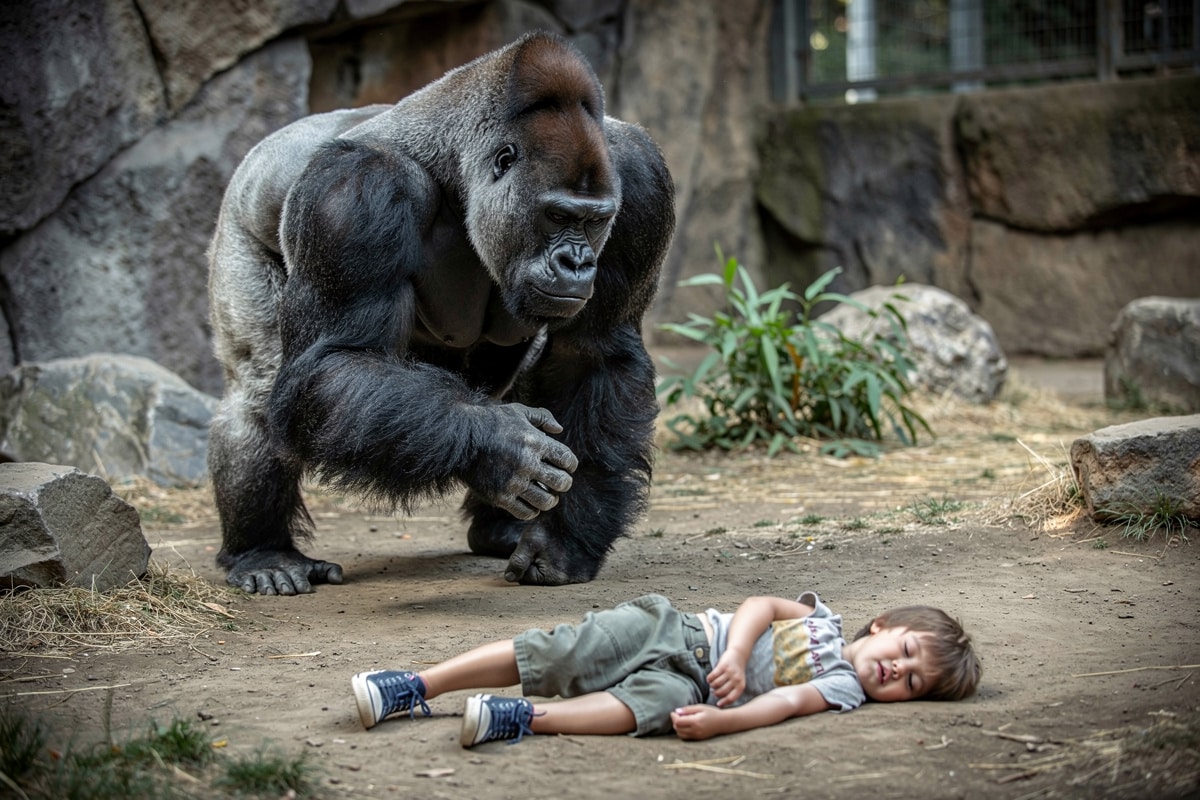
A five-year-old child lay unconscious at the bottom of a pit, surrounded by several adult gorillas. The scene looked like a nightmare. Yet that day at Jersey Zoo, the opposite happened: a dominant male nicknamed Jambo watched over him, delivering one of the most striking images in the history of primatology.
- In 1986, after Levan Merritt toppled into the enclosure, the gorilla Jambo protected him by placing himself between him and the other gorillas until help arrived.
- Filmed and photographed by visitors, the scene traveled the world and helped transform the public image of gorillas.
- In homage to Jambo, who died in 1992, a bronze statue bearing his likeness was installed at Jersey Zoo and unveiled by Levan Merritt, who had grown into adulthood.
- A Three-Metre Fall That Could Have Changed Everything
- When the So-Called Monster Becomes a Protector: The Minutes That Stunned the World
- Jambo, an Unwitting Star: How a Gesture Changed Perceptions of Gorillas
A Three-Metre Fall That Could Have Changed Everything
That summer day in 1986, Jersey Zoo buzzed with visitors. Among them, five-year-old Levan Merritt leaned too far over the railing that overlooks the gorilla enclosure. The edge gave way, and he fell.
The child tumbled three metres and crashed to the ground, knocked unconscious by the impact. He lay there, exposed and defenseless in front of a group of western lowland gorillas, a species then imagined capable of the worst toward an intruder so vulnerable.
Around him, the visitors stood frozen, paralyzed with fear. In the public imagination of the time, fueled largely by disaster films and sensational reporting, a single adult gorilla weighing nearly two hundred kilos could mean only one thing: a deadly danger to a defenseless child.
When the So-Called Monster Becomes a Protector: The Minutes That Stunned the World
That is when Jambo, the group’s dominant male, approached the motionless body. Instead of attacking, he positioned himself between the child and the other gorillas, as if forming a shield. The move was clear, almost deliberate.
Jambo then gently stroked the boy’s back, a contact observers would later describe as a calming gesture, akin to the exchanges gorillas share within their group. Nothing in his behavior suggested the aggression feared by the crowd.
Jambo protected the child for several minutes before the keepers intervened, allowing Levan Merritt to be rescued without any of the gorillas attacking him. When the boy regained consciousness and began to cry, Jambo and the rest of the group withdrew spontaneously, leaving room for an ambulance attendant and two keepers who came to extract him from the enclosure.
A large portion of the scene was filmed on amateur video by a visitor, Brian Le Lion, and abundantly photographed by the day’s spectators. These rare and striking images quickly circulated well beyond the zoo’s walls.
Jambo, an Unwitting Star: How a Gesture Changed Perceptions of Gorillas
Broadcast across major news networks and picked up by international press, images of Jambo traveled around the world in a matter of days. For the first time, the public saw a gorilla not as a wild beast prone to sudden violence, but as an animal capable of empathy toward another species.
This sequence helped to enduringly soften the irrational fear surrounding the supposed violence of gorillas. Jambo, born at Basel Zoo in Switzerland before being transferred to Jersey in the early 1970s, became, almost by accident, a symbol of animal conservation, embodying a powerful counterexample to Hollywood stereotypes.
His death in 1992 did not erase his imprint. A bronze statue in his likeness was installed at Jersey Zoo, and it was Levan Merritt himself, who had stayed in contact with the facility, who returned to inaugurate it. The now-adult boy thus maintained a lasting connection with the one who, in a sense, watched over him that day.
Three decades later, another tragedy would remind us that the outcome could have been very different. “At Cincinnati Zoo, in 2016, Harambe the gorilla was shot after dragging for ten to fifteen minutes a four-year-old boy who had fallen into his enclosure.” The circumstances differed, but the contrast between the two stories illustrates how unpredictable each situation remains, and how much Jambo’s behavior still serves as a reference for researchers studying animal behavior today.
Moreover, Jambo’s legacy extends beyond the anecdote. Jersey Zoo has recently given its gorillas a completely redesigned enclosure, inaugurated by Princess Anne, patron of the Durrell Wildlife Conservation Trust, a multi-million-pound investment that testifies to the special place this story still holds in the park’s identity nearly forty years after the events.
