
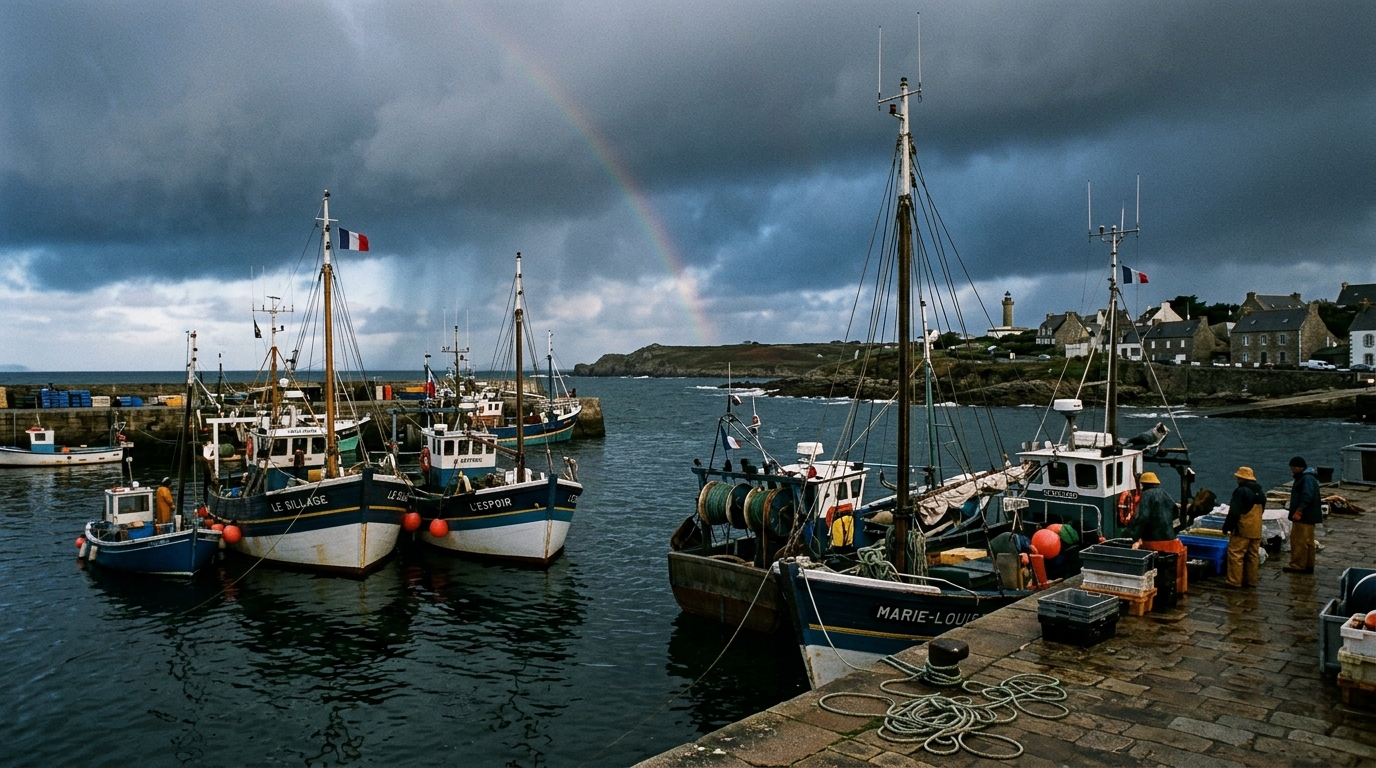
A rainbow appeared in the sky this Wednesday, just after dawn. Many saw it as a reassuring sign, heralding the sun’s lasting return. Bad news: sailors thought the opposite. This morning’s observation, far from being merely a natural spectacle, carries a warning as old as sailing itself. Before stowing the umbrella, it’s wiser to understand what this phenomenon really says about the weather in the hours to come.
- A morning rainbow forms in the west, where the rain is heading toward you, unlike the evening rainbow that signals a lull.
- A disturbance crossed France on Wednesday with rainfall totals of 15–30 mm, exceeding 100 mm near the Mediterranean, and snow on the Alps from 1,500 meters upward.
- Soils remain waterlogged, with 84% of the country under a decade-long drought as of September 20, and new heavy rain episodes possible through mid-December.
- A Dawn Rainbow That Questions the Day’s Weather
- The English-language Maritime Proverb That Illuminates This Morning’s Phenomenon
- Science Confirms What Sailors Already Knew About the Rain to Come
A Dawn Rainbow That Questions the Day’s Weather
Seeing a rainbow early in the morning is bound to surprise. This optical phenomenon is not mysterious scientifically: it forms when the sun shines during a shower, water droplets reflecting light into a colorful spectrum. But its position in the sky is not arbitrary. It depends directly on where the rain is relative to you. In the morning, the sun rises in the east. For a rainbow to appear, it must thus project toward the west, where the disturbance lies. In other words, the observed rain is not behind you; it is in front, moving toward your region. This is the exact opposite of a sky that clears for good.
The English-language Maritime Proverb That Illuminates This Morning’s Phenomenon
This logic is not a recent hunch. An English-language maritime proverb, well documented, links the morning rainbow to caution and the evening one to more favorable conditions. This tradition is notably cited in a scientific study published in 2022, available in the archives of NOAA, the United States’ National Oceanic and Atmospheric Administration. Sailors, whose safety depended on their ability to anticipate gusts and squalls, had observed this pattern long before weather bulletins emerged. A morning rainbow meant you should beware; an evening rainbow suggested a lull in the weather. In France, a similar saying has circulated for a long time: “Morning rainbow, feeds the mill,” a vivid expression classified among proverbs foretelling bad weather. Two cultures, two languages, one conclusion drawn from patient observation of the sky.
Science Confirms What Sailors Already Knew About the Rain to Come
This empirical knowledge fits perfectly with the current weather context. Météo-France confirmed that a disturbance crossed France this Wednesday, bringing rain to nearly all regions. Totals commonly ranged from 15 to 30 millimeters, with amounts surpassing 100 millimeters near the Mediterranean. Snow even returned to the Alps, initially around 2,000 meters, then down to 1,500 meters. This rainy spell is part of a broader sequence: a Mediterranean episode had already affected Languedoc a few days earlier, which is why the rainfall-inundation vigilance level was raised before being lowered to yellow for Hérault, Gard and Bouches-du-Rhône. Météo-France notes that these Mediterranean episodes occur mainly from September to mid-December, a period when the sea remains warm, with an average of three to six episodes per year. In other words, the risk of further rain is not ruled out. Especially since soils remain saturated: the national moisture index stayed at a record high throughout last month, brushing the all-season absolute record. By September 20, 84% of the territory was affected by a decade-long drought, a situation that eases only slowly despite recent rains. Only the Gard and Hérault locally returned to a more normal seasonal condition. For the coming weeks, Météo-France favors a warmer-than-normal scenario, with more humidity in the west of the country, but moderate confidence in precipitation. In this unstable context, it is wiser to avoid the classic mistake of planning an outing or outdoor work based solely on a clear sky at dawn. Keep an eye on vigilance bulletins, especially if you live near the Mediterranean coast, and always plan rain protection in case of a morning rainbow.
This Wednesday morning, the sky had already spoken well before the first forecasts. The rainbow observed at dawn did not announce a recovery, but served as a reminder to proceed with caution, a legacy of generations of sailors who had only their eyes to anticipate the weather. A timely reminder in this period when soils remain waterlogged and where intense rainfall episodes may still multiply until mid-December. Before definitively stowing the rain jacket, a final glance toward the west remains the best habit to adopt.
