
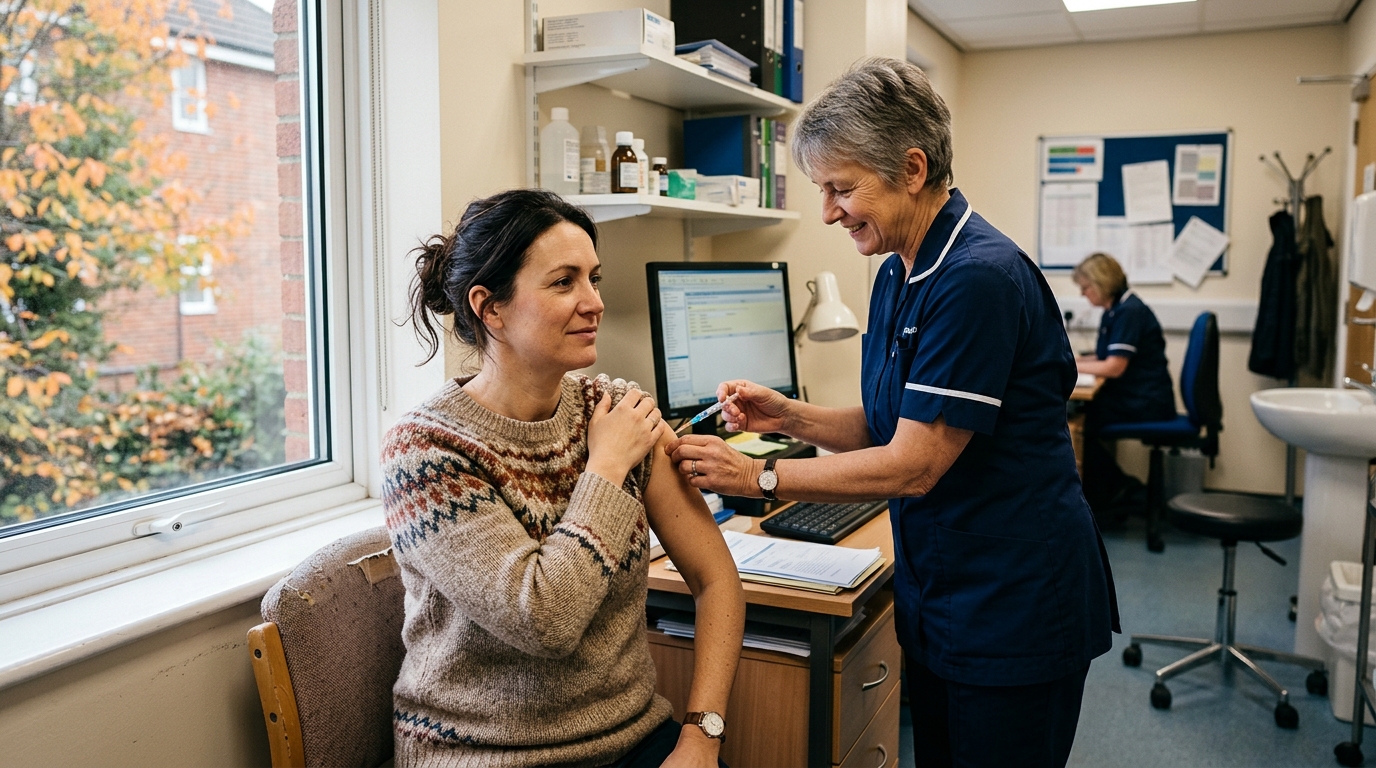
Contrary to what many people think, the usual late-October window for getting the flu shot could arrive too late this year. Signals rising from Japan, the United Kingdom, and the American West Coast tell a story that is unusual for a period still marked by the tail end of the Indian summer. Some Japanese schools had to close their doors as the new school year had just begun, while laboratories in the UK and the United States are recording influenza test positivity rates that would not be expected for several weeks. This could upend a long-standing habit: waiting until the end of October to be vaccinated. Between a virus that seems to have gained ground and a mutation that worries researchers, it is time to take stock of what is actually at stake this season, and what this change means in practical terms for those who want to protect themselves at the right moment.
- Early flu outbreaks appeared as early as summer in Japan, the United Kingdom, and the American West Coast
- The H1N1 subtype now accounts for 96% of cases, overtaking the H3N2 that dominated last season
- A mutation named G155E, detected in the majority of sequenced samples, could reduce the effectiveness of existing immunity
- Epidemiological signals accumulate ahead of schedule
- The return of H1N1 in the face of a clear drop in H3N2
- A mutation in the virus that complicates vaccination decisions
- Researchers torn between vigilance and scientific caution
- Should you move up your vaccination this year?
- What this early season reveals about global flu surveillance
Epidemiological signals accumulate ahead of schedule
Everything began in Japan, where epidemic clusters appeared as early as August and in the very early days of September, forcing some schools to close as the new term had barely begun. A calendar that is rather perplexing, since flu typically makes its appearance with the first frosts. On the UK side and on the West Coast of the United States, the observation is similar: laboratories are reporting unusually high rates of positive flu tests for this time of year. Virologist Scott Hensley, from the University of Pennsylvania, notes that if this trend holds, the American flu season could prove to be incredibly early. This could give a serious push to discussions about the best time to get vaccinated.
The return of H1N1 in the face of a clear retreat of H3N2
Another factor drawing the attention of specialists is the shift in the dominant strain. This season, the H1N1 subtype is steering the show, accounting for no less than 96% of subtyped cases according to American data collected by the end of September. A real turnaround, since the previous season was led by H3N2, which now represents only about 4% of cases. As for influenza B, it is strikingly absent at this date. This shift is not trivial, adding another layer of complexity to an already loaded equation.
A mutation in the virus that complicates vaccination decisions
If the shifting calendar raises questions, it is mainly a mutation called G155E that truly worries researchers. Alex Greninger of the University of Washington in Seattle found it in 13 of 17 fully sequenced H1N1 samples, sourced from hospitals and clinics in the region over recent months. A striking figure. This mutation was not entirely surprising: it had already been spotted by Jesse Bloom of the Fred Hutchinson Cancer Center in a preprint published on bioRxiv the previous month, which has not yet undergone peer review. His work tested antibodies from 260 blood samples collected in Australia and the United States against 148 circulating influenza A strains. Result: some strains carrying this mutation could partially evade recognition by the immune system. In other words, even immunity built through prior vaccination or past infection could be less effective against these variants.
Researchers torn between vigilance and scientific caution
In light of these elements, the scientific community proceeds with prudent caution. James Hay, an epidemiologist at Oxford University, notes that an early start to the flu season does not necessarily mean it will be more severe, since the data available remains limited at this stage. An important nuance that helps avoid panic. But other voices are more concerned. Caitlin Rivers of Johns Hopkins University recently told her Force of Infection newsletter that something is brewing this year. She even plans to move up her own vaccination rather than waiting for the usual mid- or late-October window. A testimony that, coming from a field expert, deserves serious consideration without giving in to alarm.
Should you move up your vaccination this year?
This is precisely the question many are asking now. Data suggest that the flu season in the Northern Hemisphere may have started earlier than anticipated, prompting a reevaluation of the annual flu vaccination schedule. Rather than passively waiting for the traditional late-October window, it may be wise to look into vaccination options now. Here are a few useful benchmarks to keep in mind to gain clarity:
- The current dominance of H1N1 changes the risk profile compared with the previous season
- The G155E mutation could partially reduce the effectiveness of existing immune protection
- Early outbreaks observed in Japan, the United Kingdom, and the United States urge not to delay too long
What this early season reveals about global flu surveillance
Beyond the immediate concern, this situation underscores the importance of a responsive and coordinated international flu surveillance system. Signals coming from Japan, then confirmed by UK and US data, show how interconnected epidemiological tracking networks are and how valuable they are for anticipating trends. The sequencing work carried out in Seattle, coupled with the preprint on the G155E mutation, also highlights the speed with which research can respond to a virus that evolves without warning. One thing is certain: this flu season, if it continues to press ahead of the usual calendar, reminds us that collective vigilance remains the best ally against a virus known for its yearly surprises.
While awaiting more details on how this mutation evolves and the true severity of the season, it is wise to keep a close eye on health recommendations. A small head start never costs anything, especially when it comes to protecting oneself and those around them.
