
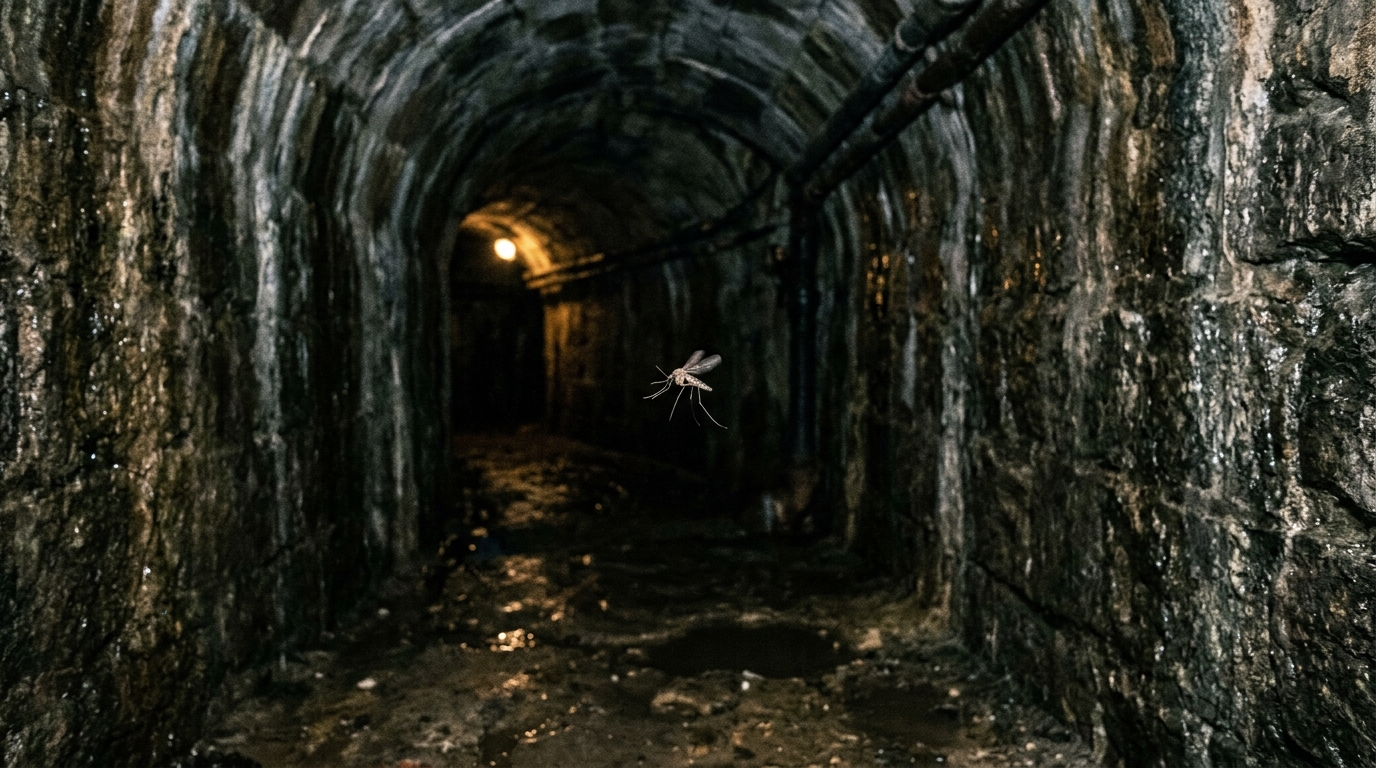
Returning home on an autumn evening, descending into the parking garage or stepping into the subway corridor, and suddenly feeling that familiar itch on the skin. A mosquito bite, even as the thermometer already shows autumn temperatures and winter is closing in. This scenario, many Parisians have experienced without paying it much mind, convinced it was merely a late visitor from the good season. In reality, beneath our feet, an entire lineage of mosquitoes has simply erased the notion of winter from its existence. It bites in every season, including in the heart of January, in the darkness of tunnels and urban basements, where no one expects it.
- Culex pipiens molestus, a subterranean lineage living beneath Paris, has lost diapause and bites year-round thanks to the stable warmth of tunnels, sewers, and cellars.
- This mosquito has specialized on human blood, can lay eggs without a prior blood meal, and mates directly within underground galleries.
- It does not transmit malaria, dengue, or chikungunya, but it can carry the West Nile virus, which justifies health surveillance.
- The mosquito that erased its own winter
- Parisian infrastructures transformed into a permanent incubator
- A diet that betrays accelerated evolution
- A city that unintentionally breeds a new species
For the vast majority of mosquitoes, cold acts as a full stop signal. This mechanism, termed diapause, triggers a radical slowdown of metabolism: reproduction halts, the insect enters a dormancy, and it patiently waits for the return of warmer days to resume normal activity. It is this seasonal logic that explains why we almost always associate mosquitoes with spring and summer, never with January.
Culex pipiens molestus, however, seems to have simply ignored this biological rule. No drop in temperature triggers this stop signal for it: it continues to feed, to mate, and to lay eggs, regardless of the season. This detail, which might seem minor, reveals something much deeper: this lineage has genetically freed itself from a survival mechanism that is millions of years old, solely because its environment allowed it to do so. The divergence between this underground form and its surface cousin would date back more than a thousand years, a history far older than the Paris Metro or the London tunnels with which it is often wrongly associated.
Parisian infrastructures transformed into a permanent incubator
If this winter truce can exist, it is because the bowels of Paris offer conditions perfectly suited to continuous activity. The subway tunnels, the sewers, and the basements of buildings maintain a stable temperature, often above 10 degrees Celsius, even when the surface is encrusted with frost. This artificial warmth recreates, underground, the conditions of a perpetual spring, a climate so mild that reproduction never stops.
The mosquito no longer needs to wait for better days: a stagnant crevice beside the rails, a bucket forgotten in a cellar, or a dirty puddle suffices as soil for larvae. This thermal stability turns urban basements into a true closed ecosystem, entirely cut off from the seasonal cycles that govern surface life. Populations virtually identical are found in environments as distant as Amsterdam’s canals, the old Alexandria cisterns, or Maghreb grain silos, proof that this underground way of life is not a local anomaly.
A diet that betrays accelerated evolution
Beyond its relationship with cold, this underground lineage stands out through habits markedly different from its surface cousin. While the classic mosquito bites birds and humans indiscriminately, Culex pipiens molestus has specialized almost exclusively on human blood, a food source abundantly available in the confined spaces it inhabits. It even lays its first eggs without needing a prior blood meal, a trait that dramatically speeds up its reproductive cycle.
Its courtship also differs from that of the typical species: forget the large aerial swarms seen outdoors; here, mating takes place in the confined darkness of galleries, just a few centimeters above the ground. These behavioral and genetic differences are so pronounced that some now regard this subterranean lineage as almost a distinct form, engaged in rapid specialization driven by its urban isolation.
A city that, unintentionally, breeds a new species
What this underground population reveals goes far beyond mere entomological curiosity. It concretely illustrates how human occupation can alter, in the space of only a few millennia, the biology of an organism as a whole. Without diapause, with a diet focused on humans, and with an entirely artificial habitat, Culex pipiens molestus embodies a form of express adaptation to the modern city, an evolutionary shortcut made possible by our infrastructures.
Paris is by no means an isolated case: London, New York, and many other metropolises host similar lineages, born from the same compromise between artificial warmth and human proximity. From a public health standpoint, however, there is reason for reassurance: this mosquito does not pose a real daily threat and is not a vector of malaria, dengue, or chikungunya. Nevertheless, it remains capable of transmitting certain pathogens that are rarer in our latitudes, such as the West Nile virus, justifying ongoing surveillance of these subterranean populations.
Behind this somewhat disquieting anecdote of bites in the middle of winter lies, therefore, a genuine lesson in accelerated evolution. In just a few hundred generations, the city has created its own biological rules, freeing certain species from the seasonal constraints that had governed their existence until now. So the next time an itch appears in the metro on a November or January evening, we can tell ourselves that it is not a mere climate accident, but the living trace of an adaptation quietly at work for centuries beneath our feet.
