
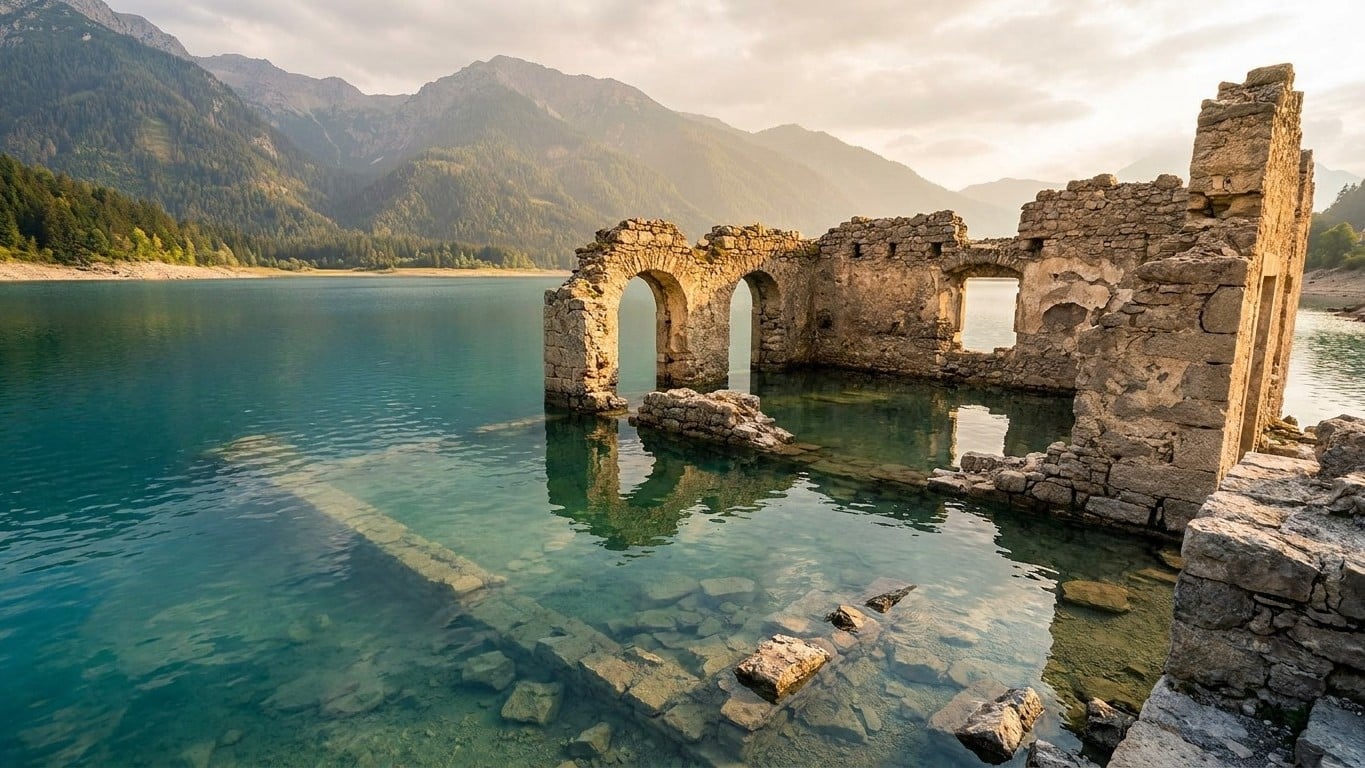
Beneath the turquoise waters of Lake Sainte-Croix lies an entire village. Not a myth, not a Provençal legend: Salles-sur-Verdon, a small Var town of a few hundred souls, was deliberately submerged in 1973 to fill the region’s largest water reservoir. Since the episodes of exceptional drought in 2022, the reappearance of its ruins is no longer rare: authorities now regard it as recurring, directly linked to climate change. Walls jutting out of the water, a road reemerging in the middle of nowhere. The past refuses to stay beneath the surface.
Key takeaways
- An entire Provençal village vanished beneath the waves in 1973: what secrets does it still guard?
- The 2022 drought lowered the lake by six meters: what did that reveal?
- 44 French valleys were submerged for hydroelectric dams: what human cost?
The richest valley in Var, doomed as early as 1908
A symbolic flock, a few sheep frozen in stone amid a handful of lavender, watched over by a photograph of “yesteryear”: this is the image that survives today of the former village of Salles-sur-Verdon, which lay in “the richest valley of Var,” submerged beneath the Verdon’s waters in 1973 during the filling of the Sainte-Croix dam. The sentence, however, dates much earlier. In 1908, Georges Clemenceau, then President of the Council, undertook a donkey-back trek along the Verdon from Fontaine-l’Évêque to Lake d’Allos: even then, the development of the Verdon and the construction of dams at strategic points along its course were being contemplated. Sixty-five years between the project and the drowning. Sixty-five years during which the inhabitants believed, then hoped, then fought.
There was the baker, where people came to have their dishes baked; the grocery, which distributed gasoline; the Auberge du Coin Perdu, where visitors were treated to lamb and other valley specialties; the laundries where, from grandmothers to granddaughters, garments were beaten with a battoir and conversations ran thick. Village life, sacred and vivid, anchored in a Provençal limestone that EDF and Paris did not seem ready to respect.
The three villages directly threatened by the birth of Sainte-Croix, Les Salles, Bauduen and Sainte-Croix, fought together for six years until a final revision of the water level—reducing the lake’s depth—left Les Salles-sur-Verdon isolated as the sole threatened site. An isolation that bore a striking resemblance to a tactic. Graffiti on the walls expressed the anger of the inhabitants: “EDF, thieves, plunderers” or “Var is not for sale, damn Paris.”
Destruction, brick by brick, then water
Despite fierce local opposition, the expropriations were approved in 1971. March 4, 1974 marks a tragic date: the last houses still standing were dynamited, and the water began to rise. The old village of Salles-sur-Verdon gradually disappeared beneath the waves. Only the church was dismantled stone by stone, in the hope of reconstructing it elsewhere. The medieval bridge that connected Les Salles to Moustiers, deemed “without interest” by EDF experts, now lies at the bottom of the lake. A single image survives: this bridge can be seen in the opening minutes of the film “Forbidden Games” by René Clément (1951). An archive, by accident.
Compensated villagers felt robbed: their lands, rich in truffles providing supplementary income to farmers, were undervalued. The indemnity for the destruction of their houses, reduced by depreciation for age—inevitable in such old villages—made it unaffordable for many residents to buy new houses in the rebuilt village, sold off to real estate speculation. The mayor of Salles-sur-Verdon, Jean Gombert, saw in the disappearance of his village, home to 166 inhabitants, a human tragedy of considerable weight. A seemingly modest number, yet each displaced family carried with it generations of memory.
The result of all this sacrifice? With 22 square kilometers, 90 meters deep, and more than 750 million cubic meters of water destined for irrigation and potable use, the Sainte-Croix Lake is France’s fourth artificial lake. Its 10 kilometers in length and an average width of 2 kilometers have shaped, since the 1973-1974 water fill, a new territory: a tourist, profitable landscape built on ruins that no one sees.
When drought reopens the archives
The Sainte-Croix Lake level was never as low as in 2022: it fell by six meters. The main attraction, access to the Verdon gorges via the canyon, was closed. At the crisis’s peak, the water level dropped by 20 centimeters per day, the result of pumping coupled with intense evaporation. This abrupt retreat had an unforeseen side effect: the old stones of Salles-sur-Verdon reappeared. Foundations, walls, and even street lines resurfaced. The village refused to die completely.
Strange photos circulated on social networks: walls protruding from the water, a church nave rising from a lake half-empty, a road reappearing in the middle of nowhere. Water levels descend enough for foundations, walls and sometimes entire bell towers to emerge from the water. This phenomenon is not limited to Sainte-Croix. The list of submerged sites includes the Bourget and Brillat villages in the Jura (Lac de Vouglans), Chantecoq, Champaubert-aux-Bois and Nuisement-aux-Bois in the Marne (Lac du Der-Chantecoq), Port-Dieu, Mialet and Singles in Corrèze (Lac de Bort-les-Orgues). Between 1920 and 1990, forty-four French valleys were submerged under now-flooded dam lakes built to supply renewable electricity. Beneath each of them were lives.
These reappearances raise practical questions: re-emerging ruins attract curious visitors, photographers, and local historians, but also raise safety concerns about structures weakened by decades of immersion. Several dam managers, notably EDF in France, have relaxed their access rules during major drawdowns. A recent concession, as if the administration finally recognized that these ruins also belong to those who come from them.
Memory does not drown
For a long time, submerged villages were a taboo subject for communities. The construction of dams had caused painful expropriations, and no one wanted to reopen old wounds. The situation changed after the late 2010s. Museums appeared almost everywhere to collect archives and objects testifying to life before the dam. At Salles-sur-Verdon, rebuilt on the plateau, the descendants of the displaced maintain a collective memory that eventually received official recognition.
The analogy with Tignes is striking. In 2000, the ruins of Tignes resurfaced during a lake lowering: 10,000 people, descendants of the expelled residents, came to visit the old village. Baptisms and weddings were even celebrated in the famous church. A village submerged since 1952, yet able to gather a whole crowd half a century later. The memory of places resists every dam.
If there are scars in memory, Lake Sainte-Croix has transformed this rural territory into a tourist hub organized around its lake, its mountains, and its famous gorges. About 40,000 tourists stay daily around the lake in the summer. They cycle, swim, photograph the turquoise reflections, unaware that 90 meters beneath their feet lie paved streets waiting for the next drought to bring them back to the world. Climate change has already decided that these resurrections will multiply. What the State drowned in 1973 to supply water to Marseille and Toulon now surfaces again each dry summer, like a memory that no one can truly erase.
Sources: info-chalon.com | varactu.fr
