
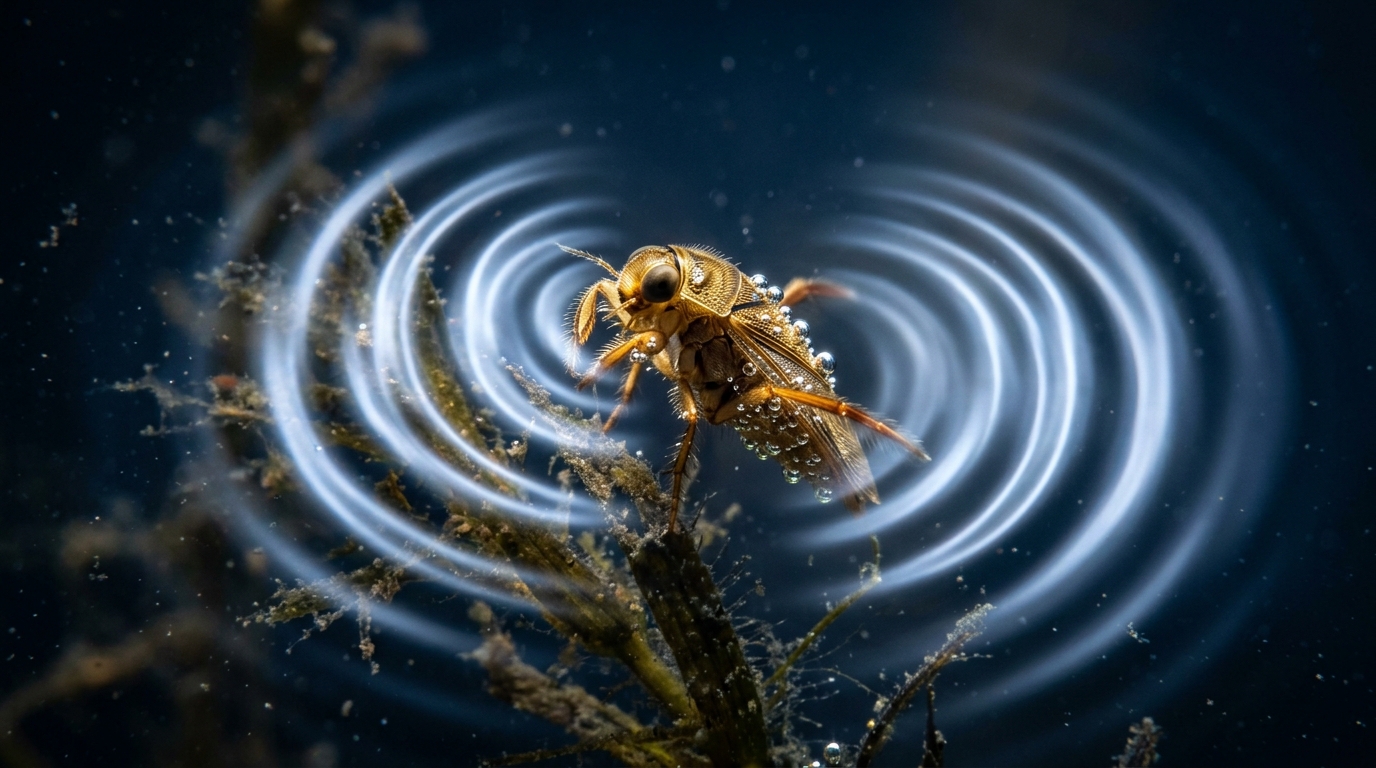
What if the title of the world champion across all categories did not belong to the elephant, the blue whale, or even the lion whose roar travels for kilometers? In the calm waters of our rivers and ponds across France, a minuscule insect barely 2 millimeters long holds a record that defies logic. When scaled to its size, this creature emits a noise so disproportionate that the scientists tasked with measuring it initially suspected a malfunction in their equipment. And perhaps the most astonishing aspect is the method it uses to sing, as unexpected as it is ingenious.
- The dwarf water boatman (Micronecta scholtzi), a 2 mm insect living in European ponds, produces a mating call reaching 99.2 decibels by rubbing its penis against its abdomen (stridulation).
- Compared to its size, its decibels-to-body-size ratio reaches 31.5, well above the animal average of about 6.9, earning it recognition by Guinness World Records.
- Most of this sound is lost when transitioning from water to air, so a passerby along a pond’s edge might only perceive a faint rustle.
- A Hidden Champion in Our European Ponds
- The Unusual Mechanism Behind This Sonic Record
- Why Size Does Not Dictate Acoustic Power
- What This Tiny Insect Reveals About the Limits of Biology
A Hidden Champion in Our European Ponds
Its scientific name, Micronecta scholtzi, probably means little to most of us, and that’s hardly surprising: this small, inconspicuous critter lives in total anonymity at the bottom of rivers and clear ponds across Europe, including France. It is sometimes nicknamed the dwarf water boatman, and it belongs to the Corixidae family, aptly dubbed the water cicadas. A name that makes sense once you discover what this insect is capable of.
At a length of just 2 millimeters, it could sit on the nail of a small finger without any trouble. Experts who study it recognize it thanks to a few precise anatomical details: a short pronotum, a distinctive dark pattern on the head, and above all a male genital apparatus featuring a twisted paramere, a trait that sets it apart from other close species in its genus. Nothing, at first glance, would hint that such a discreet creature could one day enter the annals of noise.
The Unusual Mechanism Behind This Sonic Record
That is where the story takes a turn as amusing as it is admirable. To woo females, the male dwarf water boatman does not have vocal cords or stridulating wings like crickets. He uses a far more surprising tool: his penis. Concretely, he rubs a ridge located on this organ against ridges on his abdomen, a friction phenomenon known as stridulation. The contact area involved in this rubbing measures a mere 50 micrometers, roughly the thickness of a human hair.
From this tiny gesture arises a sound that left French-British researchers literally speechless. Once recorded, the insect’s mating call reached as high as 99.2 decibels, a level comparable to a freight train rumbling past nearby, or the sensation of sitting in the front row of an orchestra playing at full blast. The result was so astonishing that sound engineers took the time to verify their instrument calibration, convinced a measurement error had crept in. It wasn’t the case.
Why Size Does Not Dictate Acoustic Power
We instinctively link an animal’s mass to its ability to make noise: the bigger the creature, the louder we imagine its cry. Calves, elephants, or lions come to mind right away. Yet when you factor in scale and the relationship between the produced sound volume and body size, the dwarf water boatman completely unsettles this intuition. Its decibels-per-body-size ratio would reach 31.5, versus an average of about 6.9 for most larger animals. A gap that would place it well beyond every other animal on this criterion.
This record did not go unnoticed, as the species has been recognized by Guinness World Records with the rather quirky title of the loudest penis in the animal kingdom. A detail that makes one smile, but more importantly it highlights just how abundant and surprising nature’s acoustic solutions can be, far from the clichés about the vocal might of large mammals.
What This Tiny Insect Reveals About the Limits of Biology
Yet this dazzling tableau deserves a little nuance: nearly all of this acoustic volume is lost as the sound moves from water to air. A walker along the autumnal shore of a calm pond might still perceive a faint rustle, a subtle trace of the underwater concert taking place beneath the surface. In other words, what we would hear would be only a minuscule fraction of the power the insect actually deploys in its own milieu.
This observation speaks volumes about the boundaries of our own biological representations. We still know relatively little about this species’ exact habits and habitat, beyond the sense that it thrives in the shallow waters of ponds or along lake margins. But this persistent mystery does not diminish the significance of its feat: the dwarf water boatman proves, in its modest and almost comical way, that acoustic power is never measured by the size of the one producing it.
Hard to look at a pond the same way after discovering this story. Beneath a surface that looks placid might lie one of the planet’s loudest singers, invisible to the naked eye, yet capable of rivaling, on its own scale, the most imposing creatures in the animal kingdom. The next time you stroll by the water, will you lend a more attentive ear to that apparent silence?
