
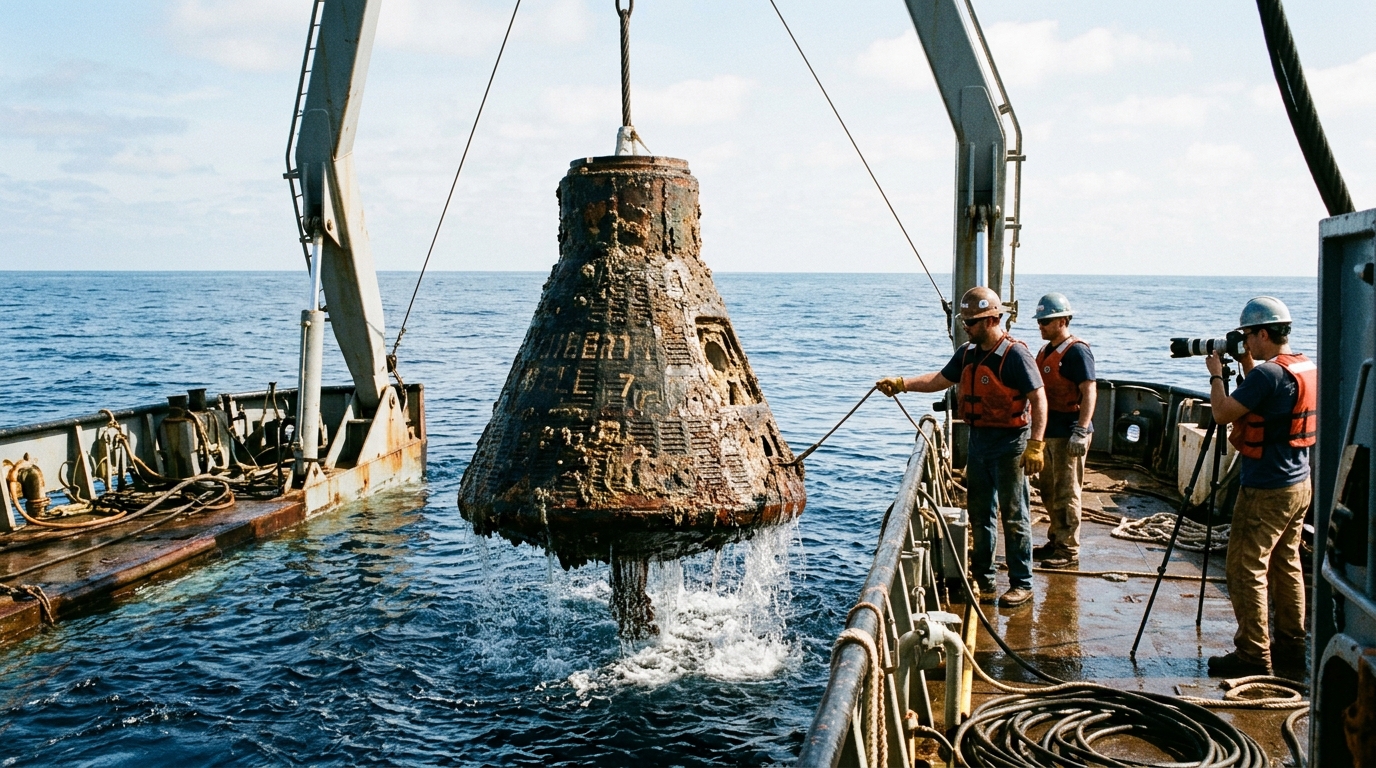
A hatch that pops open on its own, an astronaut nearly drowning, and a reputation sinking with the capsule. For nearly four decades, this story lingered in NASA’s memory as one of those mysteries that only the ocean depths could illuminate. Gus Grissom, a seasoned pilot, spent the rest of his career defending himself against an accusation never fully erased: that, in a moment of panic, he himself activated the mechanism that swallowed his capsule. It would take until the late 1990s for a submarine expedition to surface a silent witness, mute for thirty-eight years.
- The Liberty Bell 7 capsule, sunk in 1961 after its hatch opened accidentally, was located at 4,900 meters below the surface and then recovered in July 1999, thirty-eight years to the day after the mission.
- Analyses of the mechanism, too corroded, did not allow a definitive determination whether the hatch opened by itself or was triggered by Grissom, leaving the doubt in his favor.
- This incident led NASA to replace the explosive hatch with a manual system on Apollo, whose slower opening might have contributed to Grissom’s death in the Apollo 1 fire in 1967.
- Une écoutille qui explose, un astronaute accusé à vie
- 4 900 mètres sous l’eau : la traque d’une capsule spatiale
- Ce que le métal tordu raconte (et ce qu’il tait encore)
- Gus Grissom, la mer et la mémoire : ce que révèle vraiment Liberty Bell 7
An Exploding Hatch, a Lifelong Accusation Against an Astronaut
We are on July 21, 1961. Gus Grissom takes the helm of the Liberty Bell 7 for the Mercury-Redstone 4 mission, only the second crewed spaceflight in American history. The launch unfolds from Cape Canaveral, and after a successful suborbital flight, the capsule splashes down in the Atlantic, some 302 miles from the launch site. Up to that moment, everything seemed perfectly in line with the mission plan.
What happened next would leave a lasting mark on Grissom’s career. The hatch of the capsule, equipped with explosive bolts intended to enable rapid egress in an emergency, opened inadvertently. Water flooded the cabin immediately. Grissom managed to wriggle free just in time and was retrieved by a helicopter at the last moment, but the capsule, alas, did not share the same fate: too heavy, it sank inexorably toward the ocean floor. Soon, a question took root in NASA corridors and the press: did Grissom panic and trigger the hatch himself? The astronaut vehemently denied this version, insisting the mechanism had activated on its own. In the absence of physical proof, doubt persisted for decades, staining his reputation until his tragic death in the Apollo 1 fire of 1967.
4,900 Meters Underwater: The Hunt for a Space Capsule
Locating a Mercury capsule lost in the middle of the Atlantic would be an extraordinary undertaking. It was known to lie roughly 300 miles southeast of Cape Canaveral, yet the ocean is vast, and the seafloor there—the Blake Basin—descends to terrifying depths. An expedition organized by Liberty Bell-7 Inc., in collaboration with Discovery Channel, took up the challenge. In May 1999, using the Ocean Explorer 6000 sonar provided by Oceaneering International, the wreck was finally pinpointed at a depth of 16,043 feet, equivalent to about 4,900 meters below the surface.
Finding the capsule was one thing; lifting it out was another. The recovery operation, conducted in July of the same year, employed an unmanned vehicle named Ocean Discovery, equipped with lifting tools designed for the occasion and a Kevlar towline strong enough to bear the weight without tearing under tension. After several days of careful maneuvering at a depth where the pressure literally crushes metal, the capsule surfaced and was hoisted aboard a vessel on July 20, 1999, exactly thirty-eight years to the day after the mission. A troubling symbol, almost as if the ocean had waited for the anniversary to reveal its secret.
What the Twisted Metal Reveals (and What It Still Keeps Quiet)
Back in Cape Canaveral, precisely where it had launched nearly four decades earlier, the capsule delivers a discovery as moving as it is unexpected. Inside, restorers uncover cigarette butts, a disposable plastic cap, a Dial soap bar, five one-dollar bills, and no fewer than 52 Mercury dimes, those little ten-cent pieces Grissom had brought along as keepsakes to offer. Such objects, preserved by the cold, dark waters of the Atlantic, provide a window into the daily life of a pioneering astronaut at the dawn of space exploration.
Yet on the central question that had haunted everyone since 1961, the wreck remains remarkably discrete. Analyses of the hatch mechanism failed to yield a definitive verdict between a technical failure and an accidental activation by Grissom himself. The metal, corroded after nearly forty years of immersion, offers no clear conclusion. This lack of definitive proof, far from closing the debate, paradoxically reinforced the notion that Grissom may have been telling the truth: in the absence of damning evidence, the balance of probability tilts in his favor among many observers.
Gus Grissom, the Sea and Memory: What Liberty Bell 7 Really Reveals
Beyond the technical mystery, the Liberty Bell 7 episode had tangible repercussions for the future of the American space program. The 1961 incident prompted Apollo program engineers to discard the concept of an explosive hatch, deemed too unpredictable, in favor of a manual-opening system that, although slower, was considered more reliable. A decision that, viewed through the lens of history, took on a bitter edge: some now argue that this manual hatch, harder to operate in an emergency, may have hampered the crew’s rapid evacuation during the fatal Apollo 1 fire in 1967, which claimed Grissom and his two crewmates.
There is something deeply unsettling in this parallel. A man accused of triggering the premature hatch might, years later, have died because an emergency hatch proved too difficult to open quickly. The recovery of Liberty Bell 7 at the close of the 1990s offered not only a remarkably well-preserved artifact after nearly forty years at 4,900 meters, but also a chance to reexamine the memory of a pilot long judged by rumor, without tangible proof to convict or absolve him fully.
