
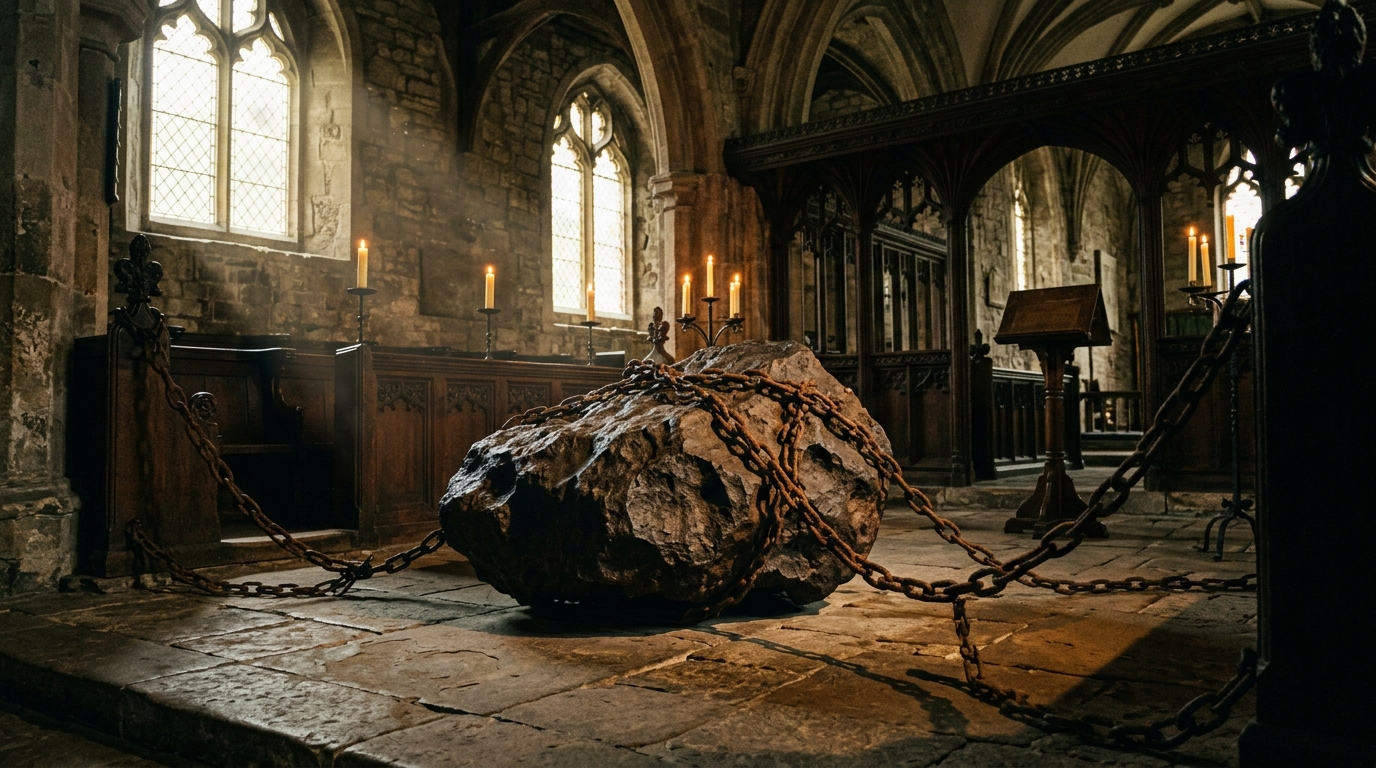
Imagine the scene: a deafening crash tears through the Alsatian sky, a blazing stone hurtles down into a field, and no one, absolutely no one, knows what it is. Faced with the unknown, the most common reaction would have been panic, flight, or even the outright destruction of this object fallen from nowhere. Yet, in Ensisheim, the villagers of the fifteenth century did the opposite: they cherished this stone, protected it, and even chained it as if it were a prisoner of high importance. This story, at the crossroads of medieval superstition and modern science, deserves attention for how it illuminates our relationship, even today, with what literally falls from the sky.
- In November 1492, a 127-kilogram meteorite crashed in a field near Ensisheim, in Alsace, constituting the oldest documented European fall of a stony meteorite with preserved material.
- Confiscated by the bailiff and later returned to the inhabitants, the stone was chained in the church choir of the village until the French Revolution, and even served as a symbol of political propaganda for Emperor Maximilian.
- Despite these precautions, the meteorite lost more than half of its mass through sampling and dispersal; the main fragment is today on display at the Regency Museum of Ensisheim, with other pieces housed in museums around the world, including Vienna.
- When the Sky Crashes on an Alsatian Wheat Field
- Chains Against Thieves, a Legend Against Oblivion
- The Oldest Celestial Stone Still Preserved in Europe
- Originally 127 kg, Less Than Half Today: What Remains of the Meteorite?
When the Sky Crashes on an Alsatian Wheat Field
We are in November 1492, a year History will remember mainly for Christopher Columbus’s discovery of the New World. Yet, thousands of kilometers away, another extraordinary event unfolds near Ensisheim, a small town then part of the Austrian realm and today nestled in Haut-Rhin. That morning, a rocky mass enters Earth’s atmosphere at a dizzying speed before crashing into a wheat field not far from homes. The impact must have been terrifying for witnesses of the time, who obviously had no notion of asteroids or cosmic phenomena.
The stone weighs 127 kilograms on arrival, a substantial heft for a simple rock fallen from space. What makes this event particularly remarkable for scientists today is that it constitutes the oldest recorded European fall of a meteorite with preserved material. Even more, it is the oldest stony meteorite fall on the continent for which material has survived to this day. A privilege that places Ensisheim on the world map of astronomy, long before the discipline was officially recognized.
Chains Against Thieves, a Legend Against Oblivion
As soon as the news spread, the population rushed to the impact site. Very quickly, residents began taking fragments of the stone, doubtless out of curiosity or to keep a tangible souvenir of this extraordinary event. It was then that the bailiff intervened to confiscate the object, aware of its symbolic and political significance. The stone was first transported to the fortified town and chained in a dungeon, as if it risked departing as mysteriously as it had arrived if left unattended.
The rest of the stone was then returned to the villagers, who decided to install it in the choir of the village church, still chained. It remained there until the French Revolution. This display, half-religious, half-superstitious, conveyed a clear intention: to prevent this precious and fascinating object from disappearing or being stolen. The episode even took on an unexpected political dimension when the humanist Sébastien Brant saw in it a favorable sign sent to Emperor Maximilian, which he would use to justify a war against France. A stone fallen from the sky thus became, for a few years, a tool of propaganda.
The Oldest Celestial Stone Still Preserved in Europe
What sets the Ensisheim meteorite apart from many other falls documented through history is its double exceptionalism: it remains not only the oldest European fall for which physical evidence has been preserved, but also the heaviest in Europe known to date. In this autumn season when people like to rediscover regional heritage treasures, it is amusing to note that this extraterrestrial rock, fallen one November day more than five centuries ago, continues to attract curious minds and enthusiasts.
The main piece is now visible at the Regency Museum, a building dating from the sixteenth century that houses precisely this celestial relic. Smaller fragments, meanwhile, have traveled much farther: they can be found in natural history museums around the world, including the Vienna museum in Austria, reminding us of the historical links between Ensisheim and the Austrian Empire of that era.
127 kg Originally, Less Than Half Today: What Remains of the Meteorite?
Here is the detail that surprises most when one looks closely at this story: despite all precautions taken by the residents of Ensisheim, the meteorite never regained its original mass. Between the samples taken in the hours after the fall, even before the bailiff’s intervention, and the many fragments distributed or dispersed over the centuries in scientific collections around the world, the stone has lost more than half of its initial mass. What began as a 127-kilogram block gradually fragmented, each shard in turn becoming a subject of study or curiosity, displayed in museums across the globe.
This paradox sums up the meteorite’s history fairly well: protected with a fervor almost sacred by chains and treasurelike confinement, it has nonetheless continued to disperse, piece by piece, through eras and continents. A destiny quite akin to that of many historical relics, torn between the urge to preserve and the insatiable appetite of human curiosity.
From this stone fallen on a November morning in 1492 remains a legacy that is both scientific and cultural: tangible proof that even the oldest and most fascinating objects do not always withstand our need to touch, to possess, even if only a fragment. So the next time you encounter the name Ensisheim, perhaps you will think of this chained stone, a silent witness of a sky that, at times, sends us far more than mere shooting stars.
