
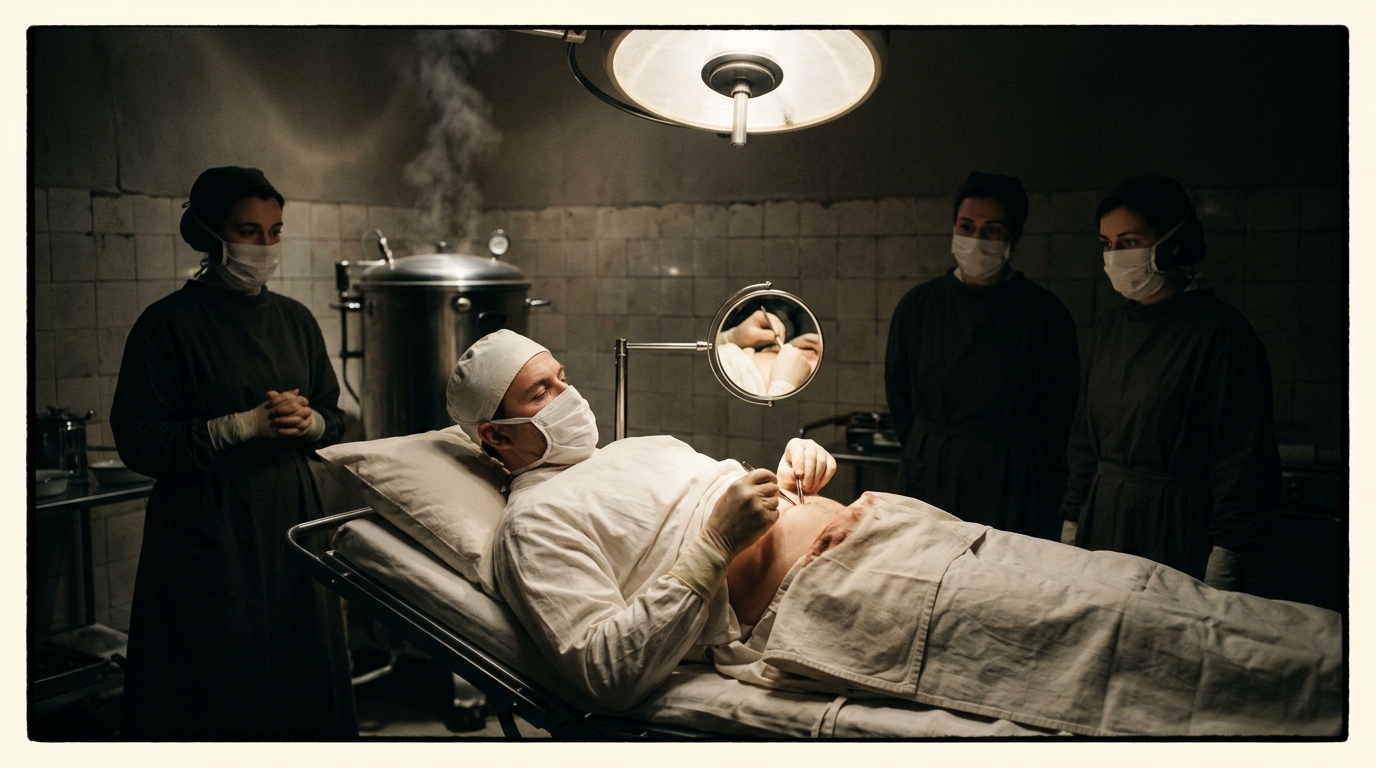
Can you truly remove your own appendix without losing consciousness or backing out along the way? The answer centers on a name and a date that the history of medicine has preserved as an anecdote both fantastical and foundational. That day, in a hospital in Pennsylvania, a seasoned surgeon decided to prove to himself, and to the medical world, that major abdominal surgery could be performed without general anesthesia. A dare that verges on extreme scientific experimentation, carried out not on a test subject or a volunteer patient, but on his own body, stretched out and fully awake on the operating table.
- In February 1921, surgeon Evan O’Neill Kane, 60, self-remedied his appendix under local anesthesia, in a semi-sitting position, during a 45-minute operation.
- Convinced that local anesthesia carried fewer cardiac risks than general anesthesia, he sought to prove its reliability by operating on himself, having already performed more than 4,000 appendectomies.
- Ten years later, he carried out a second self-operation for an inguinal hernia, reaffirming his conviction up to his death, which came shortly afterward from pneumonia unrelated to these procedures.
- The day a surgeon refused general anesthesia for himself
- Why Kane wanted to prove that local anesthesia was enough
- Ten years later, the same table, a new solitary operation
- The legacy of an extreme gesture in the history of surgery
The day a surgeon refused general anesthesia for himself
In February 1921, Evan O’Neill Kane, chief of surgery at Kane Summit Hospital, was poised to embark on an extraordinary day. At sixty years old, this widely respected practitioner had already performed more than 4,000 appendectomies over his career. That day, the patient on the table was himself. Lying in a semi-sitting position, cushions propping his shoulders so he could watch the operation, Kane prepared to remove his own appendix, using only local anesthesia.
The procedure, painstakingly planned, would last about 45 minutes. A medical team surrounded him, ready to intervene if complications arose, but it was he who wielded the scalpel on his own abdomen. A move that, when recounted today, reads like a scene from a novel, and yet it unfolded in full accordance with the surgical standards of the time.
Why Kane wanted to prove that local anesthesia was enough
It wasn’t a caprice or a passing fancy driving Kane. For years, the surgeon believed that local anesthesia posed fewer risks than general anesthesia, especially for patients with heart fragilities. The problem lay in convincing his patients themselves to accept staying awake during surgery. The best way, he figured, was to lead by example.
In a note to the New York Times published the day after his operation, Kane plainly explained his approach: he sought to demonstrate that this form of anesthesia could spare patients the cardiac risks associated with narcotics used to put someone under. By operating on himself, he turned his body into a living demonstration. He would even publish his own clinical case under the evocative title Autoappendectomy: a case history, a document that would travel through the decades as a singular testimony of its kind.
It wasn’t his first foray into self-surgery either. Two years earlier, in 1919, he had already opted to amputate an infected finger, a proof that the man was not the sort to shrink from pain when necessity—or conviction—demanded it.
Ten years later, the same table, a new solitary operation
The story could have ended there, but Kane was not finished with the operating room. A decade later, as he approached 70, he repeated the exercise. This time, it was not the appendix but an inguinal hernia that he chose to repair himself—again, under local anesthesia.
This second act, less publicized than the first yet equally revealing of his resolve, showed that Kane was no eccentric chasing a solitary stunt. It was a deeply held conviction—rooted in his medical practice—that he carried through to the end of his career. A few months after this second self-operation, Kane died, not from surgical complications, but from a pneumonia, with no direct link to his earlier experiments.
The legacy of an extreme gesture in the history of surgery
To this day, Evan O’Neill Kane is remembered as the pioneer who operated on himself for appendicitis, a fact that continues to fascinate and provoke reflection in equal measure. His act illustrates how some practitioners, convinced of the validity of their methods, were willing to push moral and professional boundaries to shift mindsets and medical practices of their era.
His story sits at a time when general anesthesia was still relatively young and raised many questions about safety. By taking on the risk himself, Kane contributed, in his own way, to fueling the debate over alternatives to total anesthesia—an issue still relevant in certain modern surgical specialties where local or regional anesthesia is preferred to minimize complications.
What this tale ultimately reveals is the special role that such figures play in the history of medicine: individuals prepared to turn their own bodies into a testing ground. A démarche that remains rare, demanding a rare blend of technical skill, nerve, and unwavering conviction.
From this medical anecdote emerges a question that extends beyond a mere historical novelty: how far can, or should, a health professional go to advance their beliefs? The story of Evan O’Neill Kane, between audacity and stubbornness, continues to feed discussions about the limits one is willing to push in the name of science.
