
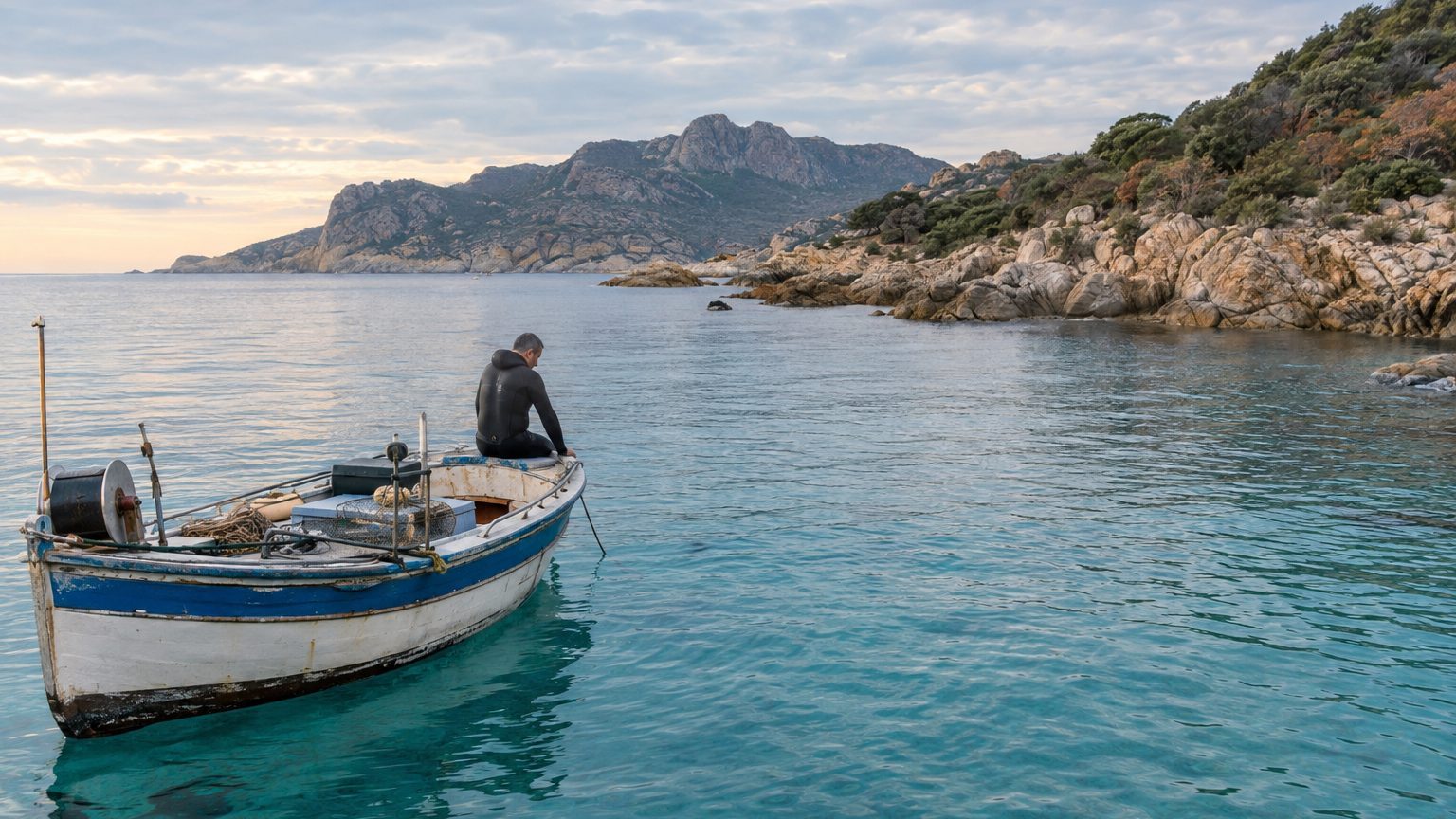
The sea urchin divers of the Gulf of Lava did not safeguard their secret for decades, at least not for the coins. The affair broke into the press on November 14, 1986, fourteen months after the discovery, when a local newspaper announced the arrest of eleven people for handling Roman coins. For the golden plate, however, the silence lasted twenty-four years.
One thing is certain: the gold did not owe anything to the divers.
- September 1985: Corsican divers discover Roman gold coins in the Gulf of Lava.
- The State confiscates 73 coins, roughly one-eighth of what Félix Biancamaria claimed.
- A curved gold plate weighing 879 grams, seized in 2010 at Roissy, remains the property of the State following the 2024 trial.
September 1985, three coins at two meters depth
On September 6, 1985, three Corsican divers, Félix Biancamaria, his brother Ange, and their friend Marc Cotoni, uncovered a substantial quantity of gold coins while sea urchin fishing. They were in the Capo di Feno cove, at a depth of about two meters, when they spotted the first three aurei. The urchin harvest was interrupted. They continued diving, discovered more coins buried in the sand, and pried rocks loose with jacks and crowbars.
Some coins were sealed into the rock. The crust had to be cracked away with a knife or a hammer.
How much gold? In his own account, Félix Biancamaria claimed to have retrieved nearly 600 coins, enough to fill several jars of jam. The expert appraisals go far beyond that: the treasure could have contained up to 1,400 coins, or even 4,400 according to another appraisal, for a total value of 21 to 100 million euros. The wide range says everything about the issue: no one has ever managed to compile a complete inventory, since the objects circulated clandestinely before anyone could count them.
The gulf was not new to such a story. As early as 1956, forty-one gold coins appeared mysteriously on the market, dispersed at auctions, before being published by the numismatist Jean Lafaurie in 1958. The 1985 divers merely reopened a vein that the circle of collectors already knew.
What the law says, and what DRASSM could do with it
The principle can be summed up in one sentence. A treasure found underwater, with the owner unknown, belongs to the State. Under French law, the Heritage Code treats these objects as maritime cultural property of the public maritime domain, to be declared to the authorities. The Biancamarias preferred the antique-dealers’ market.
The role of DRASSM, the Department of Subaquatic Archaeological and Underwater Research of the Ministry of Culture, was mainly to chase after the gold. A portion of the lot, offered for sale at the Monte Carlo Winter Sporting event, was seized by Customs at their request. On November 18, 1986, its divers combed the gulf but found neither coins nor traces of a wreck, and a prefectural order subsequently banned diving on the site. The seabed had already been emptied.
This absence of a wreck is the legal knot of the entire affair. No sign of a ship has ever been found, fueling another lead: a village rumor from Villanova speaks of ruins of Roman villas on the heights, and Italian workers who allegedly unearthed jars full of gold in the 19th century, partly hidden in a sea-cave. If the gold came from the land rather than a shipwreck, the regime governing shipwrecks applies differently. The article’s title even refers to coins “sleeping since the 3rd century” at the gulf’s bottom, though no one truly knows how they arrived there.
Convictions, vanished plate, and gold still dispersed
The first penalties were handed down in 1994. Ange and Félix Biancamaria and Marc Cotoni were condemned to eighteen months in prison with suspended sentences and a 25,000-franc fine for handling and misappropriation of a maritime wreck, with two professional numismatists also convicted, and the sentence was upheld on appeal in 1995. The material outcome was modest. The State confiscated 73 coins, entrusted to the Cabinet of Medals in Paris and to the Sartène museum. Relative to the 600 coins claimed by Félix Biancamaria himself, this represents about one in eight.
Then the plate reappeared.
The divers had hauled it from the water in August 1986. In his book, Félix Biancamaria recounts finding it beneath a large rock, lifted with a jack from an AMX30 tank. On October 21, 2010, police intercepted him at Roissy station as he returned from Brussels, where he allegedly attempted to sell it. The object is a curved gold plate 25 cm in diameter, weighing 879 grams, and its value has been assessed at between 2 and 8 million euros. It was not the first time customs, well informed, awaited a Lava gold-carrier at the exit of a train or an airplane.
The trial took place in Marseille, on January 29 and 30, 2024. The defense pleaded non-retroactivity of criminal law and a terrestrial origin for the treasure. The verdict, delivered on March 27, 2024, sentences Félix Biancamaria to 12 months in prison with a suspended sentence and a 200,000-euro fine, paid jointly with Jean-Michel Richaud, who was also sentenced to eight months with a suspended sentence. The State remains the owner of the plate.
As for the coins, the outcome is less straightforward. The treasure has never been reconstituted: reconstructing the inventory met early and largely clandestine dispersal of the objects, and gold rings were melted down, thus lost forever. The State can theoretically reclaim Lava’s objects at any time in its capacity as the wreck authority, with only a Claudius II aureus sold at auction potentially slipping away. Collectors who today hold a Gallien aureus without solid papers know all too well.
The case is not closed from a police standpoint. In March 2017, four people were arrested in Bastia with sixteen gold coins hidden inside wooden and rubber ink stamps. As for the Gallien medallion that adorned the center of the plate, estimated at 580,000 euros by itself, it had disappeared and remains actively sought by authorities.
Sources: arabnews.fr | ici.fr
