
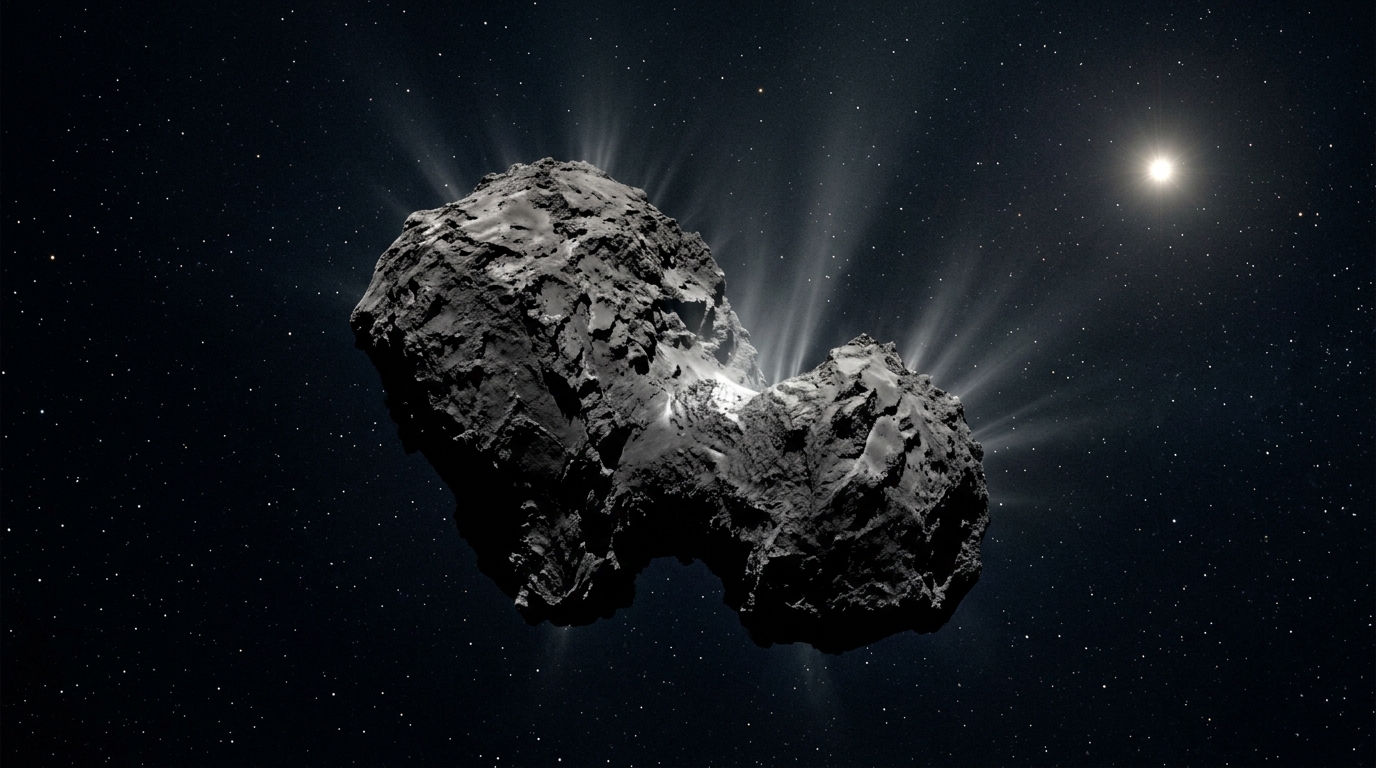
We often imagine a comet as a celestial ice cube, silent and odorless, streaking through the void with nothing but water vapor to emit. Yet this is a mistake: the European Space Agency has discovered that one of them releases a scent so persistent that no human would want to approach it.
- The ROSINA instrument aboard the Rosetta spacecraft detected on comet 67P an unexpected blend of odorous gases such as hydrogen sulfide, ammonia, and hydrogen cyanide, evoking, respectively, rotten egg, manure, and bitter almond
- These odorous compounds represent only a tiny fraction of the total gas released; the coma is mainly composed of odorless water, carbon dioxide, and carbon monoxide
- These molecules, trapped in ice since the formation of the solar system, allow scientists to reconstruct its original chemical makeup, ROSINA later even detecting glycine, an amino acid essential to life
- ROSINA, the artificial nose that sniffed a comet for months
- Rotten egg, stable, bitter almond: the improbable chemical cocktail of 67P
- Why does a comet stink so much from millions of kilometers away
- What this infernal scent reveals about the origins of the solar system
For months, a probe positioned only a few kilometers away from a 4-kilometer-wide icy nucleus patiently analyzed the faint wisps of gas escaping it. The result of this peculiar olfactory inquiry surpasses anything one might have imagined, and it speaks volumes about the raw material from which these remnants of the young solar system are made.
ROSINA, the artificial nose that sniffed a comet for months
It was the Rosetta spacecraft, orbiting the comet 67P/Churyumov-Gerasimenko, that made this feat possible. On board, an instrument named ROSINA acted as an artificial nose, capable of identifying the faintest molecules drifting in the gas cloud surrounding the nucleus, what scientists call the coma. As early as 2014, when the comet was still only about ten kilometers from the spacecraft, this instrument began detecting compounds far more varied than expected.
The mission team initially expected to detect only the most volatile gases, easy to release by a comet still distant from the Sun. But the high-resolution spectrometer of ROSINA, known as DFMS, revealed a much richer mix: methane, ammonia, methanol, then formaldehyde, hydrogen sulfide, hydrogen cyanide, sulfur dioxide, and carbon sulfide. A chemical diversity that was surprising at this stage of the approach, even to specialists on the mission.
Rotten egg, stable, bitter almond: the improbable chemical cocktail of 67P
Translating a mass spectrum into a recognizable smell is not a common exercise, but the results obtained with ROSINA have made it possible with nearly comic precision. The peak of intensity recorded on October 10 corresponded to hydrogen sulfide, the molecule responsible for the infamous rotten-egg odor. A dominant note, but far from the only one.
Add to that the tang of horse-stable smell brought by ammonia, the sharpness of formaldehyde, and the aroma of bitter almond typical of hydrogen cyanide. The methanol suggested a vaguely alcoholic scent, while sulfur dioxide recalled a vinegary note and carbon disulfide offered an unexpectedly sweet touch. An unlikely blend, halfway between a farmyard, a chemistry lab, and a damaged wine cellar, condensed on a world as small as a village.
The mission team even summarized the situation with quintessentially British humor, noting that if one could smell the comet, one would probably regret having done so. A vivid reminder that 67P, despite its appearance as a simple lump of dirty ice, hides a surprisingly robust chemistry.
Why does a comet stink so much from millions of kilometers away
First, a crucial point: this odor, impressive as it is, represents only a tiny share of the total gas released by the comet. The coma surrounding 67P is actually dominated by water, carbon dioxide, and carbon monoxide, three odorless molecules. The aromatic compounds described above circulate only as traces, embedded in an environment whose density remains far closer to the vacuum of space than to a breathable atmosphere.
What explains this chemical diversity is primarily the very nature of comets. These small bodies formed at the edges of the solar system, in regions so cold that many volatile molecules remained trapped in ice for billions of years, as if frozen in time. As 67P approached the Sun, the heat began to sublimate this ice, gradually releasing a whole stockpile of compounds hitherto locked away, including some not expected to appear so early in the mission.
What this infernal scent reveals about the origins of the solar system
Beyond its entertaining aspect, this olfactory discovery has a real scientific significance. Comets are considered time capsules, almost intact witnesses to the matter that existed even before the formation of the planets. Precisely identifying the molecules that escape from them allows scientists to reconstruct the original chemical recipe of the solar system, somewhat like analyzing the ingredients of an ancient dish to understand how it was prepared.
The data gathered by ROSINA did not stop at that initial detection. They later helped identify the presence of glycine around 67P, an amino acid essential to building life on Earth. A finding that directly links the foul odor of a frozen comet to the basic building blocks of life, and a reminder of how these celestial bodies, as repulsive as they may smell, remain invaluable archives of our cosmic origins.
Ultimately, this blend of rotten-egg, stable, and bitter-almond wafting around 67P is far from a trivial anecdote. It illustrates the rich chemistry concealed by these icy relics and the patient work required to uncover their secrets—an instrument in itself. The lingering question for astronomy enthusiasts remains: how many other comets, crossed in the sky without being approached as closely, hide perfumes just as surprising?
